Biography
Nikephoros of Chios
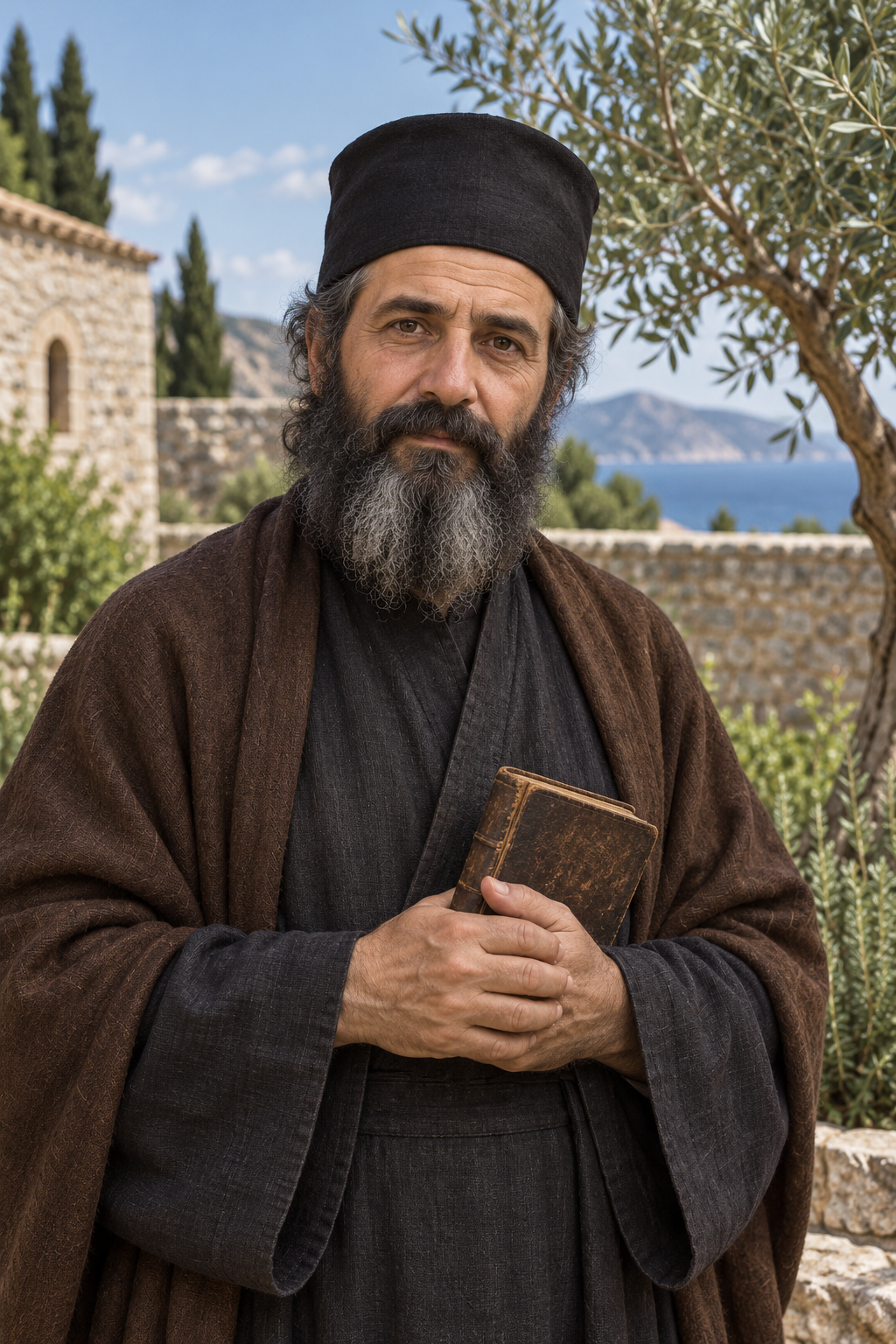
About Nikephoros of Chios
Nikephoros of Chios was a monk, teacher and writer whose life was closely connected with the villages and monasteries of his island. He was born at Kardamyla around 1750. According to the local church account, a serious illness in childhood led his parents to promise that they would dedicate him to the monastery of Nea Moni if he recovered. After his recovery he entered the monastery and came under the guidance of Anthimos Hagiopateritis.
The monastery sent him to study in the town of Chios with the priest and teacher Gabriel Astrakaris. He later became associated with Athanasius Parios. After completing his education he was ordained a deacon and taught in the island’s schools, while also preaching at Nea Moni. In 1802 he became the monastery’s superior during a difficult period in its affairs. He soon resigned and moved to Saint George’s at Resta, joining a small religious community there.
The Orthodox Church in America’s account gives a fuller explanation of that difficult appointment. Nea Moni had been required to pay a large fine, and some of its property was sold. Local people wanted Nikephoros to take charge because they trusted his lack of interest in wealth, and they called for annual audits. His efforts did not resolve the conflicts within the community. He left before completing his term, returning to a life centered on study and personal guidance.
His connection with Nea Moni continued through writing. A book published in Venice in 1804 combined services honoring the monastery’s founders, Niketas, John and Joseph, with its history and accounts of miracles attributed to the Mother of God. The University of Crete Library’s catalog preserves the title’s attribution to Nikephoros, described there as a hierodeacon of Nea Moni. The volume thus joined historical narrative and liturgical commemoration within a single publication.
The same title names the monk Paisios, called Barbarias, as the person who paid for the printing. It states that the copies were to be distributed without charge for his spiritual benefit. The catalog identifies the printer as Nikolaos Glykys of Ioannina, working in Venice. These details distinguish the author’s contribution from the financial and printing work that made the volume available. They also show that the book was conceived as a religious offering rather than merely a commercial publication.
At Resta, Nikephoros remained close to Macarius of Corinth. He became one of the contributors to the New Leimonarion, a collection of saints’ lives and martyrdom accounts published in Venice in 1819. The Orthodox Encyclopedia also remembers him as a preacher who assisted local people with agricultural work and gave money to those in need. His literary activity therefore formed only one part of a life that included practical help and pastoral contact with his neighbors.
Tree planting was a particularly remembered part of that work. The Orthodox Fellowship of the Transfiguration, drawing on Constantine Cavarnos’s account, describes his concern that communities without trees would become poorer. It also reports that he used his inheritance to support planting on the island. This later presentation places his agricultural activity within an Orthodox understanding of care for the natural world. It does not establish a formal patronage of trees or gardeners.
His involvement with converts who wished to return from Islam to Christianity was more perilous. The Orthodox Encyclopedia identifies him as a spiritual guide to several people subsequently commemorated as new martyrs, including Angelis of Chios. Publicly renouncing Islam could expose a convert to execution under Ottoman authority. This setting is essential to understanding why the religious preparation described in his life could have fatal consequences.
Yorgos Tzedopoulos’s study of reconversion places the New Leimonarion within a broader effort to collect and validate recent martyrdom accounts. Written in vernacular Greek, the book drew on the work of several collaborators, including Nikephoros. Its editors sought supporting testimony, including eyewitness reports and accounts of miracles. Tzedopoulos interprets this activity as an effort to strengthen a particular form of Orthodox communal identity. That historical interpretation should be distinguished from the collection’s own devotional claims about its subjects.
Nikephoros’s Life of Angelis also reflects his proximity to the people he described. A presentation of Myrsini Anagnostou’s research emphasizes that he had personally heard Angelis’s confession of faith and sought other witnesses for his earlier life. The presentation also notes his defense of the standing of martyrs who had previously abandoned Christianity. His writing was therefore concerned with the recognition and meaning of martyrdom, as well as with preserving a sequence of events.
He died around 1821, although accounts disagree about the year and season. The local church gives May 1 in 1820 or 1821; the OCA account suggests summer 1821. His feast is May 1. His surviving publications preserve both the older memory of Nea Moni and the religious experiences of people living on Chios in his own lifetime.
Wondering how to weigh the stories and sources? Learn how to read a saint biography.