Biography
Pacificus of San Severino
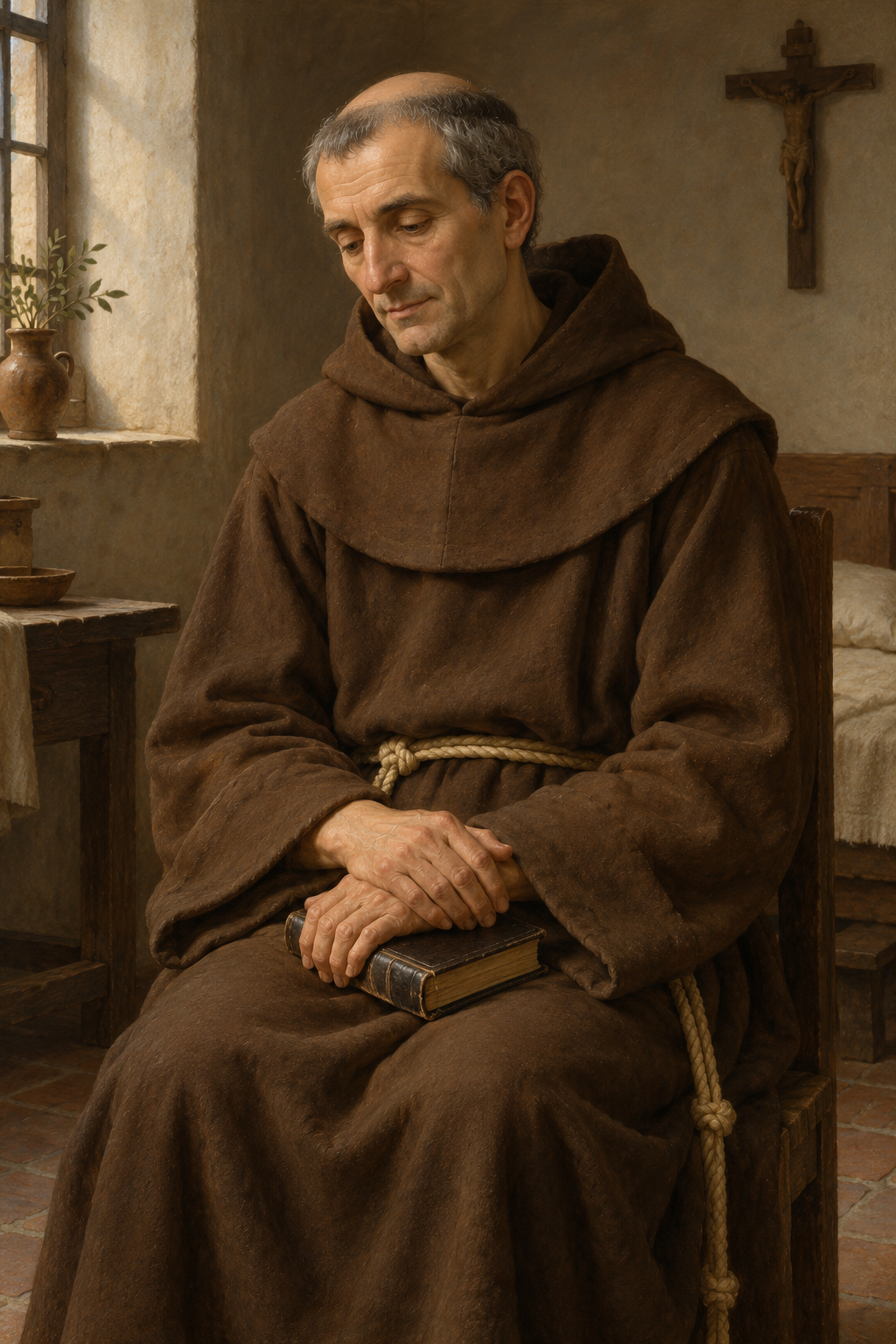
About Pacificus of San Severino
Pacificus of San Severino was an Italian Franciscan priest remembered for preaching, prayer and years of serious illness. Born Carlo Antonio Divini in San Severino Marche on March 1, 1653, he entered the Friars Minor at seventeen and took the name Pacificus. The Dicastery for the Causes of Saints describes his vocation through his love of solitude and prayer before the Blessed Sacrament. His religious life included service to others as well as withdrawal for prayer, before declining health gradually restricted his activities.
He received the Franciscan habit at Forano in December 1670 and was ordained on June 4, 1678. Michael Bihl’s Catholic Encyclopedia account places his teaching of philosophy between 1680 and 1683, followed by several years of preaching in the surrounding countryside. His work therefore began with both the education of other friars and ministry outside the convent. The same account describes a long period of difficulty with walking, hearing and sight, during which contemplation became increasingly central to his life.
His responsibilities as a superior were less straightforward than a simple account of patient gentleness might suggest. Historian Stefania Nanni identifies appointments as vicar and guardian in May 1686, while warning that the surviving evidence for his government is fragmentary and contradictory. At San Severino, he attempted to introduce a particularly rigorous observance of the Franciscan rule. He supported preaching and religious instruction, including teaching children, and obtained donations for the community’s maintenance and buildings. His strict enforcement of discipline also encountered resistance among the friars.
Nanni also distinguishes surviving evidence from later claims about his writings. Collections of sermons attributed to him were examined during the process for beatification but subsequently disappeared. Notes in his breviary survive as authenticated handwriting. These limits matter when describing a man remembered as a preacher: his reputation is better preserved than the words through which he originally taught. The account of his leadership likewise leaves room for disagreement within the community, alongside the admiration expressed by later biographers.
By 1705 Pacificus had settled again at San Severino. Vatican News describes his later condition as including deafness, severe loss of sight and an injured or diseased leg. Its account also preserves stories of extraordinary experiences during prayer. Long celebrations of Mass, associated with reported ecstasies, drew disbelief and humiliating treatment from some of his fellow friars. These are elements of his devotional biography, rather than experiences that can now be independently verified. They also suggest that recognition of his holiness was not unanimous during his lifetime.
Pacificus died on September 24, 1721. Vatican News recounts a crowded funeral and burial in the community’s shared grave, without a coffin. As reports of miracles spread, his remains were moved in 1725 into a wooden coffin at a side altar of the adjoining church. These reported favors belong to the history of devotion surrounding him; they do not establish a medical effect. His remembrance developed around the place where he had lived and prayed.
The older Catholic Encyclopedia dates the opening of his cause to 1740, nearly nineteen years after his death. The process extended across successive pontificates before beatification and eventual canonization. The dates separate the growth of devotion at his grave from the later formal recognition of the Church. They also show that his inclusion among the saints came long after the community that had known him personally. Bihl’s entry explicitly identifies its sources as biographies and material drawn from the canonization proceedings.
Pope Pius VI beatified him on August 4, 1786. Gregory XVI canonized him in the Vatican Basilica on May 26, 1839, and his liturgical remembrance falls on September 24.
His hometown continues to honor him as a co-patron. A municipal announcement for the 2023 feast described a walking pilgrimage from a roadside shrine in the Settempeda neighborhood to his sanctuary, followed by Masses involving the local community and civic authorities. This local devotion is distinct from his broader reputation: EWTN’s devotional listing identifies him as a patron concerning illness and chronic pain.
The Franciscan Province of Picena also names him as its co-patron alongside James of the Marches. Its account of the September 2026 celebration records friars, religious sisters, young people and other residents gathering at San Domenico in San Severino. Across the Atlantic, the Catholic community in Humphrey, New York, maintains a church dedicated to Pacificus. Its parish history connects the building with the early mission of Italian Franciscan friars in the area.
Modern interest has included historical research as well as worship. Reviewing Giancarlo Mandolini’s substantial study in the diocesan newspaper Presenza in 2007, Valerio Torreggiani emphasized its use of sources and its effort to place Pacificus within his own time. The review also recalled Archbishop Edoardo Menichelli’s personal attachment to the saint’s sanctuary and his reading of Pacificus’s solitude and simplicity as practices relevant to ordinary Christian life.
Wondering how to weigh the stories and sources? Learn how to read a saint biography.