Biography
Pedro María Ramírez Ramos
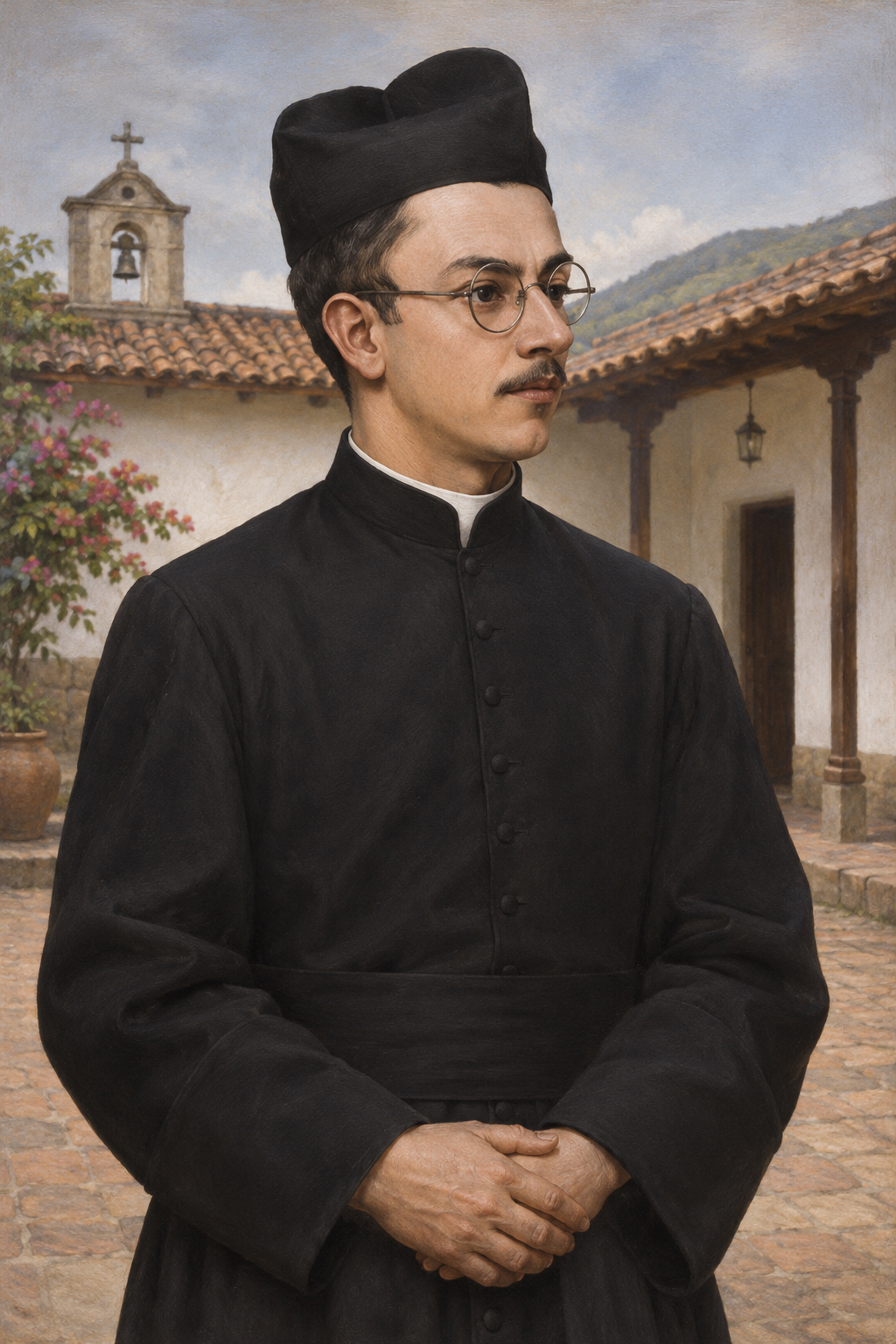
About Pedro María Ramírez Ramos
Pedro María Ramírez Ramos was born at La Plata, Huila, Colombia, on October 23, 1899. He attended the elementary school before beginning studies for the priesthood. His younger brother Leonardo became a Jesuit. Pedro entered the minor seminary at Elías when he was twelve and continued at the major seminary of Garzón in 1915. His path to ordination included a long interruption. Troubled by doubts about his vocation and recurring headaches, he left the seminary in 1920. During the following eight years he taught, worked with parish music and continued helping with catechesis. He returned to theological studies at Ibagué in 1928 and was ordained on June 21, 1931.
The years outside the seminary gave him responsibilities in several communities. He first worked as a secretary and parish choir director at Anolaima, Cundinamarca. From 1922 he taught at the school in Elías where he had studied. He subsequently directed schools at San Mateo, now Rivera, at Colombia in Huila, and at Alpujarra in Tolima. At Alpujarra he combined his educational duties with parish work. Pedro María Rodríguez Andrade, formerly his parish superior and by then bishop of Ibagué, encouraged him to resume preparation for priesthood. After ordination he served at Chaparral from 1931 to 1934, Cunday from 1934 to 1943, Fresno from 1943 to 1946, and finally Armero. These appointments kept his priestly ministry within the diocese of Ibagué. The bishops' conference biography records his burial beside his mother at La Plata on May 7, 1948.
Bustamante records his baptism the day after birth. The account follows a childhood in La Plata into studies elsewhere and then years of paid educational work. It shows the return to seminary as a renewed decision after experience outside its walls.
In Armero his ministry included visiting sick people and helping those in need. The official biography remembers a serious and direct man whose pastoral work was sustained by prayer. He remained with his parish when violence threatened him in April 1948. During the disturbances he attended a wounded person and sought to safeguard the Eucharist and the religious sisters serving nearby. Advice to leave did not persuade him to abandon these responsibilities. He was killed at Armero on April 10, 1948.
His death occurred during the upheaval following the assassination of Jorge Eliécer Gaitán in Bogotá on April 9. Anthropologist Andrés Felipe Ospina Enciso examined how judicial records and later religious narratives described the events at Armero. His study reports that a crowd searched the church of San Lorenzo for weapons without finding them. Explosions and gunfire near the church on the following afternoon intensified accusations against the priest. He was brought out to the crowd and killed with machetes. Ospina emphasizes differences among witness accounts and between the court proceedings and devotional retellings. The surviving legal documents therefore require careful reading alongside the church biographies. His research identifies proceedings begun in April 1948 and records preserved in the historical archive at Ibagué. The article treats later stories about Armero as the work of communal memory, rather than offering evidence that a priest's curse caused a natural disaster. Its distinction between an event and its later narration helps keep the circumstances of Ramírez's death within their historical setting. The analysis combines archival research with attention to local remembrance.
Before the beatification, the apostolic nuncio Ettore Balestrero spoke about Ramírez to Colombia's bishops in July 2017. He remembered the priest's devotion to the Eucharist and Mary and his commitment to truth and to the people he served. Addressing pastors, the nuncio presented the coming recognition as a call to consistency and courage in their own ministry. He described Ramírez and Bishop Jesús Emilio Jaramillo Monsalve as witnesses to peace and reconciliation. That interpretation directed attention to the responsibilities of living church leaders as well as to the two men being commemorated. In Balestrero's account, their memory called for a faith expressed through pastoral service.
Francis beatified Ramírez together with Jaramillo at Villavicencio on September 8, 2017. In the homily he named both men as signs of a people seeking a way out of violence and resentment. His appeal for reconciliation included respect for victims and refusal to excuse injustice. Ramírez's recognition thus formed part of a public invitation to build peace through concrete acts of responsibility.
Looking back on the visit five days later, Francis again discussed the two beatifications. He placed them beside the afternoon prayer for reconciliation in Villavicencio, where survivors spoke about wounds and forgiveness. He recalled the sorrow and joy with which the congregation heard the martyrs' biographies. For him, remembering lives lost through violence belonged within the work of healing a wounded people. The Catholic Church honors Ramírez as a blessed martyr. His public remembrance remains closely associated with the parish he served and the Colombian search for reconciliation.
Wondering how to weigh the stories and sources? Learn how to read a saint biography.