Biography
Pedro Poveda Castroverde
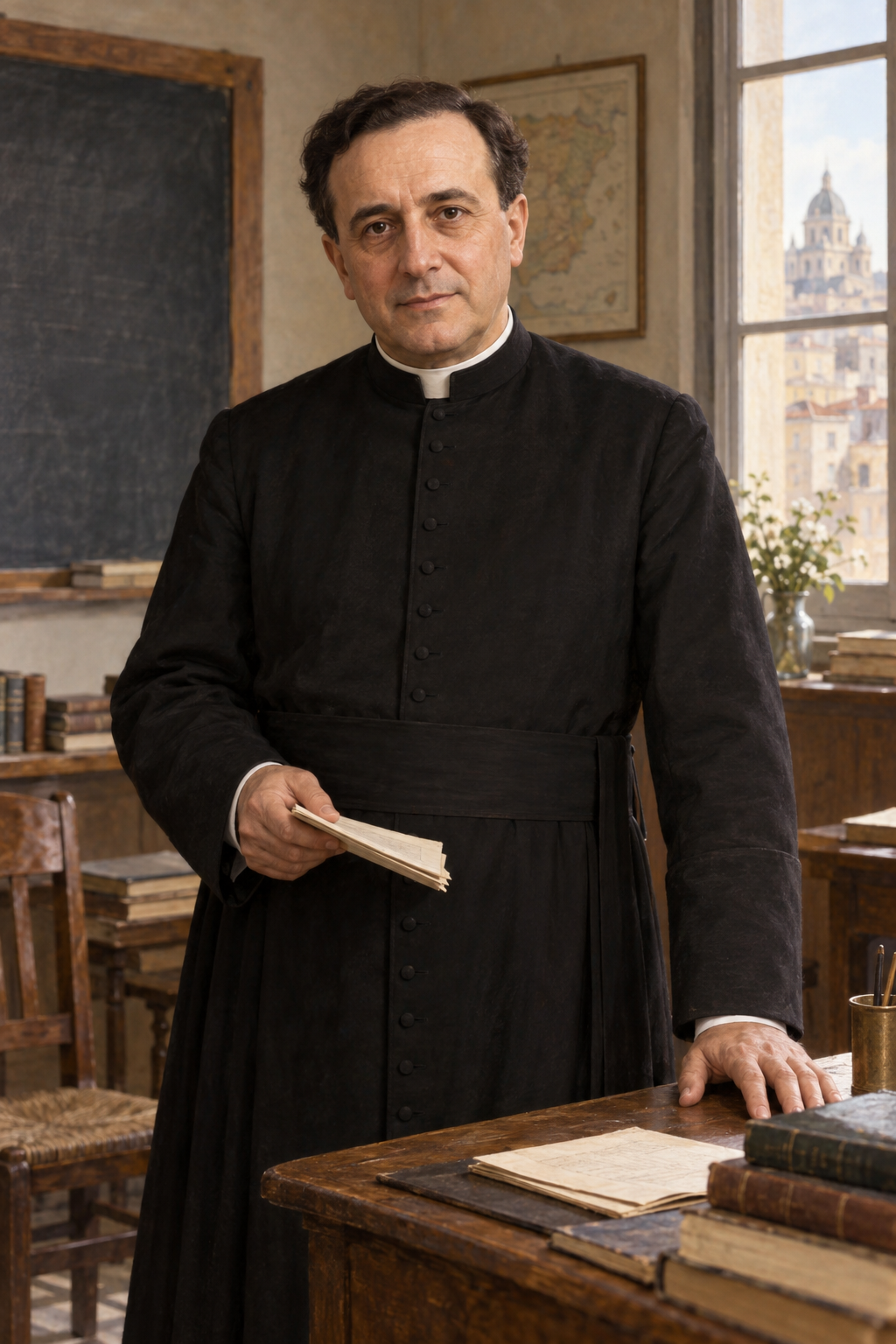
About Pedro Poveda Castroverde
Pedro Poveda Castroverde was born in Linares, in the Spanish province of Jaén, on 3 December 1874. He entered the seminary in Jaén as a teenager and finished his studies in Guadix after a scholarship made further formation possible. He was ordained there on 17 April 1897. The Church's later biography places teaching at the seminary among his first assignments. His early work would move beyond the classroom walls, but he remained a priest and educator throughout his life. The years in Guadix exposed him to unequal access to schooling and helped shape the practical form of his later ideas about Christian education.
Outside Guadix, families lived in caves cut into the hills. Poveda visited them and organized a school for children and workshops for adults. The initiatives joined elementary instruction, work skills and pastoral care. These were not abstract proposals about education; they required rooms, teachers, materials and the trust of families often left out of ordinary provision. His own institution remembers resistance to his work, and he eventually left Guadix. The account does not require every local opponent to be named or assigned a motive. What can be seen is that his first substantial educational project began among people whose needs were easy for the wider town to overlook.
In 1906 Poveda became a canon at Covadonga in Asturias. The move took him away from the Guadix district but not from the question of education. He wrote about how Christian belief and modern knowledge could meet within schools, and he observed the preparation of teachers as a pressing need. A later historiographical essay reads his thought against the tension between religious and secular approaches to schooling in early twentieth-century Spain. Poveda wanted Christians able to work competently within public culture rather than withdraw from it. That aim would become especially important for women entering teacher training and higher study, areas where new opportunities were opening but support was uneven.
The first academy connected with the Teresian Association opened in Oviedo in 1911. Its aim was to help form teachers, especially women who would bring their skills into schools beyond the association itself. The Spanish association's history also records a 1914 academy and residence in Jaén directed by Josefa Segovia. These beginnings show a network built through collaborators and institutions. Poveda's priestly role and educational program were important, but the women who directed residences and taught future teachers made the undertaking function day by day. Formation meant study, shared life and professional preparation, not simply repeating a religious message.
María Josefa Segovia became a decisive collaborator and later the association's first general director. Her own institutional profile presents her as an educator and organizer, not merely a helper carrying out Poveda's instructions. Their partnership matters to the history of women's education: women trained in pedagogy shaped the academies and gave leadership to a Catholic lay association. Poveda encouraged the project, opened paths and defended its purpose, while Segovia and others governed its work. This division of responsibility corrects a common tendency to tell the story solely through the founder. It also makes clear why the association could continue after his death.
Poveda also opened a women's university residence in Madrid in 1914. The Vatican biography calls it a national first, but the secure fact needed here is its purpose: it gave women pursuing higher study a place to live and a supportive educational community. His initiatives joined cultural and professional preparation with a Christian way of life rooted in ordinary work. They were not a monastic foundation. Members of the Teresian Association remained lay people active in schools and society. The distinction explains why teacher education, residences and publications mattered to Poveda: they formed people who would carry commitments into institutions he did not own.
By 1921 Poveda had moved to Madrid as a royal chaplain. The Holy See's biography says the association received papal approval in 1924 and expanded beyond Spain. He continued to support it, although its leadership was shared with lay collaborators. The *New Catholic Encyclopedia* describes education as his principal adult ministry and notes his concern for teachers in public schools. That emphasis gives coherence to the different settings of his life: a cave district, a shrine, teacher academies and a university residence. In each, he looked for people and institutions able to make learning available and to link intellectual formation with service.
The outbreak of the Spanish Civil War in July 1936 brought violence against clergy and other religious people. Poveda was taken from his home and killed in Madrid on 28 July.
Church accounts report that he identified himself as a priest when challenged; the exact words belong to transmitted testimony rather than an independently checked transcript. The Dicastery classifies his death as martyrdom, the Catholic Church's judgment that he was killed for his faith. The record here does not establish the names or particular motives of individual captors. Care with those limits does not diminish the fact of his killing or the severe danger faced by many people in those weeks.
John Paul II beatified Poveda in 1993 and canonized him in Madrid on 4 May 2003. In the canonization homily, the pope emphasized education's social importance and Poveda's work among marginalized families. That interpretation joined his earlier service in Guadix to the teacher formation of later years. Catholic recognition came decades after his death and after the association had grown under the leadership of members such as Segovia. It therefore speaks both to a priest's personal witness and to an educational movement he helped create. The enduring public trace is concrete: schools, residences and trained teachers carrying work forward beyond the founder's lifetime.
Wondering how to weigh the stories and sources? Learn how to read a saint biography.