Biography
Peter Baptist
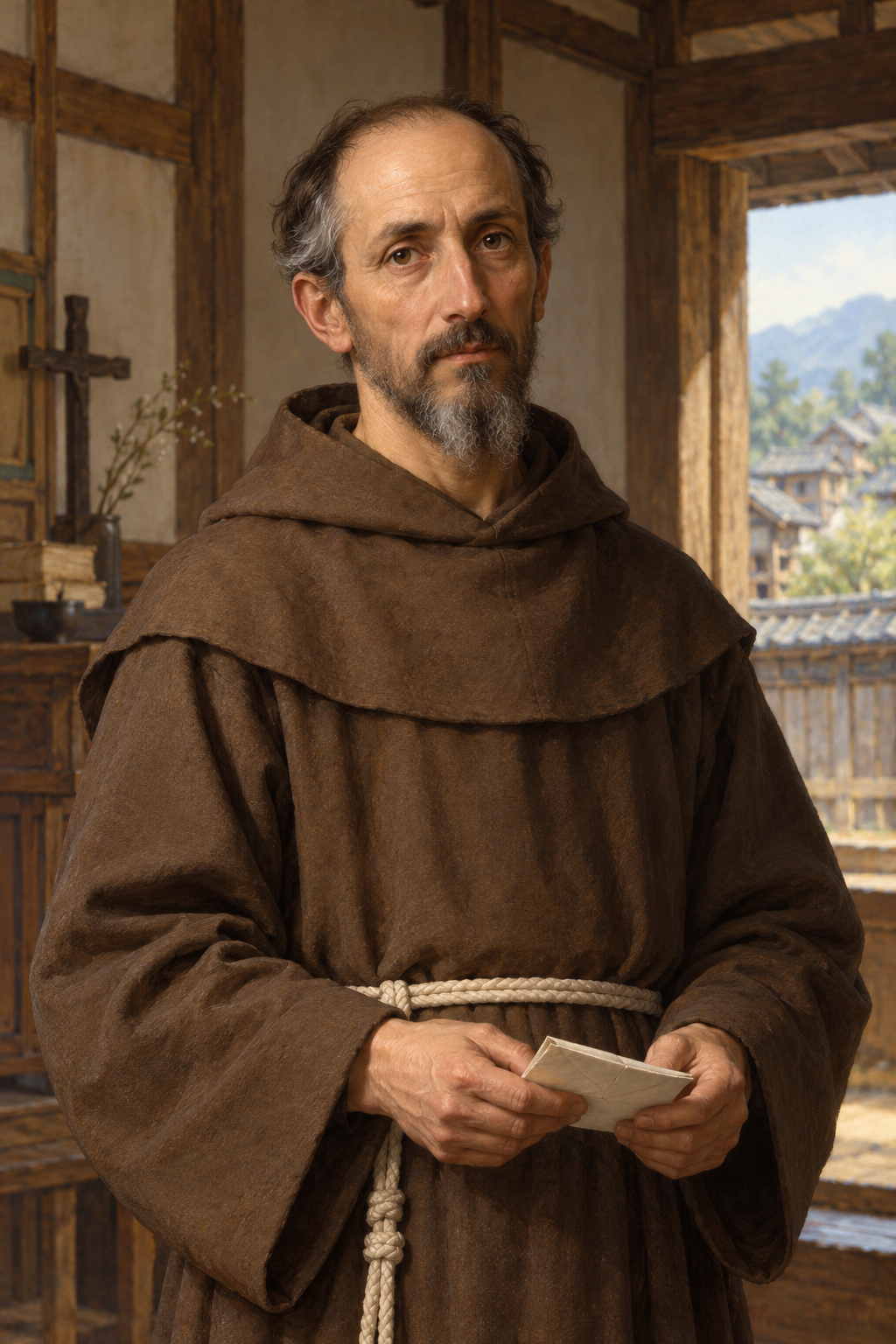
About Peter Baptist
Peter Baptist, also known as Pedro Bautista Blásquez, was a Spanish Franciscan priest whose missionary work brought him to Japan. He belonged to the group executed at Nagasaki on February 5, 1597. Their canonization by Pope Pius IX took place on June 8, 1862. His life crossed the routes connecting Spain, Mexico, the Philippines and Japan.
He came from San Esteban del Valle, near Ávila. The diocesan account describes studies in Mombeltrán, Oropesa, Ávila and Salamanca, followed by entry into the Franciscan community at San Andrés del Monte, near Arenas de San Pedro. His later journeys took him first to Mexico and then to the Philippines before his Japanese mission.
The Franciscan biographical supplement records his work as a preacher and his responsibilities as custos and guardian in Manila. It places his arrival there in 1583 or 1584, openly retaining uncertainty about the year. His service in the Philippines preceded his selection for an embassy to Japan in 1593.
That embassy carried political responsibilities. Historian Hélène Vu Thanh explains that the governor of the Philippines sent Peter after Hideyoshi threatened the Spanish colony. An earlier envoy, Juan Cobo, had been lost on the return voyage. Peter offered friendship and possibilities for trade. Vu Thanh argues that the friars used their diplomatic position to establish a mission despite restrictions favoring the Jesuits and Portuguese interests. The surviving evidence does not make the original instructions entirely clear.
Peter continued reporting on Japanese affairs and negotiating commercial relations. The mission’s religious purpose therefore operated within imperial competition and fears of invasion. Vu Thanh connects the crisis following the wreck of the Spanish ship San Felipe in 1596 with that ambiguity: the Franciscans demanded restitution of cargo, while Hideyoshi suspected an attempted Spanish foothold. The historian treats their execution as part of this entanglement of missionary work, diplomacy and security.
Peter’s surviving letters offer a more immediate account of imprisonment. Excerpts dated January 4 and February 2, 1597 describe the prisoners being publicly paraded, having part of an ear cut off, and being carried under guard toward Nagasaki. The sentence, he wrote, charged the preachers with teaching Christianity against the ruler’s command and condemned their companions for being Christians. He asked his fellow friars to pray for them and expressed hope in God while expecting death. These words preserve his own religious understanding of what was happening to him. He also described the written sentence being displayed before the prisoners, making the stated charges visible to the crowds as the condemned passed through the towns.
The friars were crucified with their Japanese companions. The group included Paul Miki and two companions associated with the Jesuits, as well as the Franciscans and lay Christians. Urban VIII beatified the martyrs in 1627. Their later canonization brought formal recognition to a devotion that had developed long before.
The introduction to The Cambridge Companion to Counter-Reformation Sanctity examines testimony gathered for their cause. People collected blood, clothing and other objects associated with the execution. Investigators also sought a toe reportedly taken from Peter’s body. Witnesses in Mexico, Macau and Japan described having seen the relic or hearing of its possessor, but neither the guard said to have kept it nor the object was located. The authors use this unresolved episode to show how devotion and testimony circulated across oceans. Reports of relics document that devotion; they do not by themselves authenticate the objects.
A separate claim concerns his supposed appointment as bishop of Camarines. A.A.Pardalis’s account for Caceres Inbox notes that early Franciscan writers reported a royal nomination arriving after his death. It also records historian Domingo Abella’s objection that he had found no supporting document in the Spanish archives. The appointment should therefore remain an unverified claim, rather than an established office in Peter’s life.
San Esteban del Valle honors its patron in winter and summer. The municipal account connects the February celebrations with his martyrdom and the arrival of a relic in 1891, and the July celebrations with the inauguration of his chapel in 1682. The Vítor procession combines torches, verses and mounted participants.
Paracuellos de la Ribera also venerates him as patron. José Ángel Urzay Barrios traces the local devotion to relics brought by the Franciscan Pedro Campos. His description records celebrations centered on February 5, with a procession, Mass and veneration of the relic, followed the next day by visits to sick people who requested them.
His name remains attached to a Franciscan province in the Philippines.
The Diocese of Cubao lists both a basilica and a vicariate dedicated to him.
Caceres identifies him as its principal patron.
The parish of San Pedro Bautista in Alcorcón also celebrates him as its titular saint. Its 2020 report distinguishes the general February 6 feast from its local custom of celebrating on the first Sunday of February.
Wondering how to weigh the stories and sources? Learn how to read a saint biography.