Biography
Peter Fourier
About Peter Fourier
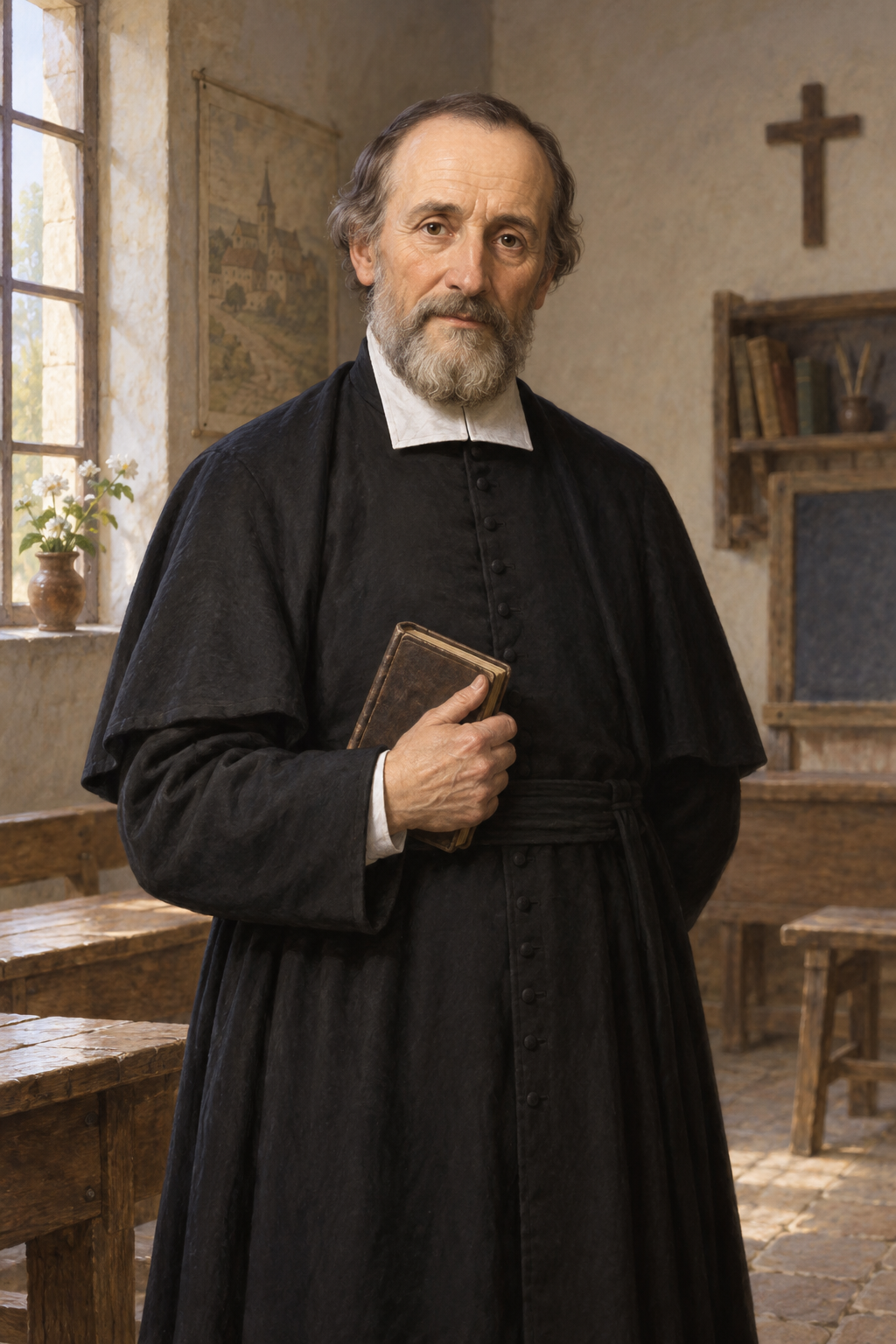
Peter Fourier was born at Mirecourt in Lorraine on November 30, 1565, according to the Vatican Dicastery for the Causes of Saints. He entered the canons regular of Saint Augustine, a community of clergy living under a shared rule, and was ordained a priest in 1589. The Catholic Encyclopedia records his studies and early religious formation, while the Dicastery emphasizes the practical direction of his later ministry. In 1597 Fourier took charge of the parish at Mattaincourt. The choice placed him close to families dealing with poverty and division rather than in an academic career. His work there joined religious teaching with attention to ordinary needs, a link that became central to his reputation.At Mattaincourt, Fourier organized a fund to help artisans borrow money without being trapped by usury. The French Bishops' Conference also remembers a mutual aid fund for the poorest parishioners. He gave particular attention to education. With Alix Le Clerc and other women, he fostered schools where girls could receive instruction without fees. The resulting community became the Congregation of Notre-Dame, a lasting institution rather than a single local class. Accounts vary in how they describe the stages and dates of its formation, but the collaboration and the commitment to free teaching are consistent across the reviewed church sources. The girls and women involved should be recognized as participants and founders, not treated as passive recipients of Fourier's plan.Fourier also worked within his own religious order. The Catholic Encyclopedia says the bishop of Toul tasked him in 1621 with reform of the canons regular in Lorraine; their reorganization became the Congregation of Our Saviour, and Fourier later served as its superior. The Dicastery likewise identifies him with the Canons Regular of Our Saviour. His aim connected priestly formation with the same kind of patient teaching that shaped his parish. Some older accounts frame his ministry through sharp judgments about Protestants in Lorraine. This profile does not repeat those polemics as a measure of his success. The well-supported work is more concrete: a parish, relief for households, institutions for education, and reform of a religious community.The Thirty Years' War brought danger to Lorraine. The Vatican record says Fourier received death threats and fled to Gray, where he died on December 9, 1640. The French church account likewise describes exile to Franche-Comté. The place and date of death are therefore better supported than any attempt to assign a specific cause from the short sources reviewed here. Recognition followed long after his lifetime: the Dicastery lists a beatification under Clement XII in 1730 and canonization under Leo XIII in 1897. Those dates mark institutional decisions, not episodes to invent a scene around. They also explain why an older Roman martyrology could call him blessed even while a current Vatican saint page identifies him as canonized.His commemorations show a change in calendar practice. The Vatican Dicastery and the French Bishops' Conference both give December 9, the date they associate with his death, as his current Catholic memorial. An older Roman martyrology instead lists blessed Peter Fourier at Gray on July 7. The latter entry is important evidence of past veneration but should not silently override the directly documented current date. This record uses December 9 for the primary Roman Catholic feast and keeps July 7 separately labeled as a historical observance. The profile's life fields use the precise birth and death dates supplied by the Dicastery and the named places Mirecourt and Gray. The illustration is an imaginative reference to his educational work, not a likeness or a reconstruction of a particular classroom.
Wondering how to weigh the stories and sources? Learn how to read a saint biography.