Biography
Peter Julian Eymard
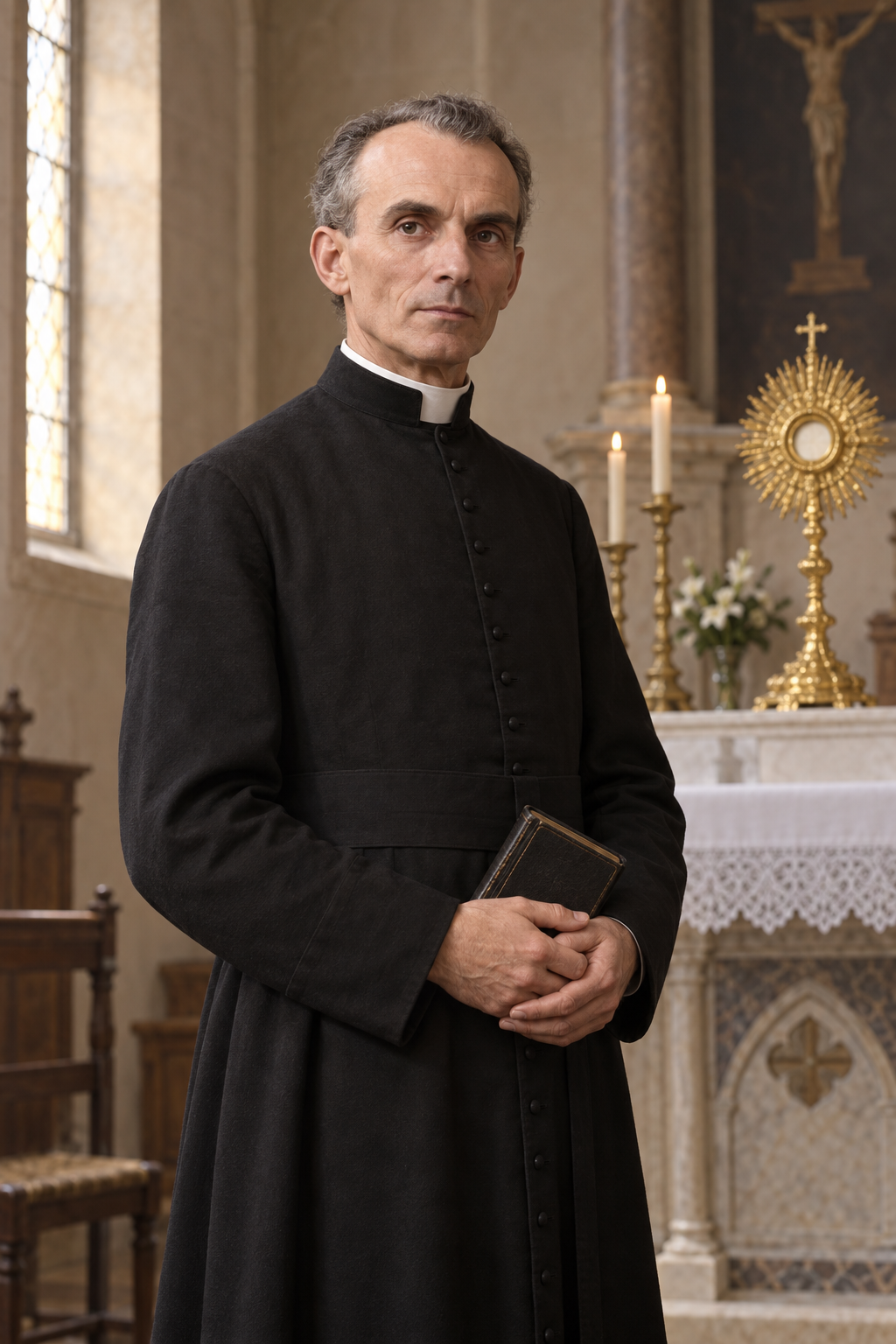
About Peter Julian Eymard
Peter Julian Eymard was born on 4 February 1811 at La Mure in Isère, France, in a family supported by his father's craft and small business. He later connected his desire for priesthood with his First Communion on 16 March 1823, although his father initially opposed that path. Eymard studied Latin while working in the family shop and entered the Oblates of Mary Immaculate in Marseille in 1829. Poor health forced him to leave the novitiate after several months, so this first attempt at religious life did not continue. After his father's death he entered the major seminary of Grenoble and was ordained there on 20 July 1834 by Bishop Philibert de Bruillard.
For five years Eymard served the Diocese of Grenoble, first as an assistant at Chatte and then as pastor of Monteynard. His surviving sermon notes and the study program in his Vade mecum show disciplined preparation rather than an effortless public ministry. The order's historian describes his early spirituality as austere and influenced by Jansenism, then gradually opening toward a stronger emphasis on love. Eymard himself interpreted particular moments of prayer as turning points; this profile treats those accounts as his religious understanding of experience, not as independently demonstrable miracles.
Still drawn to religious community, Eymard entered the Society of Mary in Lyon on 20 August 1839 and made profession on 16 February 1840. At the Marist college in Belley he served as spiritual director, working especially with students and young people. He later joined the Society's government in Lyon as provincial assistant and visitor general and directed the Third Order of Mary. That lay work included organized formation for people in different states of life and extensive personal correspondence. The period also left administrative records, retreat notes, and sermons, though some surviving instructions cannot be dated securely enough to assign to one stage of his ministry.
During the early 1850s Eymard's Eucharistic emphasis became more distinctive as he preached, directed lay groups, and participated in nocturnal adoration. John Keenan's manuscript-based study describes this development as a movement from a conventional nineteenth-century devotional approach toward a spirituality integrating prayer, Church, and social responsibility. Eymard proposed a new community devoted to the Eucharist, but Marist leaders judged that project outside their institute's purpose. After the proposal did not receive a decision in Rome, he asked to be released from his Marist vows and traveled to Paris in April 1856.
In Paris, Eymard and Raymond de Cuers presented a plan that joined adoration to the preparation of adults for First Communion. Archbishop Dominique Sibour initially saw the proposal as merely contemplative, but authorized it after Eymard explained its outward work. The authorization of 13 May 1856 marks the foundation of the Congregation of the Blessed Sacrament. The first community began regular exposition on 6 January 1857 with four members and very limited resources. Its difficult beginning matters because the later institution did not emerge fully formed from one private inspiration; it required permission, collaborators, housing, and sustained organization.
With lay members of the Society of Saint Vincent de Paul, Eymard's community gathered poorly catechized workers in a deprived Paris district and prepared them for First Communion. Twelve young people received Communion on 15 August 1859 and were confirmed the following day. The Congregation's official account interprets this work as a social expression of Eucharistic faith because it addressed basic human conditions as well as religious formation. The Aggregation of the Blessed Sacrament also drew lay people into adoration and service, while new communities opened beyond Paris. Pius IX granted a laudatory brief in 1859 and formal approbation followed in 1863.
Eymard also worked with Marguerite Guillot, who arrived in Paris with two companions in May 1858 to prepare a women's branch dedicated to the same Eucharistic mission. The Servants of the Blessed Sacrament became a canonical community at Angers on 26 May 1864, with Guillot, known in religion as Mother Marguerite, as its first superior general. Eymard preached to the women and helped shape their constitutions, but Guillot's leadership is essential to an accurate account of the foundation. Together, the men's congregation, the women's institute, and the lay aggregation made his project broader than a single chapel or form of private prayer.
Eymard published little during his lifetime, but left extensive correspondence, retreat notes, constitutions, and preaching materials. The modern complete edition is important because earlier devotional collections sometimes combined texts or reconstructed missing material, making confident attribution unsafe without editorial review. His writings show an evolving theology rather than one fixed system, with the Eucharist increasingly understood as encounter, community, and a demand for self-giving. In a letter to de Cuers he rejected a spirituality closed in on itself, writing that a purely contemplative life could not be fully Eucharistic.
A prolonged effort to establish a Eucharistic community at the traditional site of the Cenacle in Jerusalem ended without approval. During a nine-week retreat in Rome in 1865, Eymard's notes recast that failure around what he called the gift of his personality, or surrender of self. The language records his interpretation of a spiritual experience; it does not turn the unsuccessful project into an externally verifiable revelation. He continued preaching, revising constitutions, and opening communities, while illness, institutional setbacks, and spiritual dryness marked his final years.
Exhausted and in poor health, Eymard left Paris in July 1868 and returned to La Mure, where he died on 1 August. Pius XI beatified him on 12 July 1925, and John XXIII canonized him on 9 December 1962, immediately after the first session of the Second Vatican Council. John XXIII's canonization homily identified Eucharistic worship and apostolate as the characteristic direction of Eymard's priestly activity. His name entered the universal calendar in 1995, and the current United States calendar observes Saint Peter Julian Eymard, Priest, as an optional memorial on August 2. His durable contribution lies in linking sustained Eucharistic prayer with formation, communal organization, and practical concern for people on the margins of nineteenth-century Paris.
Wondering how to weigh the stories and sources? Learn how to read a saint biography.