Biography
Peter of Narbonne
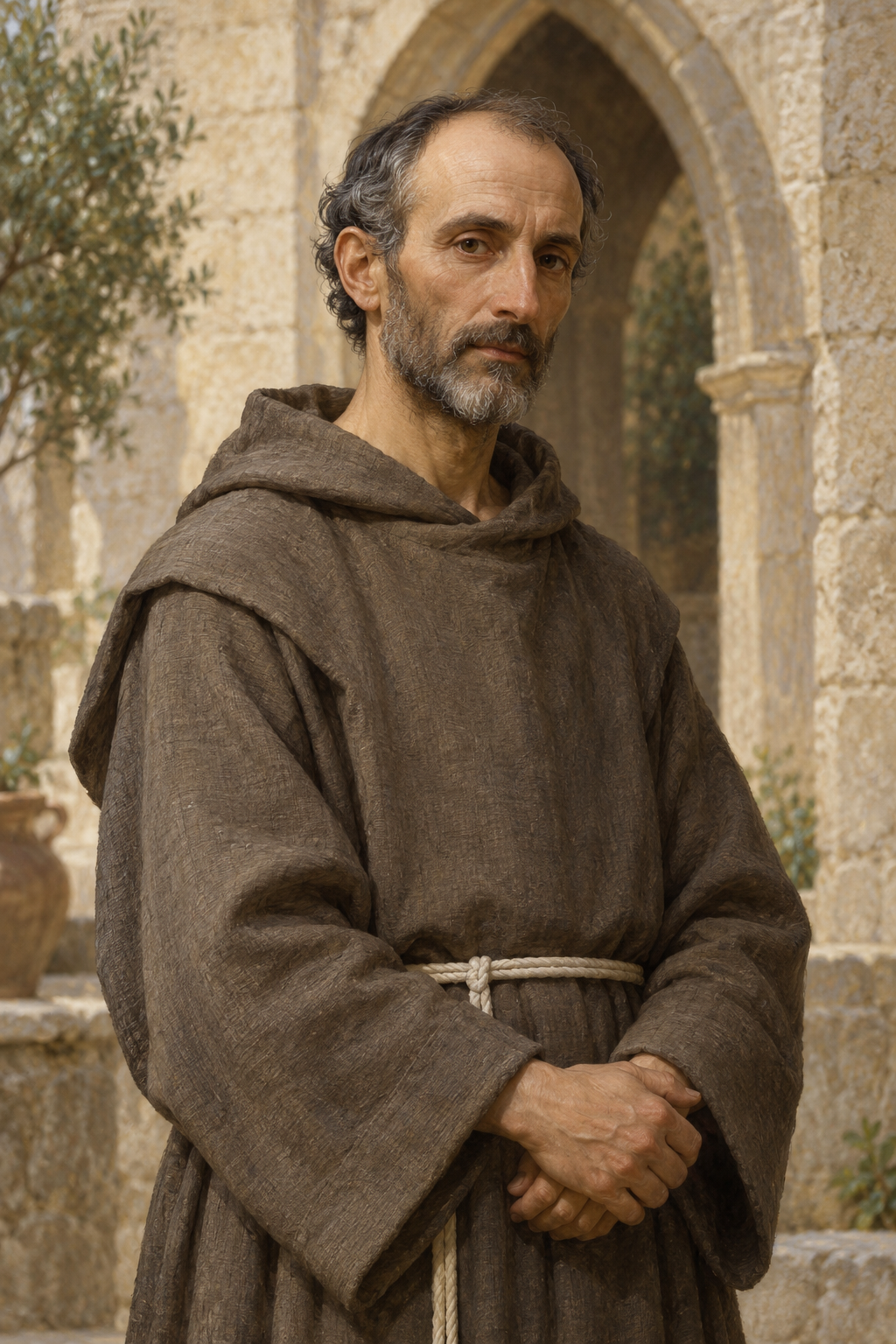
About Peter of Narbonne
Peter of Narbonne was a French Franciscan priest killed in Jerusalem with Nicholas Tavelic, Deodatus of Rodez and Stephen of Cuneo. The four belonged to the same religious order but came from different parts of Europe. Their common feast is November 14.
The account published by the Dicastery for the Causes of Saints places Peter in the Franciscan province of Provence. He later travelled to Italy, drawn to the Observant reform associated with Paoluccio Trinci. He lived at the hermitage of Brogliano in Umbria before leaving for the Holy Land. His brief individual profile describes a period of prayer and meditation there, but does not provide a birth date or a detailed account of his early life.
In Jerusalem he lived at the Franciscan convent on Mount Zion. According to the same account, he arrived in 1381 and subsequently joined the three friars with whom he would die. The group prepared a written statement defending Christianity and attacking Islamic teaching, after consulting two theologians.
On November 11, 1391, they approached the qadi, a Muslim official, and delivered their statement. Historian Dominic Monti describes their demand that their hearers accept the Christian gospel. Ordered to retract, they refused and were imprisoned and beaten. Their decision brought them into a deliberate confrontation with the authorities; Monti notes that the other Franciscans in Jerusalem were left unharmed.
Peter and his companions were executed on November 14, 1391.
Their canonization took place on June 21, 1970, under Paul VI.
In his homily, Paul VI acknowledged the difficulty of their case: they had knowingly exposed themselves to death. He recalled the traditional objection to deliberately provoking martyrdom, while interpreting their actions through their wish to imitate Christ. He also urged mutual understanding between Christians and Muslims, placing the commemoration within the Church’s commitment to peace.
Monti contrasts their approach with the work of Franciscans in the Holy Land today, who serve local Christians and cooperate with Muslims for the wider community. That distinction allows their story to be remembered without presenting religious confrontation as the only expression of Franciscan mission.
Wondering how to weigh the stories and sources? Learn how to read a saint biography.