Biography
Philip Benizi
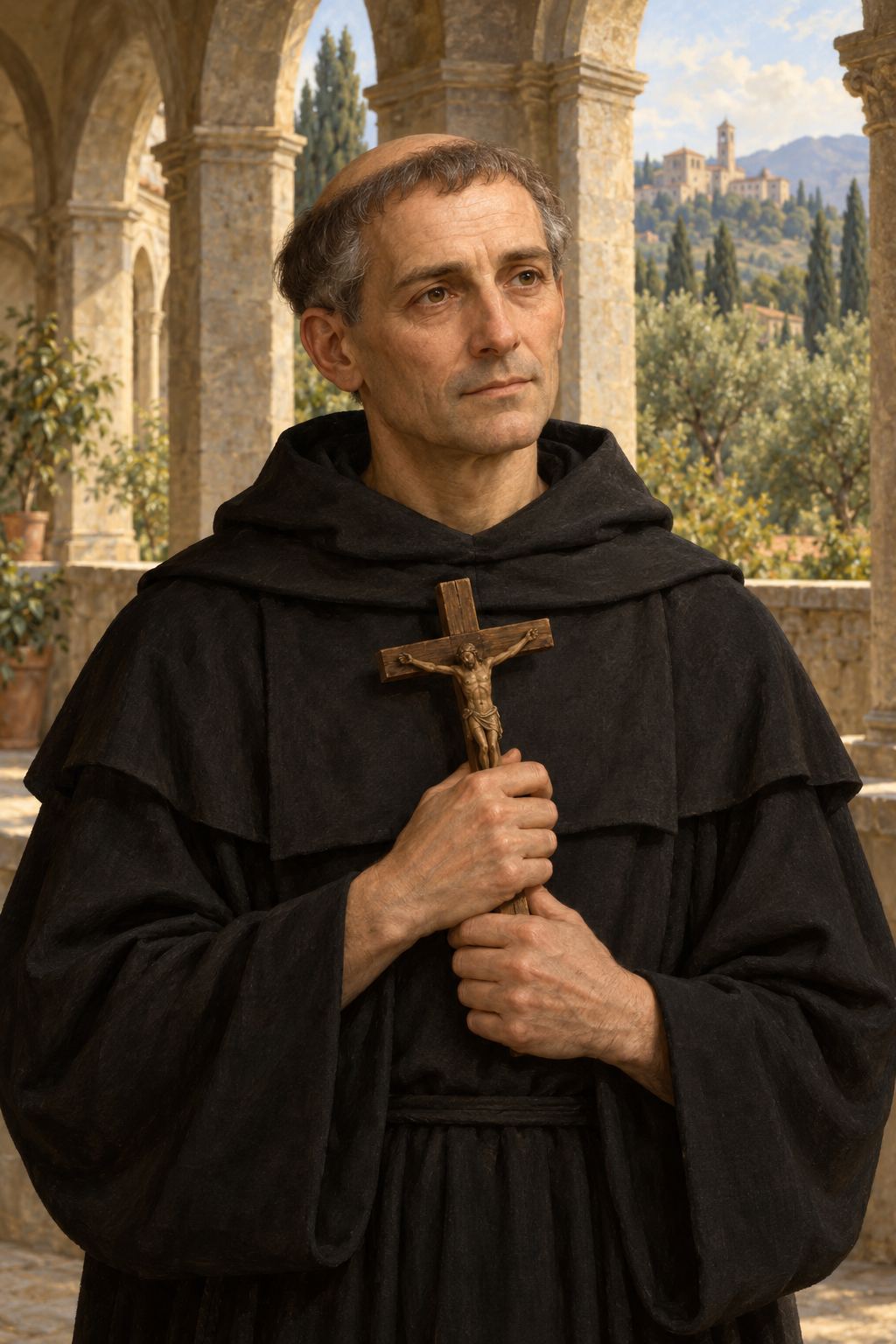
About Philip Benizi
Philip Benizi was a Florentine Servite priest who led his religious order through a period when its future was uncertain. Born in Florence in 1233, he belonged to a generation whose life became the subject of several different accounts after death. Historian Franco Andrea Dal Pino distinguishes the early legends from later additions, an important caution when reading the detailed stories attached to Philip’s childhood and education.
The tradition places his entrance into the Servites in 1254, while a document locates him at Siena in 1255. He became prior general in 1267. The Second Council of Lyons in 1274 threatened the survival of recently established mendicant communities. Philip helped the Servites navigate that danger, including a legal consultation in 1277 concerning their rule and their ability to possess property. His leadership required negotiation as well as personal devotion.
An official Servite anniversary letter describes his repeated annual election as general until his death. A financial register from May 1285 already refers to him with language honoring his holiness. His reputation therefore did not begin only with the much later formal canonization. The same letter records a translation of his remains in 1317 and public provision for commemorative candles in 1327, showing how remembrance took institutional and civic form.
The order’s struggle continued beyond his lifetime. Papal approval under Benedict XI came in 1304, a later development that should not be credited to a ceremony Philip personally witnessed. His importance to the Servites lies partly in sustaining a community through an unsettled period whose final resolution he did not live to see.
Philip died at Todi on August 22, 1285. The Dicastery for the Causes of Saints records his canonization on April 12, 1671, and identifies the shrine at Todi that bears his name and preserves his body. These dates distinguish his medieval life from the later formal recognition through which the Catholic Church extended his public veneration.
Devotion to Philip also developed through blessings associated with everyday needs. The Servite blessing book gathers rites for children, sick people, bread and water. Its explanations connect these practices with stories about his life, including accounts of help in sickness and food supplied during scarcity. The book presents a liturgical tradition, rather than historical proof that every miraculous episode occurred exactly as later narrated.
Bread and water have a particular place in that tradition. The blessing book associates their blessing with Philip’s feast on August 23, while also allowing other suitable occasions. It describes settings ranging from church celebrations to a family table. Some forms may be led by a lay person responsible for the gathering. The custom makes the ordinary necessities of eating and drinking part of the saint’s devotional remembrance.
Later artists gave visible form to the miracle stories. Prato’s Palazzo Pretorio museum preserves Alessandro Allori’s painting of Philip and a spring, dated 1603. Its catalogue describes the saint praying in a wooded setting as water appears to relieve thirst. The work belonged to a group commissioned for the Spini family’s chapel at Peretola, alongside scenes concerned with grain and bread. These paintings show how later patrons and artists understood Philip’s reputation for assistance in hunger and thirst; they are not contemporary records of his life.
His name also became attached to places of worship. The history of Monte Senario records the consecration of its church on April 4, 1717, with a joint dedication to Our Lady of Sorrows and Philip Benizi. That dedication belongs to the later history of the shrine, rather than to Philip’s own century. It preserves his connection with a place central to Servite memory.
At Sergio Osmeña in the Philippines, the diocesan parish history explains a different route by which his name arrived. The community originally bore the name of the Resurrection, then adopted Philip Benizi’s name through its relationship with an American sister parish. This supports a specific parish dedication. It does not establish the broader claim sometimes repeated that he is patron of the entire province of Zamboanga del Norte.
The Fullerton parish in California traces its beginnings to 1958, when its first Mass was celebrated in a roller rink. Its church was dedicated on August 23, 1959. Such local records show the continuation of Philip’s patronage in communities far from medieval Tuscany, while preserving the particular history of each dedication. The same parish history records an arson attack in 2000 and the rebuilding completed in 2005, showing that the community’s later life included loss and renewal as well as its founding celebration.
The Jonesboro parish in Georgia began in 1965 with worship in a storefront. Its history attributes the choice of Philip Benizi’s name to benefactors whose donation supported the new church through the Church Extension Society. This practical account of a parish’s founding adds another documented form of his remembrance, alongside the older Italian civic patronages and the Servite rites associated with his feast.
Wondering how to weigh the stories and sources? Learn how to read a saint biography.