Biography
Philip Evans
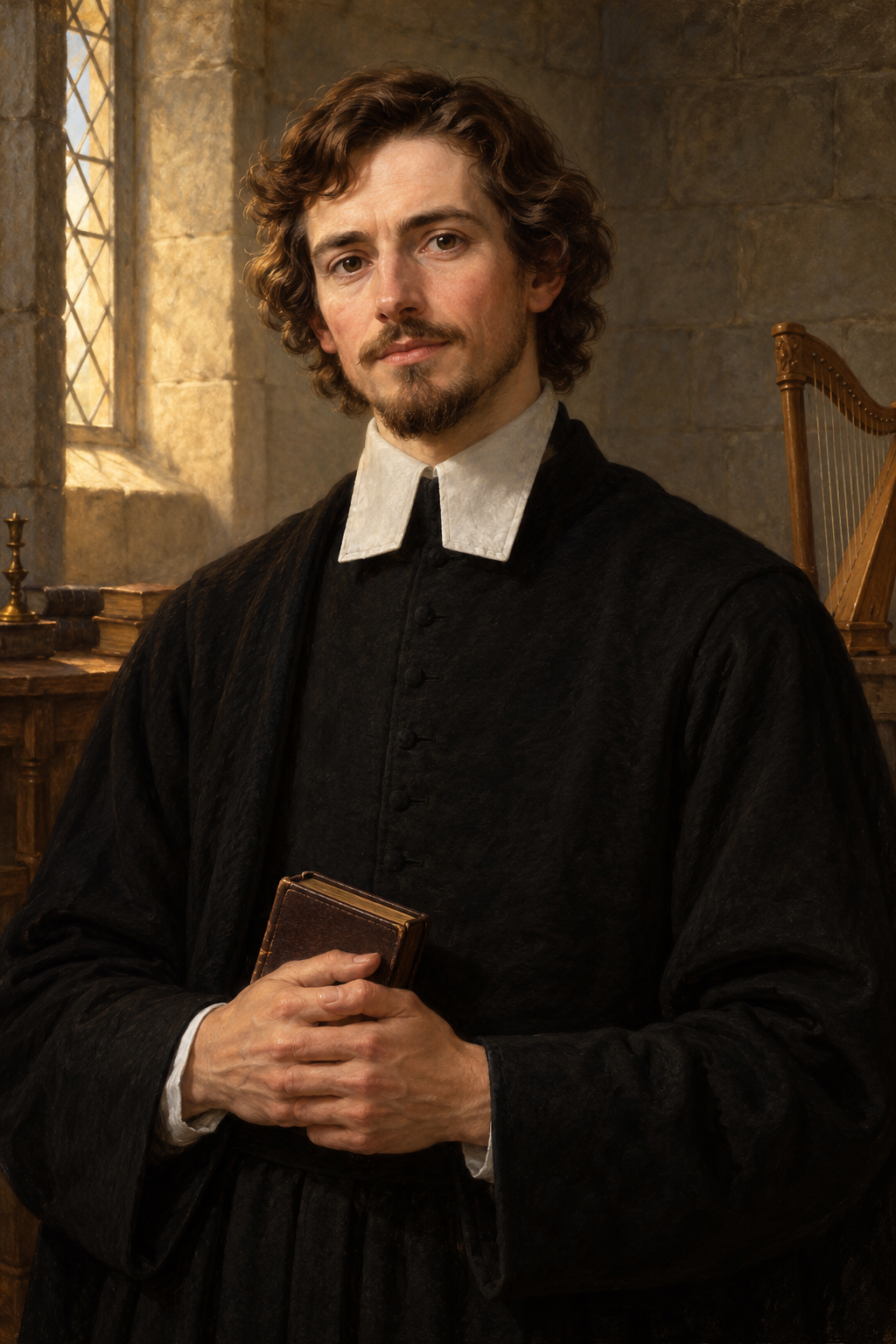
About Philip Evans
Philip Evans was a Welsh Jesuit priest executed at Cardiff on July 22, 1679, during the persecution stirred by the supposed Popish Plot. Born at Monmouth in 1645, he studied at Saint-Omer and entered the Society of Jesus. Following ordination at Liège in 1675, he returned to South Wales to minister to Catholics. His service there lasted only a few years before arrest brought it to an end.
The Dictionary of Welsh Biography names his parents as William Evans and Winifred Morgan. It describes a ministry centered on Monmouthshire and Glamorgan, carried out through Catholic households. At Abergavenny he stayed with Thomas Gunter and preached in Welsh in the chapel at Gunter’s house in Cross Street. He also visited other families and served at Sker, the home of Christopher Turberville. Such households provided places where Catholics could gather for worship under restrictive laws.
Titus Oates’s allegations of a Catholic conspiracy intensified the danger in 1678. The Jesuits in Britain describe the campaign of the magistrate John Arnold to secure Evans’s capture. He was arrested in Glamorgan that December. The accusation of a plot formed the atmosphere of the persecution, but it should not be mistaken for proof that Evans had taken part in an assassination conspiracy.
Evans spent his first weeks of imprisonment in solitary confinement. Later he shared captivity with John Lloyd, a diocesan priest. The Jesuit Collections account emphasizes the companionship that developed between them: they encouraged one another through the months before their execution. Their close association in later remembrance reflects that shared imprisonment and death, rather than membership in the same religious order.
The two priests were tried in the spring of 1679. Cleary’s scholarly account identifies the charge as being seminary priests under an Elizabethan statute. Their execution did not follow immediately. During the interval, Evans was permitted enough freedom to play tennis, and the news that he would die the next day reached him while he was playing. The remembered request to finish his game became one of the best-known details of his story.
Music also appears in accounts of his final imprisonment. John Cronin’s 1929 narrative describes Evans asking for a harp and writing to his sister, a nun in Paris, on the eve of his death. Cronin also discusses farewell letters expressing gratitude to friends and concern for their families. These writings and recollections preserve personal relationships around a man whose public memory is often reduced to the circumstances of his execution.
On July 22, Evans and Lloyd were taken to Gallows Field at Cardiff. Evans was executed first. The New Catholic Encyclopedia records the punishment as part of the legal proceedings against his priesthood, and places his farewell to Lloyd within that final scene. The Catholic Church remembers him as a martyr, honoring his fidelity under a sentence imposed for his religious ministry.
The identification of surviving human remains requires more caution. Jesuit Collections discusses the possibility that the bones associated with Holywell belonged to Evans and Lloyd, but frames that attribution conditionally. The physical evidence and the history of their deaths may support a hypothesis; they do not justify presenting the identity of the remains as certain. This distinction matters even when later devotional accounts speak with greater confidence.
Evans and the other Forty Martyrs of England and Wales were canonized by Paul VI on October 25, 1970.
His name remains part of Cardiff’s Catholic life. The parish dedicated to him was established in 1975, and its early Masses moved from a local high school to the new Saint Philip Evans School. After years of fundraising, the parish church opened in October 1985. The parish’s own history explicitly names Evans as its patron and records the school bearing his name.
He is also presented as patron of tennis by Église et Sport, a Catholic pastoral sports resource. This devotional association recalls the prison story without establishing a dated decree of appointment.
Wondering how to weigh the stories and sources? Learn how to read a saint biography.