Biography
Philip Neri
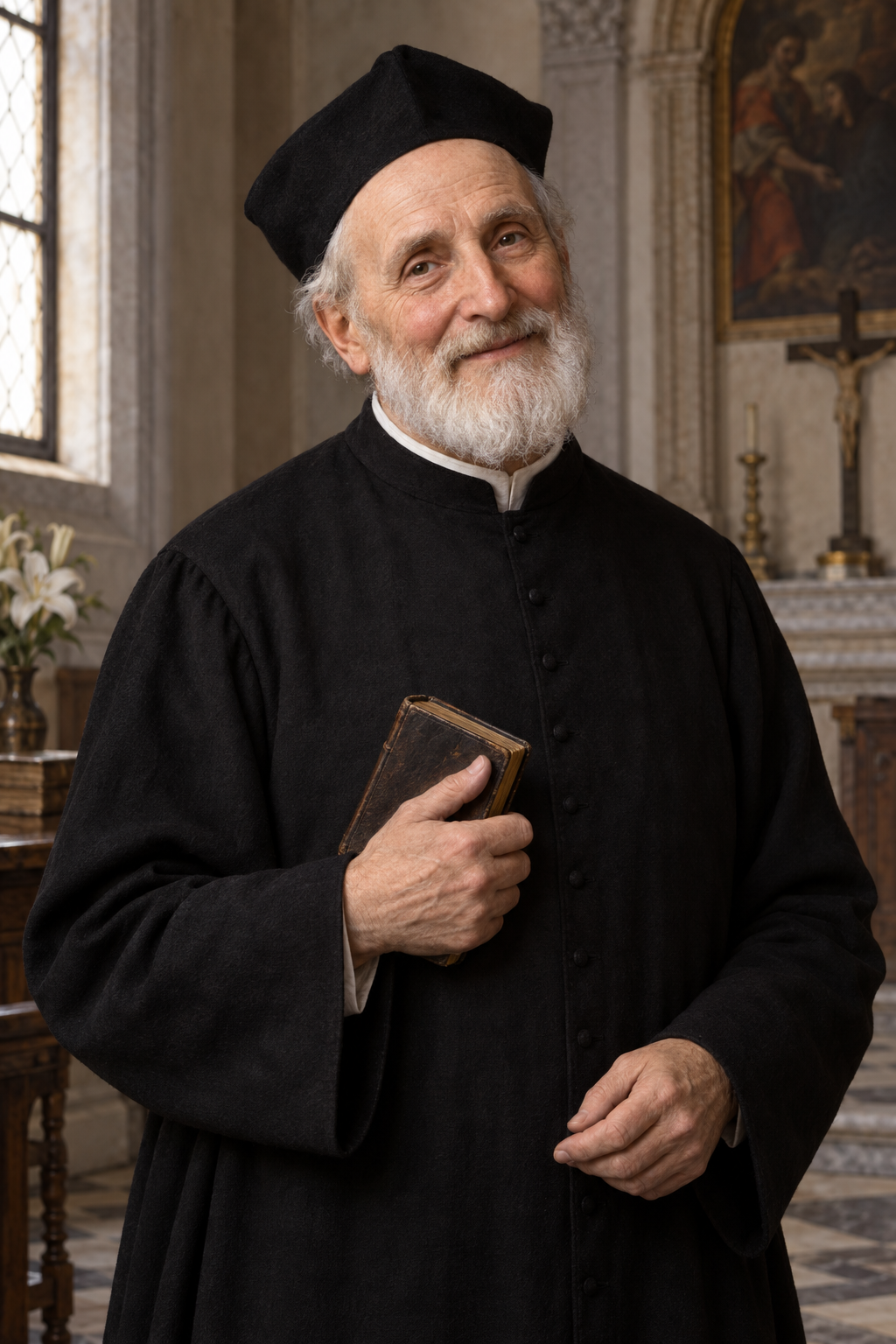
About Philip Neri
Philip Neri was born in Florence on 21 July 1515 to Francesco Neri, a notary, and Lucrezia da Mosciano. His mother died in 1520, and the family lived in modest circumstances despite earlier social standing. He received ordinary schooling and spent time around the Dominican convent of San Marco, where the memory of Girolamo Savonarola remained influential. The scholarly account cautions against treating his youth as a finished religious vocation; the sociable, expansive character remembered later was already visible.
Around 1532 or 1533 Philip left Florence for San Germano, now Cassino, where a relative hoped to introduce him to commerce. Accounts disagree about how long he stayed there and whether he reached Rome in 1533 or 1534, so no exact arrival date is asserted. In Rome he lodged with the Florentine Galeotto Caccia, tutored Caccia's sons, and attended philosophy and theology courses. He did not pursue an academic career or join a monastery, but gradually adopted a mobile lay apostolate among people in the city.
Philip prayed in quiet churches and at the catacombs while serving sick people and meeting residents in streets and public squares. With his confessor Persiano Rosa, he became a principal organizer of the Confraternity of the Holy Trinity of Pilgrims and Convalescents, active by 1548. During the Jubilee of 1550 the confraternity received and assisted pilgrims arriving in Rome. He also developed the Seven Churches pilgrimage, combining prayer, walking, companionship, and visits to major Roman basilicas. Hospital service and care for travelers were not secondary additions to his prayer; papal accounts present works of charity as part of the formation he gave his companions.
Oratorian tradition connects a powerful experience during prayer at the catacombs of Saint Sebastian with Pentecost 1544. Philip understood the event as the Holy Spirit enlarging and warming his heart. Later testimony and a physician's 1593 observation described violent palpitations and separated ribs near his heart. Those records document physical symptoms and Philip's interpretation, but they do not independently establish a miraculous cause.
At the urging of Persiano Rosa, Philip was ordained a priest at San Tommaso in Parione on 23 May 1551. He then lived at San Girolamo della Carità, where hearing confessions and offering spiritual direction became central to his ministry. Penitents and friends began gathering in his room for meditation, conversation, and prayer; when the group outgrew that space, it moved to a larger room above the church. The Oratory therefore developed from repeated pastoral practice before it became a formally recognized congregation.
Meetings included familiar discussion of Scripture, Church history, and saints' lives, together with prayer and moral reflection. The afternoon gathering took shape through readings followed by short contributions rather than a single formal sermon, and vernacular devotional songs increasingly accompanied it. Philip sent participants from talk to action through hospital visits, catechesis, and aid for people in need. Music and other arts also had a place in the group's formation, but entertainment was joined to disciplined spiritual direction rather than treated as an end in itself. His humor and short maxims made demanding counsel memorable without turning his ministry into spectacle.
Some disciples became priests and formed a common household at San Giovanni dei Fiorentini, anticipating the later Congregation of the Oratory. On 15 July 1575 Gregory XIII issued the bull Copiosus in misericordia, canonically establishing a congregation of secular priests and clerics and assigning Santa Maria in Vallicella to it. The structure was unusual because its members remained secular priests rather than taking the vows of a religious order. Philip stayed at San Girolamo until 1583, while his companions developed common practices and debated constitutions through shared decisions. Those constitutions were repeatedly revised and did not receive final approval until 1612, seventeen years after Philip's death. The long process guards against describing every later Oratorian rule as Philip's personal design.
Philip's mature ministry reached young people, lay participants, priests, cardinals, and poor residents through personal conversation rather than one uniform program. Pope Francis's centenary message emphasizes that prayer, Scripture, sacramental preparation, Church history, and works of charity belonged together in this approach. He continued hearing confessions through the last day of his life, making sustained individual accompaniment as important as public gatherings. Philip knew Ignatius of Loyola and formed a close friendship with Charles Borromeo, relationships that place him among several reforming networks in sixteenth-century Rome. Yet the Oratory's growth depended on collaborators such as Cesare Baronio and Francesco Maria Tarugi, not on Philip acting alone.
Declining health marked Philip's later years, although he continued receiving people at Santa Maria in Vallicella and relinquished leadership only in 1593. He died in Rome during the night of 25-26 May 1595. Gregory XV canonized him on 12 March 1622 in the same ceremony as Ignatius of Loyola, Francis Xavier, Teresa of Avila, and Isidore the Farmer. The current United States calendar observes his memorial on May 26, while the Church of England calendar lists him that day as Founder of the Oratorians and Spiritual Guide. His durable contribution is an Oratory model that joined friendship, accessible teaching, communal prayer, and practical charity without requiring its priests to become a vowed religious order.
Wondering how to weigh the stories and sources? Learn how to read a saint biography.