Biography
Pierre Teilhard de Chardin
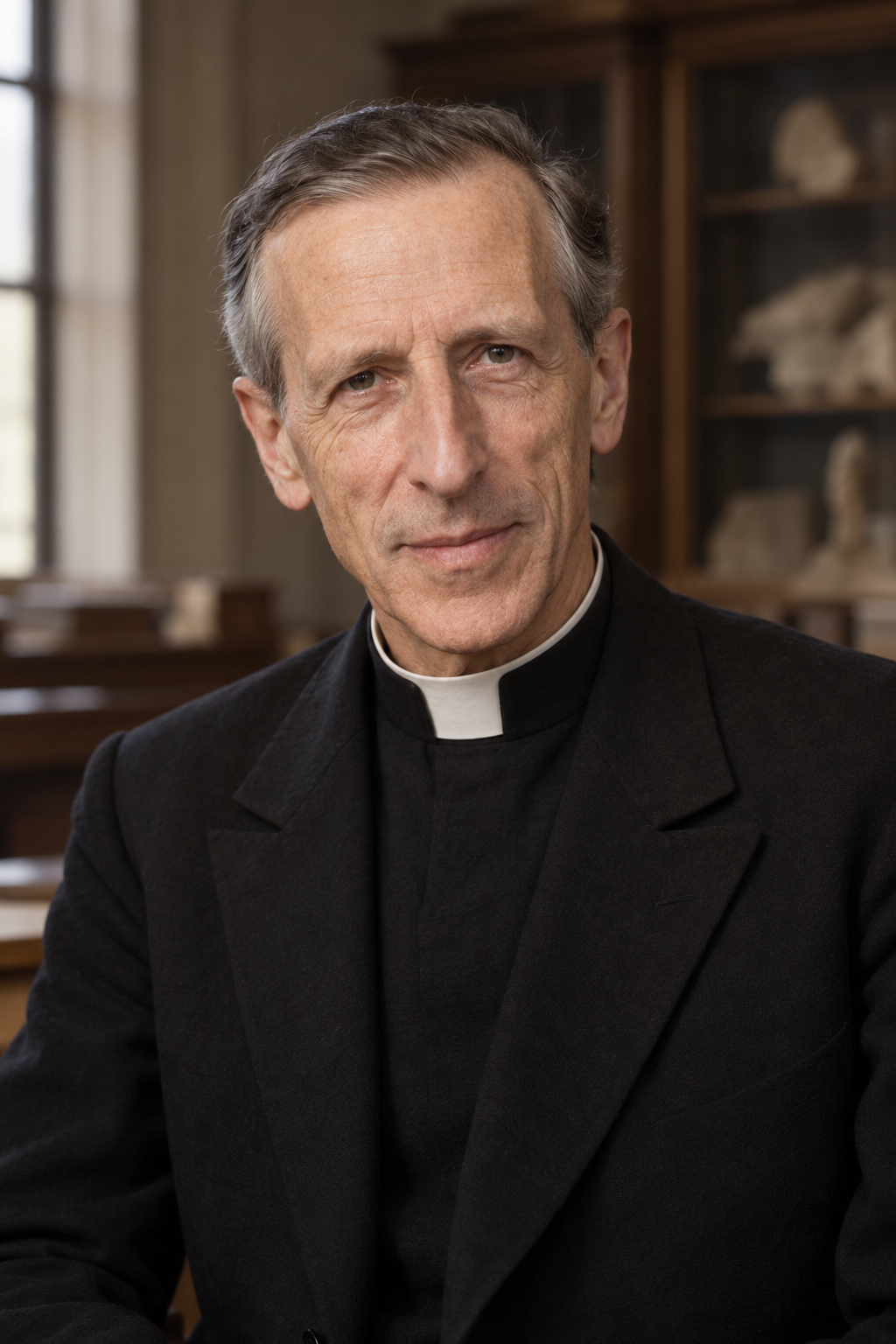
About Pierre Teilhard de Chardin
Pierre Teilhard de Chardin was a French Jesuit priest and scientist who spent his final years working in New York. He tried to understand Christian faith in relation to an evolving universe. His career brought him into scientific expeditions and intellectual friendships across continents, while disagreements with church authorities restricted the publication of his religious writings. In 1951 he accepted a research position with the Wenner-Gren Foundation in New York, where he lived among fellow Jesuits at St. Ignatius Church.
Born at Sarcenat in 1881, he entered Jesuit formation and taught physics and chemistry in Cairo before studying theology in England. He was ordained in 1911. Alongside his religious studies, he collected fossils and developed an interest in geology. In Paris he worked with Marcellin Boule at the natural history museum. The First World War interrupted his studies, and he served at the front as a stretcher-bearer and nurse. He completed his doctorate in 1922.
Much of his scientific career unfolded in China. He worked with Émile Licent and later joined investigations associated with the Chinese geological service and the Cenozoic Laboratory in Beijing. His responsibilities included studying the geology and fossil evidence at sites connected with early human remains. At Zhoukoudian, he worked within an international collaboration that included Chinese researchers. His scientific contribution belonged to this wider collective effort, rather than to a discovery made by one person alone.
Scientific work also shaped his religious writing. The Jesuit theologian Thomas King describes research as a form of prayer and discipline for Teilhard. In essays begun during the war, Teilhard explored the relation between the material world and the Christian understanding of Christ’s body. He argued that work in science, education and other ordinary occupations could participate in religious life. This offered a way of thinking about faith that took daily work seriously, instead of treating it simply as an interruption of devotion.
His vision included both activity and loss. King explains that Teilhard’s account of spiritual life moved from growth and effort toward accepting limitations, suffering and death. In The Mass on the World, written in China in 1923, he used Eucharistic imagery to contemplate the world’s work and suffering. These were theological and devotional interpretations, not conclusions that fossil evidence could establish. They help explain why readers beyond his scientific field became interested in his writings.
His religious ideas met resistance from his superiors. After the Second World War he sought permission to publish The Phenomenon of Man, but did not receive it during his lifetime. He also failed to obtain permission to accept a proposed position at the Collège de France. In New York, his days included visits to his research office and to his friend Rhoda de Terra. He visited France again in 1954, but returned to America after permission to settle permanently in France was refused.
The Wenner-Gren Foundation lists him among participants in its International Symposium on Anthropology in June 1952. The gathering brought together researchers to assess their field and discuss future work. Papers circulated before the meetings and were subsequently published in two volumes. His participation placed him in a broad scholarly conversation, extending beyond his own geological research and private religious manuscripts. These were Anthropology Today: An Encyclopedic Inventory and its companion volume, An Appraisal of Anthropology Today.
His ideas about humanity also contained serious prejudices. In a systematic study published in 2024, John P. Slattery traced colonial racism through Teilhard’s writings and found a sustained commitment to eugenics in his later years. Slattery distinguishes his claims of racial hierarchy from expressions of overt hatred: opposition to the latter did not amount to belief in human equality. These findings complicate accounts that celebrate his hope for human unity without examining whom his theories treated as inferior.
Slattery’s argument is not that every insight in Teilhard’s work should be discarded. He calls for its troubling elements to be acknowledged and examined alongside its religious and intellectual influence. Such criticism matters when interpreting a thinker whose language of progress can otherwise obscure the unequal value he assigned to different peoples.
Teilhard died in New York on April 10, 1955. The Jesuit necrology records him as a priest who had made the order’s four vows. His death ended a life that had continued within the Society of Jesus despite intellectual conflict.
His influence continued beyond his lifetime. In 2005, the Episcopal News Service announced programs marking the fiftieth anniversary of his death, including discussions at New York’s Cathedral of St. John the Divine. The announced themes joined scientific research, spirituality and environmental responsibility. They show the range of questions that later readers brought to his work.
St. Mary’s Episcopal Church in Kansas City lists his commemoration on April 10. This Episcopal remembrance does not imply Roman Catholic canonization or acceptance of all his ideas.
Wondering how to weigh the stories and sources? Learn how to read a saint biography.