Biography
Pio of Pietrelcina
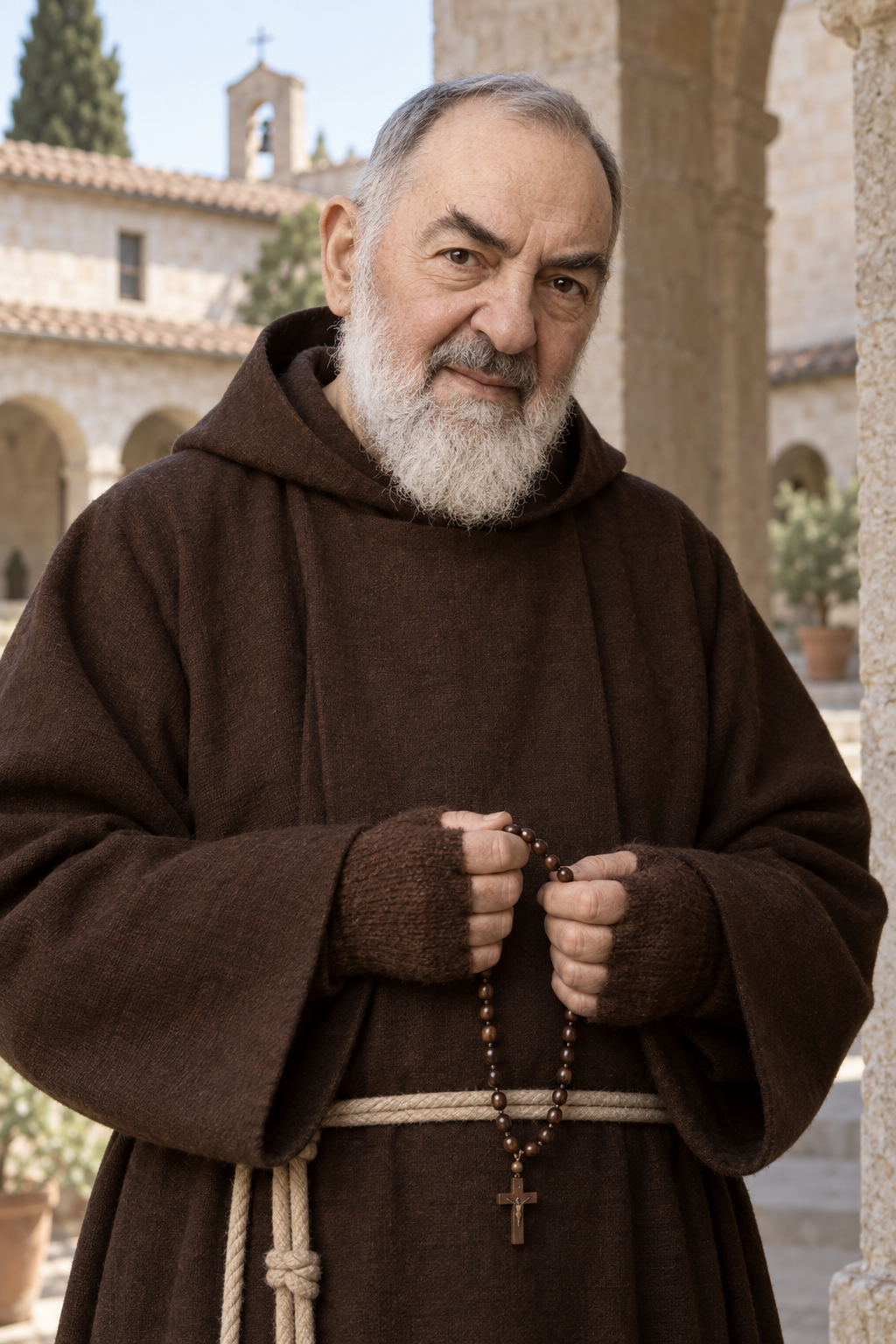
About Pio of Pietrelcina
Pio of Pietrelcina was born Francesco Forgione on 25 May 1887 in Pietrelcina, in the province and archdiocese of Benevento, to Grazio Forgione and Maria Giuseppa De Nunzio. He was baptized the following day and received the name Francesco; at twelve he received confirmation and made his First Communion. A critical biography treats the influence of a local Capuchin friar on his early vocation as probable rather than certain. At sixteen he entered the Capuchin novitiate at Morcone on 6 January 1903, received the habit and name Brother Pio on 22 January, made simple vows in 1904, and professed solemn vows on 27 January 1907.
His studies and early religious formation took him through several Capuchin houses in southern Italy. Recurring illness repeatedly interrupted that formation and led his superiors to permit long periods with his family at Pietrelcina. He was ordained a priest at Benevento on 10 August 1910 and celebrated his first solemn Mass in Pietrelcina four days later. During the First World War he underwent brief military service separated by medical leave and was discharged in March 1918.
Pio first reached the friary at San Giovanni Rotondo in 1916 and returned there in September with permission that was described as temporary; he remained for the rest of his life. There his ordinary work centered on celebrating Mass, hearing confessions, and offering spiritual direction to the growing number of people who sought him. People formed prayer groups inspired by his example, while the flow of pilgrims made a remote Gargano friary a place of international devotion. The spread of roads, print, photography, and Catholic associations after the Second World War further enlarged his public following.
On 20 September 1918 Pio reported that, while praying before a crucifix, he saw a mysterious bleeding figure and then found wounds on his hands, feet, and side. The wounds remained visible for decades and were examined by physicians sent or accepted by his superiors. Devotees understood them as stigmata sharing in Christ's Passion, while medical and ecclesiastical investigators disputed their cause and the culture that grew around them. A historical account can document Pio's testimony, the observed wounds, and the competing judgments without claiming that their supernatural origin is independently demonstrable.
Vatican scrutiny brought a series of limits on his public ministry during the 1920s and early 1930s. In 1931 he was barred from public priestly ministry except for Mass celebrated privately in the friary chapel. Public Mass resumed in July 1933, and permission to hear confessions returned during 1934. The later Holy See biography emphasizes that he accepted investigations and restrictions in obedience; the documentary history also preserves serious institutional suspicion rather than a simple story of uninterrupted approval.
Pio joined his pastoral concern for suffering people to an ambitious hospital project at San Giovanni Rotondo. The plan for Casa Sollievo della Sofferenza took shape in 1940, construction began in 1947, and the hospital opened on 5 May 1956. Its own institutional history records that the original private clinic opened with 250 beds and later became a major hospital and research center. John Paul II described Pio's aim as first-class medicine practiced in a humane setting that attended to patients as persons.
The prayer groups and the hospital gave durable institutional form to two themes that Catholic reception identifies in his ministry: persistent prayer and concrete charity. His confessional could demand long waiting lists, and accounts remember both sustained attention to penitents and a severity that some found abrupt. A renewed apostolic visitation in 1960 produced additional controls over the friary, the hospital, and access to Pio. In February 1964, under Paul VI, his Capuchin province was told that he could exercise his ministry in full freedom.
Pio's health declined sharply in his final years, and by 1968 he needed a wheelchair. He celebrated his last Mass on 22 September 1968 and died at San Giovanni Rotondo early the next morning, aged eighty-one. The Holy See biography records that a very large crowd attended his funeral and that devotion to him continued to spread after his death. The reported disappearance of the wounds at death belongs to the devotional record; surviving accounts document the claim but do not settle its medical interpretation.
The formal cause opened after the Holy See granted permission in 1982, and the diocesan inquiry ran from 1983 to 1990. A decree recognizing heroic virtue was promulgated in 1997, and John Paul II beatified Pio on 2 May 1999. After the canonization process examined a further healing, the decree of canonization was promulgated in February 2002 and John Paul II proclaimed him a saint on 16 June 2002. The Roman Catholic calendar observes his memorial on 23 September, the date of his death. His lasting significance lies in a ministry that brought prayer, sacramental reconciliation, and organized medical care together, even as responsible history continues to distinguish church judgment, devotional testimony, and contested evidence.
Wondering how to weigh the stories and sources? Learn how to read a saint biography.