Biography
Pompilio Maria Pirrotti
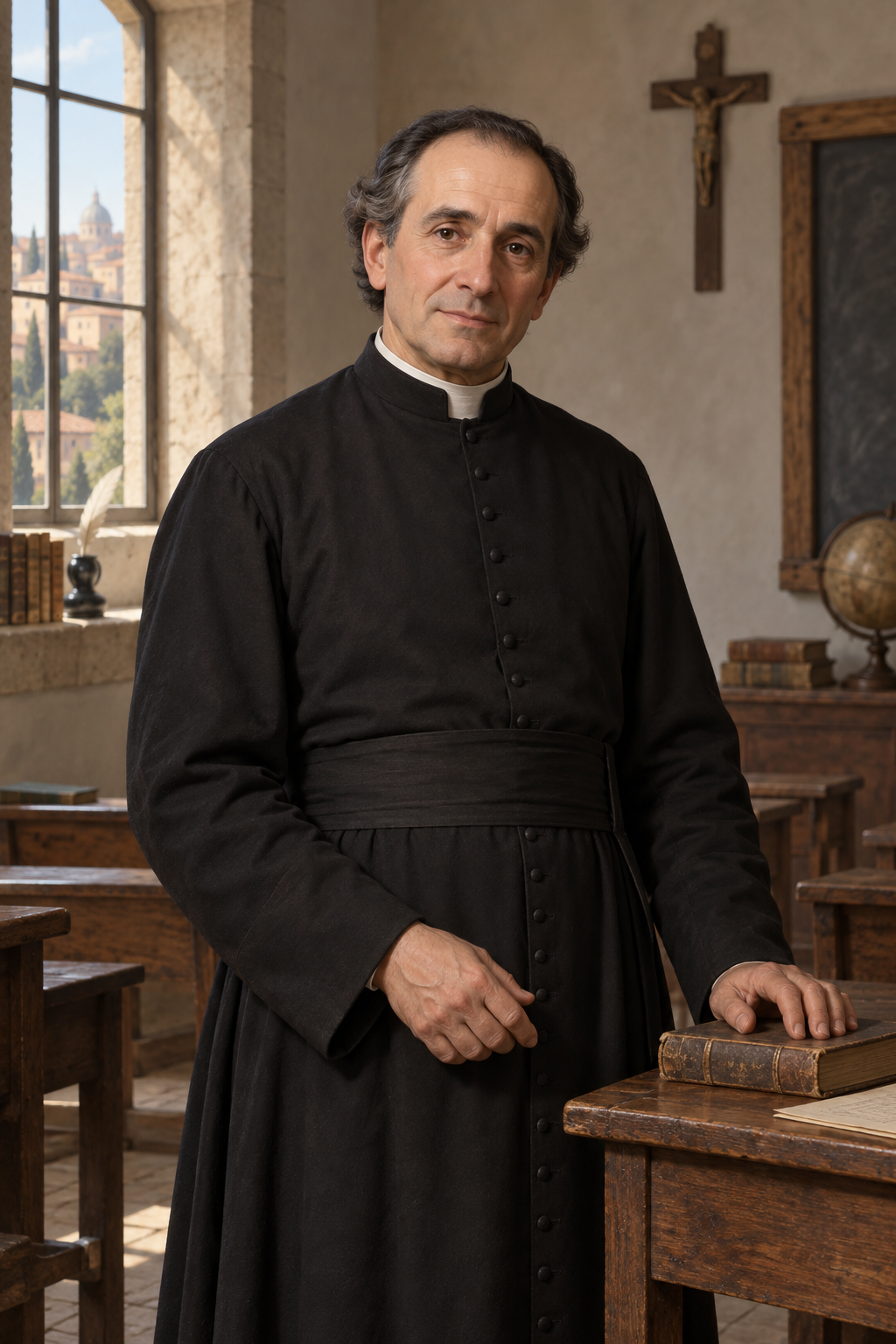
About Pompilio Maria Pirrotti
Pompilio Maria Pirrotti was born Domenico Pirrotti at Montecalvo Irpino on 29 September 1710. His parents were Girolamo Pirrotti and Orsola Bozzuti. The Catholic Church in Norway's biographical account places the town in the present-day province of Avellino and the diocese of Benevento, two different kinds of jurisdiction. It also describes his early education and eventual entrance into the Piarist order. Its page title gives a mistaken death year, so that detail is checked against other sources. The birth setting was southern Italy before national unification. These distinctions prevent a misleading modern address from replacing the historical setting.
The Piarists, or Order of the Pious Schools, combined religious life with instruction, especially for young people with few resources. Their schools formed part of a wider early modern movement for accessible education. An older Italian encyclopedia remembers the order's teachers and intellectuals as well as Pirrotti's preaching. This setting helps explain why his life cannot be told only as a sequence of sermons or devotional practices. He joined a community whose ordinary work included classrooms, study, and the formation of other teachers. Pirrotti would later be remembered for ministry beyond school walls, but it grew from this educational institution.
During Lent 1726, a Piarist preacher at Montecalvo influenced Domenico's vocation. Sodano cautions that later stories dramatize parental resistance; a letter shows he left without permission. He entered the order as a postulant, received the habit at Naples on 2 February 1727, took the name Pompilio Maria of Saint Nicholas, and professed in 1728. The steps show a gradual entry into Piarist life.
He studied at Chieti and Melfi and began teaching at Turi. The Piarist biographical dictionary dates his priestly ordination in Brindisi to 20 March 1734. Its author traces later assignments to Brindisi, Ortona, and Lanciano. That movement was normal in an order with schools across regions, yet it also exposed him to communities with different expectations of a priest's work. Classroom instruction and spiritual guidance were not rival activities for him. Both appear in the order's account of his service, alongside preaching and confession. The educational work is historical, though devotional biographies give it less space.
The *New Catholic Encyclopedia* portrays Pirrotti as a teacher in several Piarist schools, in Abruzzo, and as a priest who helped others. It says he promoted frequent communion and devotion to the Sacred Heart at a time when such practices could be controversial. This synthesis is brief and written from a Catholic perspective, but it preserves the breadth of his ministry. Pirrotti's practical contact with students and families made his work public; it also brought scrutiny. His reputation for caring for poorer people and his unusually expressive religious practice both affected how others judged him.
As his work spread beyond classrooms, Pirrotti encouraged frequent communion and devotion to the Sacred Heart. The *New Catholic Encyclopedia* describes his care for poorer people, the suspicions raised by his enthusiasm, and his eventual exile by the king of Naples. Its compact account treats popular indignation as helping to reverse the order. Other records give more detail about how the exile came about, but the encyclopedia shows how the conflict appeared in a later Catholic reference work. His time outside the kingdom included service in other Piarist houses. The episode illustrates how a public ministry could attract both committed supporters and institutional opposition.
A Piarist reflection published in 2016 describes Pirrotti as spending roughly ten years devoted to school work before preaching became a more prominent part of his vocation. Its author insists that his later ministry remained connected to the order's educational purpose. That retrospective judgment helps explain why the record moves between classrooms, confession, and public sermons rather than dividing his life into unrelated careers. It is a modern interpretation, not a report from an eighteenth-century witness. The point is still useful: teaching formed his habits of attending to individuals, while preaching brought that care to a wider public.
In 1765 Pirrotti was permitted to return to the kingdom, though Naples itself remained excluded. The Catholic Church in Norway's chronology places him first on a journey through Montecalvo and Lecce before his final service at Campi Salentina. He joined the Piarist house there and continued pastoral work, including a public way of the cross in its church early in 1766. His final assignment was brief. He died at Campi on 15 July 1766, the date also used for his liturgical memorial. The Norwegian page's heading incorrectly says 1756, but its detailed narrative and the official Dicastery agree on 1766.
The Piarists' modern magazine remembers Pirrotti as a teacher, preacher, and guide who favored kindness in personal spiritual care. This is the order's interpretation of a member's legacy rather than an eyewitness assessment. It nevertheless draws attention to an important balance in the record: his school teaching was joined to individual guidance, while his devotional practices provoked disagreement in his own century. Remembering only the conflict would obscure his service to students; remembering only affection would obscure the institutional tensions. His life belongs to both the history of education and the changing religious climate of eighteenth-century Italy.
Leo XIII beatified Pirrotti in 1890; Pius XI canonized him in 1934. His documented teaching, preaching and charity remain clearer than disputed motives or later devotional stories.
Wondering how to weigh the stories and sources? Learn how to read a saint biography.