Biography
Porphyrios of Kavsokalyvia
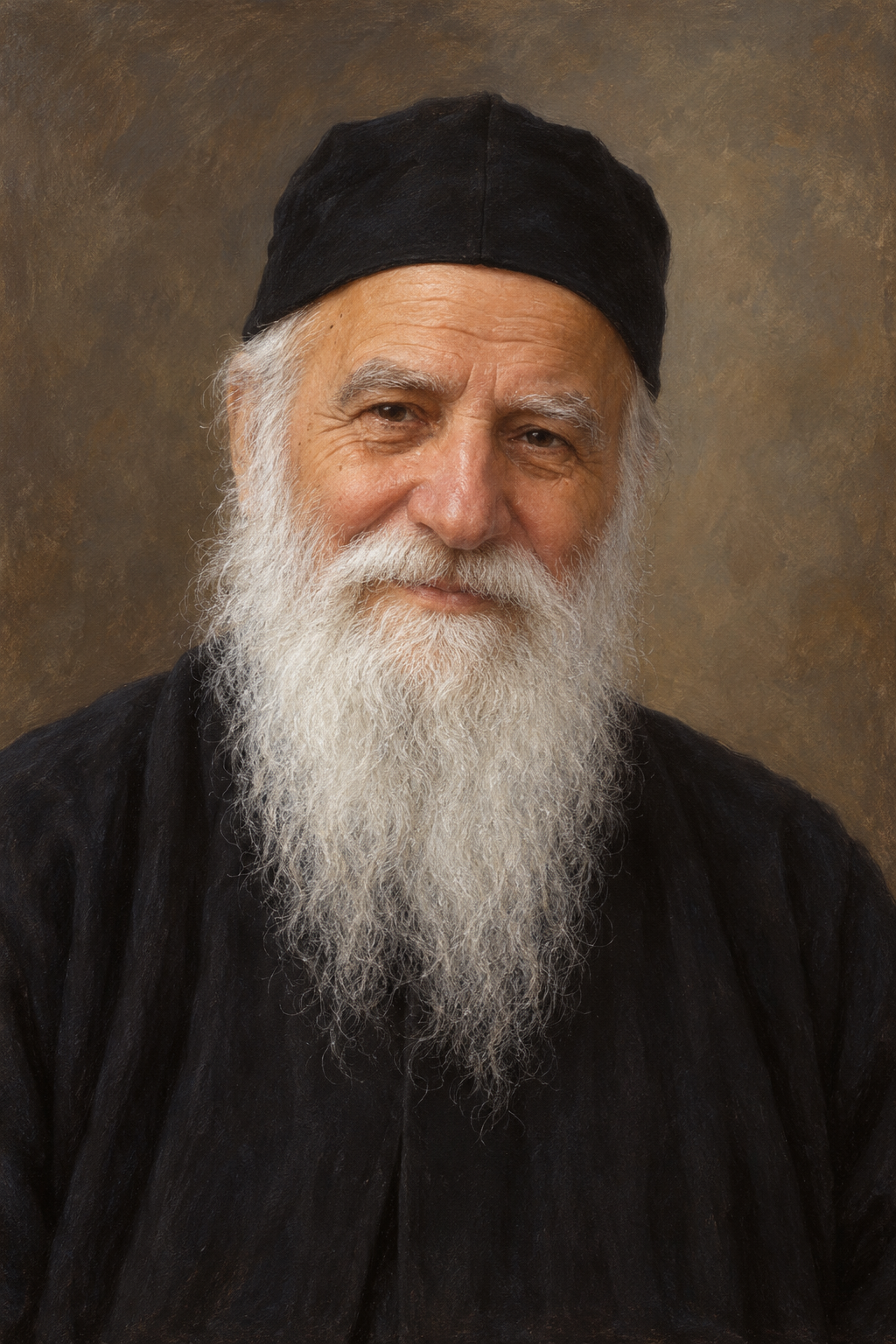
About Porphyrios of Kavsokalyvia
Porphyrios of Kavsokalyvia was a Greek monk and priest, born Evangelos Bairaktaris in 1906. Poverty interrupted his schooling and sent him to work while still a child. He later entered monastic life on Mount Athos, where he was first named Niketas. Illness brought him back to Euboia. Ordained in 1926, he received the name Porphyrios and served as a confessor. In 1940 he began his long ministry at the Athens Polyclinic, caring spiritually for patients.
His formation at Kavsokalyvia took place under the elders Panteleimon and Ioannikios. The publisher’s account of Athanasios Papathanasiou’s study emphasizes the movement between this monastic setting and the city. Athos remained his spiritual home even when poor health required him to live elsewhere. His later work brought that formation into daily contact with urban suffering.
Metropolitan Nektarios, who says he knew Porphyrios personally, recalls that his limited formal education initially raised objections to his hospital appointment. The ministry lasted thirty-three years. It brought him among patients, relatives, doctors, and nursing staff, as well as people who came through the surrounding city. Nektarios remembers his support for families and his readiness to hear confessions. In the bishop’s interpretation, this life showed that holiness could develop in a busy neighborhood near Omonia Square, without abandoning the discipline learned on Athos. Nektarios also stresses his humility, simplicity, respect for each person, and enduring liturgical prayer as central qualities of his religious life.
After retiring from hospital service, he lived at the small monastery of Saint Nicholas at Kallisia, north of Athens, before proceeding with the foundation at Milesi.
The community he hoped to establish was to join monastic prayer with hospitality. According to the convent’s account, he wanted women living together in Christian love, attentive to the hymns and readings of the church. The daily and seasonal services would provide their education in humility and devotion. He also hoped the monastery would welcome people burdened by grief, bodily suffering, or spiritual distress. Its strongest teaching, in this account, would come through prayer and example. Silence belonged to that vision, alongside the availability of confession and worship. He envisaged a church spacious enough for many visitors and a community where people could turn at any hour toward Christ. These were his aspirations for the monastery, rather than a description of every arrangement that later developed. The convent specifically recalls his emphasis on the Psalter and the church’s service books, through which the sisters would continually encounter the words of saints.
He also worked to establish the Transfiguration monastery at Milesi, despite illness and failing sight. Near the end of his life, he returned to Kavsokalyvia on Mount Athos. He died there on December 2, 1991.
At Milesi, Nektarios recalls, he first lived in a caravan and later in two simple brick rooms. Repeated illness often confined him to bed. The church and the wider complex were still unfinished during his lifetime. His return to Athos therefore came before the building work reached its eventual form. He remained in touch with spiritual children by telephone before his death.
His recorded teaching includes a vivid delight in the natural world. In Wounded by Love, he encourages attention to plants, animals, the sea, and the changing sky as occasions for gratitude to God. That attention also extends to human buildings, towns, and different ways of life. Curiosity, in his account, can become part of prayer. He remembers birdsong on Athos and at Kallisia, and describes a journey on which a companion had overlooked the flowers and birds around them. The recollection presents spiritual attentiveness as something learned, rather than an automatic response to a beautiful place.
These words reached readers through a collection prepared after his death. Two women who had known him for more than three decades kept notes and recordings of his conversations, memories, and guidance. After they entered Chrysopigi convent in Crete, the material was transcribed and arranged by subject under the abbess’s direction. The resulting book preserves an edited record of spoken teaching, rather than a continuous autobiography written for publication.
The Ecumenical Patriarchate recognized him as a saint on November 27, 2013. The community at Milesi had already arranged its annual memorial service when the announcement arrived. In its own account, the sisters describe going immediately to the church, ringing the bells, and singing his hymn. Visiting Serbian clergy and monks shared the news with contacts in Serbia.
The planned memorial became a celebration of the newly recognized saint. On December 2, a large congregation attended the convent’s first liturgy honoring his feast. Celebrations followed in his birthplace and at the monastery of Saint Charalambos. The account preserves the community’s response to a formal recognition that many of his spiritual children had hoped for.
The Orthodox Institute for Missions and Development names Porphyrios as its patron saint.
Wondering how to weigh the stories and sources? Learn how to read a saint biography.