Biography
Ralph Sherwin
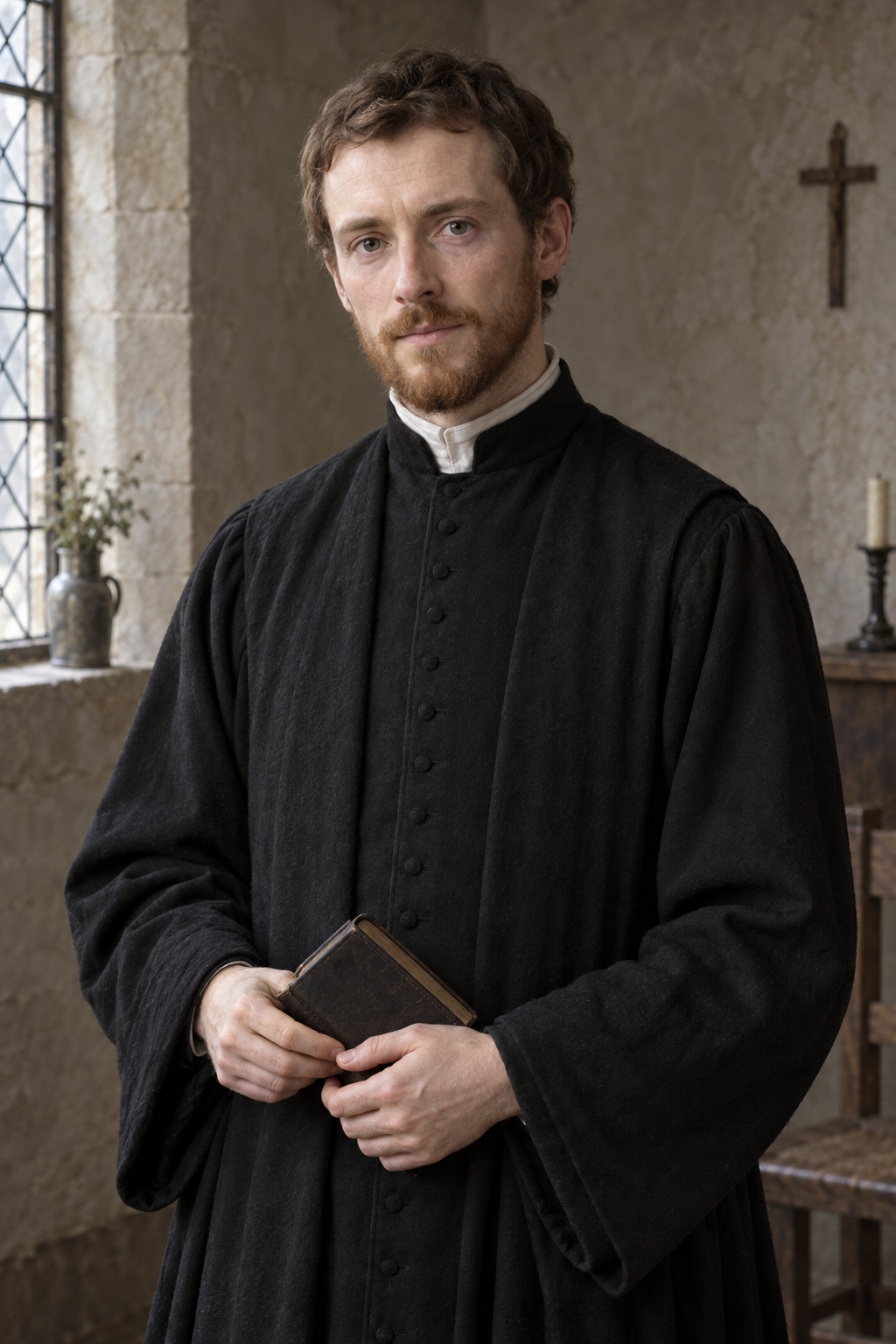
About Ralph Sherwin
Ralph Sherwin was born in 1550 at Rodsley, near Longford in Derbyshire. In 1568 Sir William Petre nominated him to a fellowship at Exeter College, Oxford. Sherwin gained his master’s degree on 2 July 1574. His reputation rested on serious study: he was remembered for his ability in philosophy and his command of Greek and Hebrew. Those scholarly accomplishments preceded the decision that would take him away from Oxford and eventually back to England as a Catholic priest.
His Oxford years fell in a period of change for Exeter. Petre’s recent endowment had widened the college’s recruitment and increased its resources. Revised statutes provided more permanent fellowships and more organized teaching. The undergraduate timetable stretched from early logic lectures to evening disputations. This was an academic community in which religious allegiance also mattered. Exeter retained strong Catholic sympathies, partly through its western English connections and partly through the fellows Petre appointed. Sherwin and another fellow, John Cornelius, would later become missionaries and be executed. After Sherwin had left, government commissioners intervened in the college in 1578, removing several fellows. These circumstances locate his education within a community already caught in England’s religious divisions.
In 1575 Sherwin became a Catholic and went abroad to the English College at Douai. He was ordained a priest there in 1577. He then continued his studies at the English College in Rome for about three years. His preparation thus crossed several countries before he began the work for which the English Catholic community remembers him. In April 1580 he left Rome with thirteen companions. Among them were the Jesuits Edmund Campion and Robert Persons. Their destination was England, where they intended to minister to Catholics.
His ordination at Douai took place on 23 March 1577, with the Bishop of Cambrai as the ordaining bishop. On 2 August he left the college to travel onward to Rome.
The Roman college was itself a young institution. Its first students had arrived from Douai in 1577 and attended lectures at the Jesuit Collegio Romano. In 1578 the students signed a missionary oath in the Liber Ruber, the college’s register. Sherwin was the first to sign. The college preserves his readiness to return to England immediately as a distinctive part of his memory. Its formal foundation followed in 1579, and disputes troubled the early community. Sherwin therefore belonged to its first generation, when the practical purpose of a seminary abroad was inseparable from a hoped-for return home.
On their journey north the missionaries stayed for eight days with Charles Borromeo at Milan, and Sherwin preached before him. He had left Rome on 18 April 1580. By November he was a prisoner in the Marshalsea.
The precise course of his short English mission is difficult to reconstruct. Michael Brown’s study distinguishes the surviving notices from later assumptions about his movements. Sherwin was arrested while preaching at Nicholas Roscarrock’s London house, and was in the Marshalsea by 9 November 1580; the exact arrest day is uncertain. His ministry continued among fellow prisoners. Early in December he was moved to the Tower of London. There he was interrogated and subjected to the rack. The questioning sought information about Campion, Persons and the people sheltering the missionaries. Brown’s account places the prison narrative beside contemporary correspondence, official records and later Catholic recollections.
The Universalis account remembers his efforts to bring other prisoners into the Catholic Church. It also records repeated torture and exposure to snow after the rack. His imprisonment lasted roughly a year before his trial. The work he had prepared to do in private households had become a ministry within confinement, under increasingly severe pressure.
He was tried at Westminster Hall on 20 November 1581. The formal accusation was treasonable conspiracy, including alleged participation in plans directed against the queen. Sherwin denied that accusation and insisted that his Catholic religion was the reason he stood accused. He was convicted and condemned to death. While awaiting execution he wrote to friends and to his uncle John Woodward. His final letter, dated 30 November, thanked his uncle, maintained his innocence and asked for prayer.
On 1 December 1581 Sherwin was taken from the Tower to Tyburn on a hurdle shared with Alexander Briant. He was executed that day, aged thirty-one.
His death became central to the memory of the English College in Rome. The college keeps 1 December as Martyrs’ Day. Its tradition of gathering before Durante Alberti’s Martyrs’ Picture to sing the Te Deum recalls the news of former students’ deaths and continues the remembrance of Sherwin and the other martyrs.
Pope Paul VI canonized Sherwin in 1970 among the Forty Martyrs of England and Wales. The Diocese of Nottingham identifies him as patron of the St Ralph Sherwin Catholic Multi-Academy Trust. The same diocese continues to commemorate him through pilgrimage and worship.
Wondering how to weigh the stories and sources? Learn how to read a saint biography.