Biography
Raymond Nonnatus
About Raymond Nonnatus
Raymond Nonnatus is honored in the Roman Catholic Church and especially in the Order of Mercy, but the surviving evidence does not permit an ordinary medieval biography. The New Catholic Encyclopedia reports that no reliable contemporary sources establish the events of his career. Dates such as 1200 or 1204 for his birth and August 31, 1240 for his death belong to a received chronology rather than a continuous documentary record. Even Raymond's historical identity has been questioned by modern writers. A responsible account must therefore distinguish the man remembered in worship from the much later stories told about him.
The setting in which the tradition places Raymond is better documented than Raymond himself. Historian James William Brodman traces Pere Nolasc in records as a rector of the poor in 1226 and as a collector of alms for captives by 1230 and 1231. A community and a Barcelona house for this work took shape during the 1230s. In 1235 Gregory IX granted the brothers of Santa Eulalia the Rule of Saint Augustine. These records show that organized ransom work existed in the Crown of Aragon during Raymond's supposed lifetime. They do not, however, name Raymond Nonnatus or confirm his participation.
According to later tradition, Raymond was born at Portell after his mother had died during childbirth. The epithet Nonnatus, meaning not born, was explained by the story that he was removed from her body rather than delivered in the usual way. The tradition then places him among the early Mercedarians and describes Peter Nolasco as the leader who received him into religious life at Barcelona. It remembers Raymond as a friar and priest whose vocation centered on people held captive across the Mediterranean. None of these details should be mistaken for contemporary testimony, even though they became central to his religious identity.
Later accounts place Raymond in Algiers from 1236 to 1239, where they say he ransomed captives, became a hostage, served prisoners, and preached. His captors, the story continues, pierced his lips and fastened them with a padlock to stop him speaking. A payment eventually secured his release and return to the Iberian Peninsula. This narrative expresses the Mercedarian ideal of sharing a captive's danger, but its specific acts remain traditional rather than documented events in Raymond's life.
The Order of Mercy's own current historical note introduces a significant complication. It points to Ramon Surrons, a friar from Portell who appears in records of provincial chapters at El Puig in 1324 and Lerida in 1335. The note says Surrons was appointed a redeemer and associates his work in Algiers with the padlock torture. That evidence belongs about a century after the traditional Raymond's lifetime. It may explain how a real ransomer's experience entered the saint's story, but the Order's page does not demonstrate that Surrons and the thirteenth-century Raymond were the same person.
The claim that Gregory IX made Raymond cardinal of Sant'Eustachio is especially difficult. The New Catholic Encyclopedia calls the cardinalate historically uncertain. Antoni Llorens i Sole reviews an earlier archival critique and concludes that Raymond was not a cardinal. He explains that the title was probably attached to Raymond through confusion among cardinals whose names began with the same initial, including the actual holder of Sant'Eustachio. The scarlet clothing sometimes given to Raymond in art should therefore be understood as an attribute of later hagiography, not a reliable office in his vocation taxonomy. His death at Cardona, probably around August 31, 1240, remains a cautious historical estimate rather than an exact certified date.
The written history of Raymond's cult is firmer than the narrative of his career. Llorens finds no biographies before the later sixteenth century and identifies works printed in 1588 and 1591 as the earliest substantial witnesses he discusses. The Cardona inquiry of 1612 gathered testimony for Raymond's cult, but nearly all witnesses spoke from tradition rather than medieval documents. The Order of Mercy records a decree recognizing immemorial cult on November 5, 1625, entry in the Roman Martyrology on June 19, 1655, and extension of his office and Mass. Innocent XI made the observance obligatory for the wider Church in 1681. These actions document the growth and authorization of devotion; they do not retroactively verify every episode in the received life.
Buildings in Catalonia show how that devotion became attached to place. The municipality of Sant Ramon dates the small chapel at Portell to 1651 through 1655 and says it was raised where tradition located Raymond's birth. At Cardona Castle, a later chapel marks the traditional place of his death and miraculous final communion. Catalonia's heritage service dates that chapel's origins to the seventeenth century. Both sites are genuine witnesses to later memory, while their claims to identify precise events in Raymond's life remain traditional. For that reason, map records can name Portell and Cardona at settlement level without treating either chapel as a confirmed medieval site.
Raymond's August 31 feast continues in the Mercedarian proper calendar. The Order's proper office calls him a priest and describes his birth, ransom service, captivity, and death as reliable tradition. Its collect asks that worship lead to charity shared with oppressed people. Current Mercedarian practice also names Raymond as a patron of novices, expectant mothers, the falsely accused, family life, and unborn children. Those patronages describe the present devotional tradition; they are not evidence for the circumstances of his medieval birth. No securely attributable words spoken or written by Raymond were found, so an invented quotation would obscure rather than honor the record.
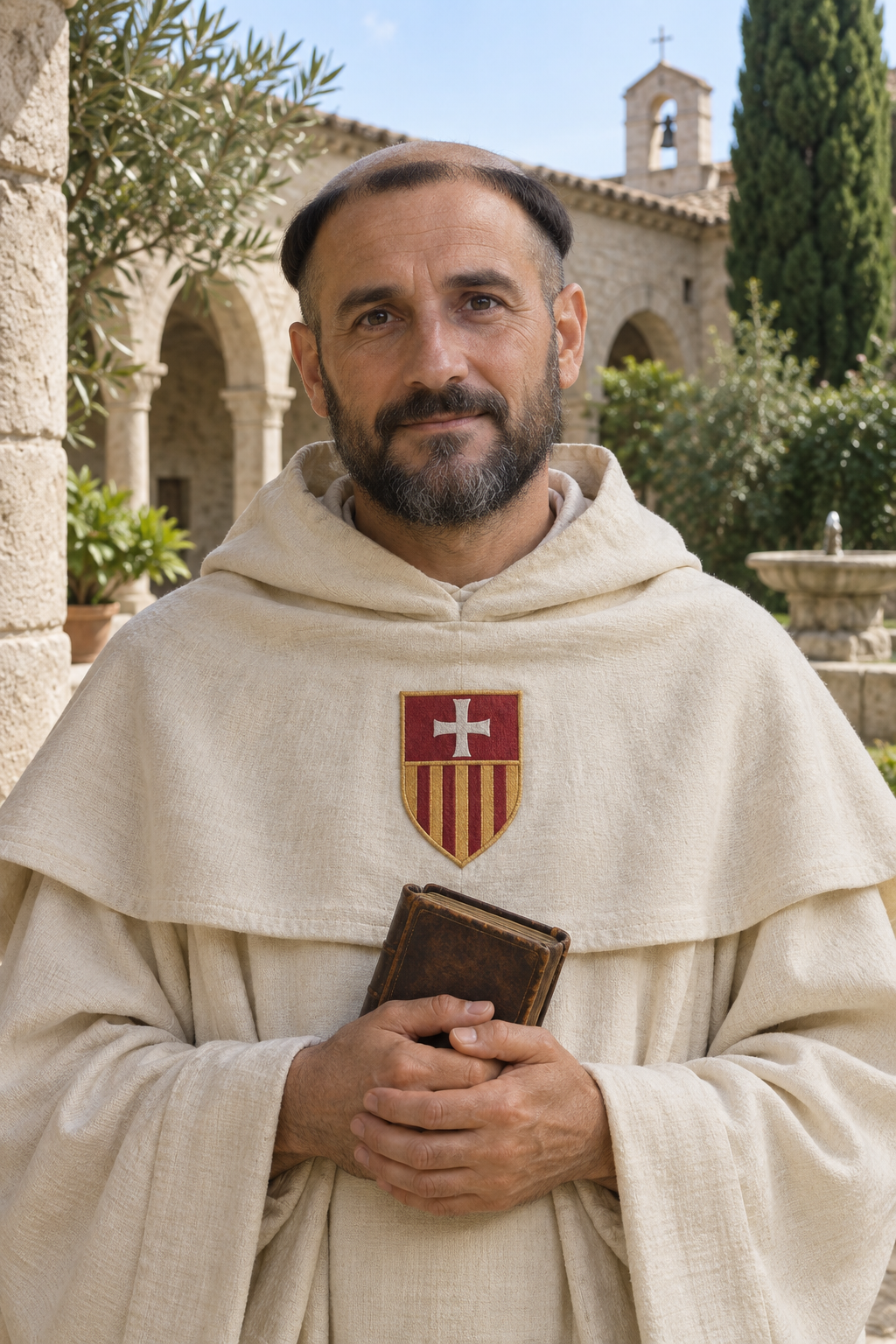
The catalog portrait and badge are modern AI-generated devotional images, not historical likenesses. They show the same bearded man in a white hooded habit, wearing a red-and-gold shield and holding a small book before a cloister. Their restrained presentation avoids repeating the disputed cardinal title, although the face and setting remain imaginative. Raymond's continuing significance lies in the demanding ideal carried by his cult: freedom may require sharing the danger borne by captives. Historical care adds a second responsibility, preserving that ideal without turning a late tradition into a documented life.
Wondering how to weigh the stories and sources? Learn how to read a saint biography.
Explore similar vocations
Prayers for Raymond Nonnatus
Raymond Nonnatus: Mercedarian collect excerpt
may we follow the example of his unbounded charity.