Biography
Raymond of Peñafort
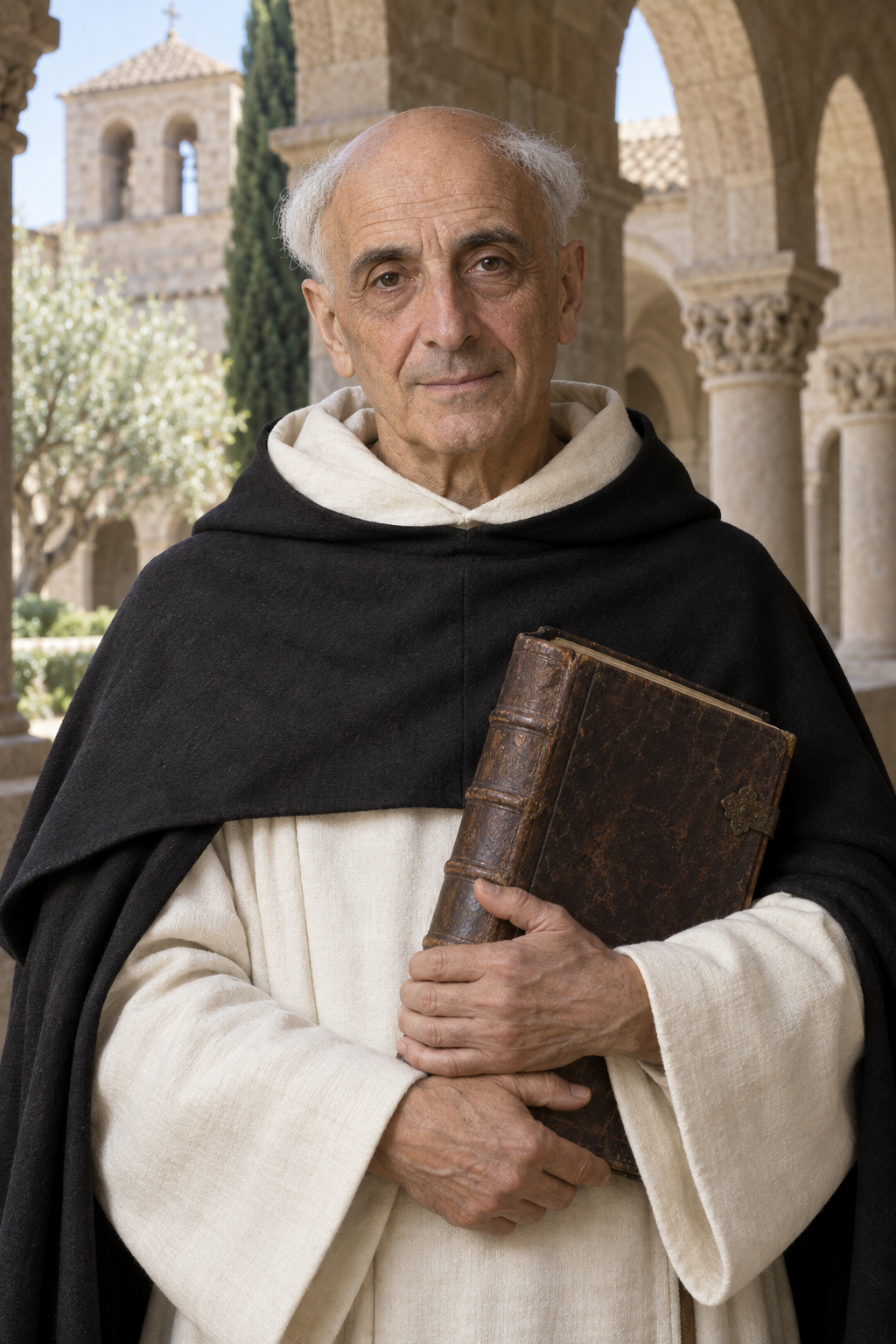
About Raymond of Peñafort
Raymond of Peñafort brought a lawyer's training into the life of a Dominican friar. Born near Barcelona in the later twelfth century, he studied and taught before entering the Order of Preachers. The Spanish Dominican account places his formation at Barcelona Cathedral and his advanced legal studies at Bologna. On returning to Barcelona he continued teaching, then joined the Dominicans at their house of Saint Catherine in 1222. His religious life did not discard his earlier learning. The skills of a teacher and lawyer would become central to his service within the Church, both in the confessional and in its governing institutions.
His work soon extended beyond his own community. He served Cardinal John of Abbeville, and Gregory IX called him to Rome as chaplain and grand penitentiary. The pope also entrusted him with organizing a large body of ecclesiastical decisions. Earlier collections contained material that needed selection, arrangement and reconciliation. Raymond's task was to make the accumulated law more usable, rather than to invent a new religious system from nothing. The resulting collection was arranged in five books. The older Catholic Encyclopedia emphasizes both his learning and his reluctance to accept ecclesiastical advancement, including his refusal of the archbishopric of Tarragona.
The collection of decretals was promulgated in 1234, but Raymond also wrote for more immediate pastoral needs. His work on marriage addressed problems that a priest could meet when advising people or hearing confessions. Pierre Payer's introduction explains its organization around engagement, marriage, impediments, legal procedure, legitimacy and dowry. Raymond revised an earlier treatment by Tancred rather than claiming every part as his own invention. The discussion gave particular importance to consent and considered circumstances such as force, error and prohibited relationships.
For Raymond, pastoral law involved more than matching a wrongdoing to a penalty. Stefan Mangnus describes his handbook for confessors as an explanation of doctrine and law that could help a priest advise a penitent. Its discussion of marriage attends to freedom of consent and to the goods that married life should protect. The confessor needed to understand the person and the moral problem, not merely find an entry in a list. That emphasis helps explain why legal learning belonged within his religious vocation. Careful distinctions could be a form of service when they helped someone approach a difficult decision with an informed conscience.
Raymond also carried responsibility for the Dominican Order itself. As its master for two years, he worked on its constitutions and the arrangements by which its communities governed their common life. The Order's liturgical account remembers this alongside his five-book legal collection and his penitential handbook.
His missionary activity also placed him within a coercive Christian political order. Kate Tinson identifies him as a key organizer of the 1263 Barcelona disputation between the Jewish scholar Nachmanides and the Christian convert Pablo Christiani. Raymond was present as a Dominican and as a confessor of King James I. The encounter sought to press Christian claims upon a Jewish audience through argument about Jewish texts. Tinson also discusses pressure for the removal of passages from the Talmud and compulsory attendance at Dominican sermons. These measures restricted Jewish religious freedom. They cannot accurately be described as a mission that simply chose reason instead of force.
The conditions of the debate matter as much as the arguments reported from it. Miriam Bodian's account explains that Jews could be summoned to listen and compelled to participate. She reproduces an earlier royal order requiring Jewish and Muslim audiences to attend preaching when called. The Barcelona encounter survives in different Christian and Jewish narratives, each presenting its own side as successful. Reading those accounts together does not remove the unequal power under which the meeting occurred. Raymond's contribution to legal and religious learning therefore belongs beside, not in place of, this history of pressure upon people who did not share his faith.
A letter preserved in the liturgical readings reveals a different setting for his pastoral voice. Addressing suffering Christians, Raymond recognizes troubles that arise within a person as well as injuries inflicted from outside. He is especially attentive to the pain of harm caused by people close to the sufferer, including members of the Church. The letter ends in prayer for protection from disturbance and for a final resting place in God's peace.
Raymond spent his final years at Saint Catherine's in Barcelona and died in 1275. The cathedral's account records his canonization by Clement VIII in 1601 and the later transfer of his tomb to the cathedral. It also relates the famous journey from Mallorca on a cloak, explicitly identifying that episode as legend. That image has become part of his devotional memory, but his surviving legal work offers a firmer way to understand the labor of his life. Barcelona continues to honor him, and Catalan lawyers regard him as their patron. His memory holds together a teacher's patient distinctions and the unresolved moral demands of his public actions.
Wondering how to weigh the stories and sources? Learn how to read a saint biography.
Explore similar vocations
Prayers for Raymond of Peñafort
Raymond — letter prayer excerpt
May the God of love and peace set your hearts at rest