Biography
Robert Hunt
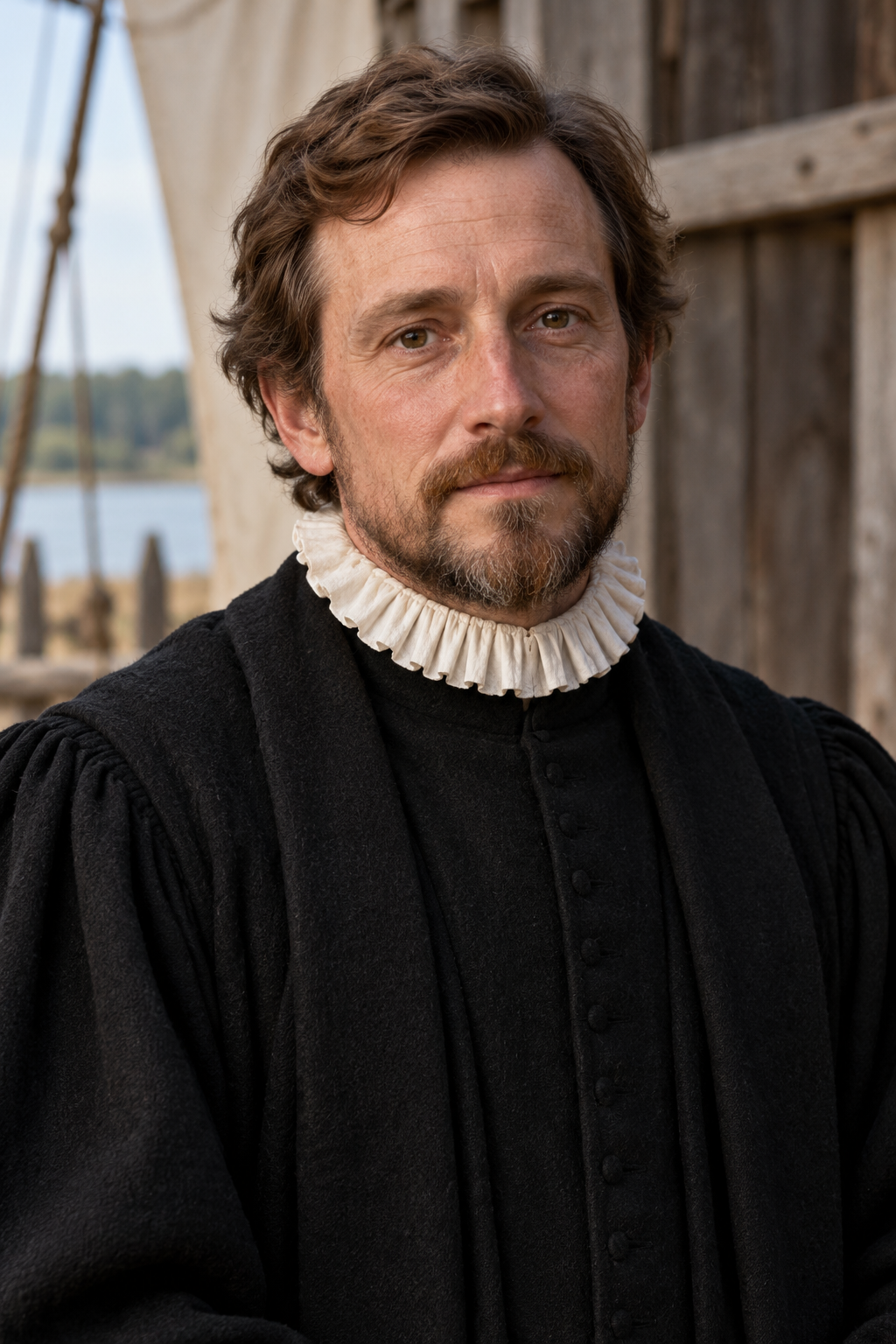
About Robert Hunt
Robert Hunt served as chaplain to the English expedition that established Jamestown, Virginia, in 1607. A Church of England priest, he led worship through the settlement’s first year, when the colonists faced illness, shortages, and disputes among their leaders. His ministry is remembered particularly for regular prayer and for attempts to bring quarrelling settlers together.
The Church of England was the colony’s official church. Hunt’s assignment included both the settlers’ spiritual care and the intended conversion of the Indigenous peoples of the region. His pastoral work therefore formed part of a colonial undertaking in which English religious authority accompanied the effort to establish a permanent settlement on Indigenous lands.
Hunt was born in England around 1568. He served parishes at Reculver in Kent and Heathfield in Sussex before going to Virginia.
Jamestown Rediscovery’s account places his birth in Hampshire in 1569 and records his education at Oxford. He married Elizabeth Edwards, and they had two children, Elizabeth and Thomas. The slight difference in reported birth years calls for an approximate date rather than unwarranted precision.
His English ministry included serious difficulties. A published transcription of the Lewes ecclesiastical court records describes a charge of sexual misconduct involving his servant. In March 1603/4, Hunt cleared that charge through seven compurgators, people supporting his oath. The same entry records separate proceedings over his absence from the parish, lack of hospitality, and appointment of an unauthorized curate. It does not give the outcome of those proceedings. These are allegations and recorded legal actions, not grounds for presenting the alleged misconduct as an established event in his life.
Edward Maria Wingfield later explained his part in choosing the expedition’s pastor. Writing in defense of his own leadership of the colony, he said that he had sought the support of the archbishop of Canterbury. He praised the minister he selected as neither Roman Catholic nor inclined to religious faction. That judgment reflects the religious boundaries of the English colonial project. Wingfield wanted a pastor who would support its established church and help prevent division among the emigrants. His account is valuable evidence of the appointment, while also being a defense of his own choices.
The voyage tested Hunt before the ships had left English waters. The narrative collected in John Smith’s Generall Historie says that adverse winds kept the expedition within sight of England for six weeks. Hunt became so ill that some doubted he would recover. Nevertheless, he remained with the expedition rather than returning home. The account credits his patience and example with calming disputes during the delay.
After arrival in Virginia, the settlers first worshipped outdoors, beneath a sail hung for shelter. Hunt led prayer, preached, and celebrated Communion while the colony worked to establish itself. A chapel eventually replaced the improvised outdoor space. Worship continued amid material insecurity, with ordinary religious routines giving structure to the community’s days.
The Generall Historie also credits Hunt with helping reconcile a dispute over John Smith’s place on the governing council. It describes Communion following that reconciliation. These recollections come from a narrative strongly favorable to Smith, and their praise should be read with that perspective in view. They nevertheless show the pastoral role Hunt was remembered as playing within a divided leadership.
An accidental fire destroyed much of the settlement in early 1608. The same narrative records that Hunt lost his books and nearly all his belongings, keeping only the clothes he wore. It remembers him accepting the loss without complaint.
Hunt died in 1608, probably in the spring. His will was proved in England that July. The surviving chronology does not establish an exact day of death.
Archaeologists later associated a grave in the chancel of the 1608 church with Hunt. The burial’s early date, the estimated age of the man, and the position of his head to the east support that identification. The remains were wrapped in a shroud rather than placed in a coffin. This is a reasoned archaeological identification, not certainty supplied by an inscription naming him.
His place in church memory also belongs to the difficult history of colonization. At the Jamestown anniversary in 2007, Episcopal leaders remembered the beginnings of their church alongside the damage done through empire and slavery. Native American ministry representatives participated in the commemorations, which included an emphasis on reconciliation. The church’s own reporting also acknowledged Anglican worship in North America before Jamestown, avoiding the claim that Hunt began all Anglican ministry on the continent.
In testimony that year supporting recognition of Virginia tribes, Jonathan Barton of the Virginia Council of Churches explicitly criticized Hunt and other early colonists for failing to recognize the full dignity of Indigenous people. This was Barton’s assessment of the colonial religious legacy. It adds a necessary counterpoint to the settlers’ accounts of Hunt’s care for their own community.
The Episcopal Church commemorates Hunt on April 26.
Wondering how to weigh the stories and sources? Learn how to read a saint biography.