Biography
Sebastian Dabovich
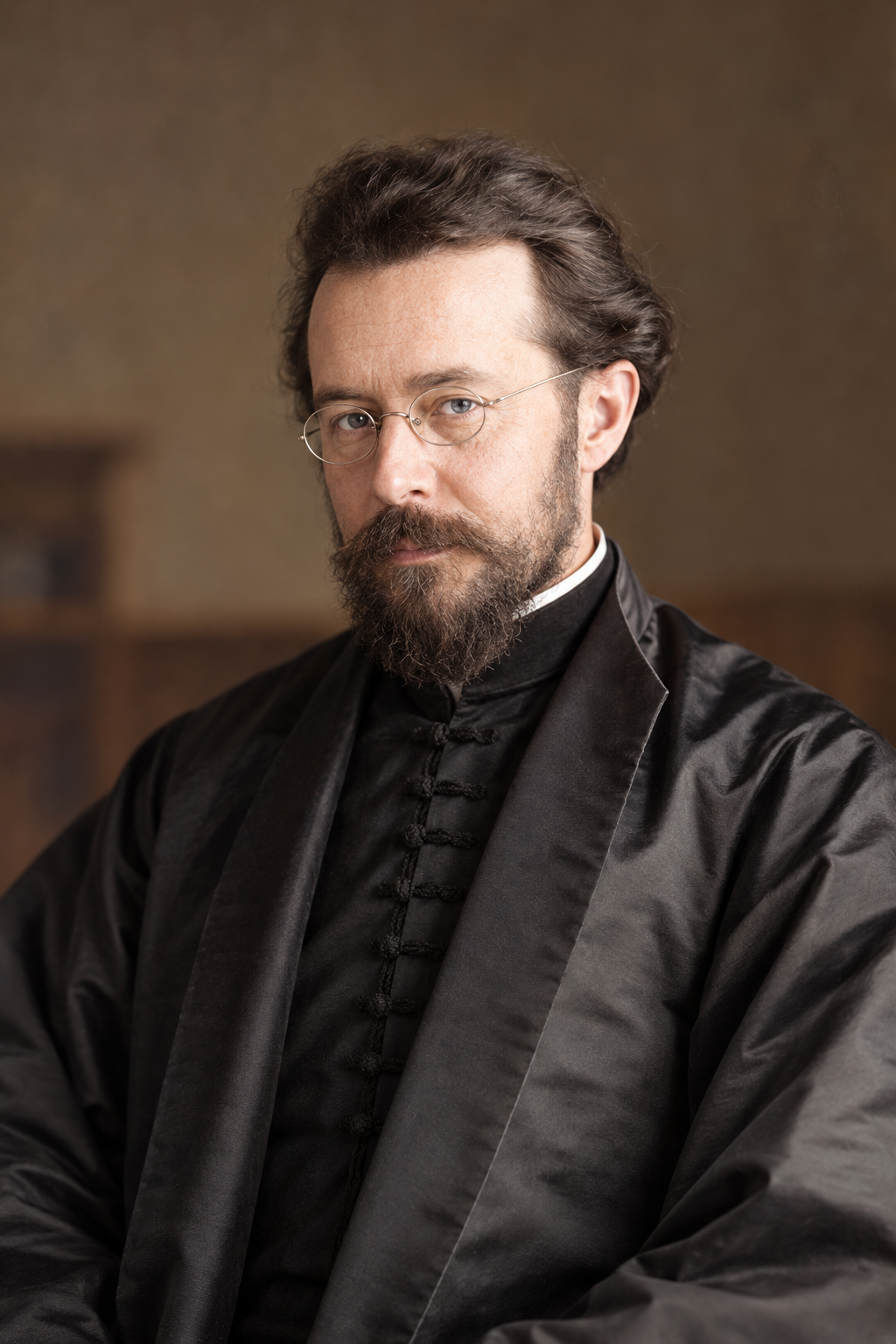
About Sebastian Dabovich
Sebastian Dabovich grew up in San Francisco as Orthodox church life was taking root there. Born Jovan in 1863 to immigrant parents, he attended the church’s mission school. He learned Russian and Church Slavonic and later worked as a reader, singer and teacher. In 1884 he continued that work in Sitka, Alaska. There he helped organize outreach by Orthodox Tlingit parishioners to other Tlingit communities. He subsequently studied theology in Russia, became a monk and returned to San Francisco.
Sebastian was ordained a priest in 1892. His western travels brought him into contact with immigrants who lived far from a parish. Historian Brigit Farley’s study, drawing on his letters, describes his efforts to establish places where these scattered communities could worship. He favored Portland as a chapel site because it could serve Orthodox people in the surrounding area, including Greek fishermen along the Columbia River. In Seattle, he found an enthusiastic group already building a church. He also identified Orthodox residents in nearby towns and in Victoria, British Columbia. These reports show his attention to the location of parishioners as well as to the construction of churches.
He served in Minneapolis the following year. His time in Minneapolis involved difficult misunderstandings. Father Edward Pehanich’s diocesan account describes a dispute over customary gifts given to priests for services. Sebastian declined these gifts, while Alexis Toth had depended on them when he lacked a salary. Parishioners interpreted the difference as evidence against Alexis. The article also reproduces Alexis’s complaint that Sebastian changed parish customs too quickly. This account preserves a colleague’s criticism alongside the later church’s recognition of Sebastian.
He later helped establish Saint Sava Church in Jackson, California.
In 1898, Sebastian published The Lives of the Saints and Several Lectures and Sermons in San Francisco with The Murdock Press. The title page identifies him as compiler and translator and describes the volume as intended for family reading and school use. His preface addresses Orthodox readers in the English-speaking world. The volume also preserves an address given before Bishop Nicholas and the congregation and parish school of Saint Sergius in San Francisco. In that address, Sebastian honored the centenary of Innocent’s birth and recalled his missionary work in Alaska. He presented himself as an American-born member of the Orthodox Church, linking his own congregation with an earlier generation of missionaries. He also defended Eastern Christianity against accusations of spiritual inactivity. The address shows how his teaching joined remembrance of Orthodox history with an argument for the Church’s continuing missionary life.
Sebastian’s teaching also reached readers through English-language books. His 1899 collection, Preaching in the Russian Church, brought together sermons and lectures. He dedicated it to parish priests and church schoolteachers in America. The preface explicitly addresses English-speaking readers, especially Americans, and presents the book as an introduction to Orthodox history, theology and moral teaching. He challenged the claim that the Russian emperor headed the Orthodox Church. To explain his position, he pointed to Orthodox communities living under several different governments and distinguished financial support from supreme religious authority. His comparison with relations between the Anglican and American Episcopal churches used a setting his audience might recognize. His argument was also sharply partisan: he praised Eastern Christianity’s spiritual inheritance while contrasting it with Western achievement in worldly affairs. The contents range from the education of children to fasting, temperance and major Christian feasts.
In 1905 he took charge of the Serbian mission based in Chicago. Church organization brought further difficulties. In 1909 he asked to leave the leadership of the Serbian mission amid disputes over Russian ecclesiastical jurisdiction. He continued serving communities after that request was granted. In 1913, he also taught at Saint Platon’s Seminary in New Jersey.
Bishop Nicholai Velimirovich later recalled meeting Sebastian in New York in 1921. According to Nicholai, Sebastian was living on voluntary donations and had very little money, yet continued planning journeys to Alaska, Japan and Europe. Nicholai also remembered the religious books, printed sermons and small crosses that Sebastian carried to distribute during visits. His recollection connects the missionary’s public teaching with these small gifts to the families he visited.
In his final years, Sebastian lived in Serbia. Nicholai recalled that he stayed at the patriarchate until 1938, then spent time at Žiča and Herceg Novi before returning to Žiča. Father Jovan Rapaich cared for him as his health declined. From the monastery, Sebastian kept in touch with American friends by letter. In one letter reproduced by Nicholai, he expressed a longing to see San Francisco again and remembered his childhood there. Nicholai described visiting him frequently and recorded his death on November 30, 1940. He also reported that the American consul general attended the burial as the ambassador’s representative.
The Serbian Orthodox Church recognized Sebastian as a saint in 2015. The OCA commemorates him on November 30.
Wondering how to weigh the stories and sources? Learn how to read a saint biography.