Biography
Simón de Rojas
About Simón de Rojas
Simón de Rojas was born in Valladolid, Castile, on 28 October 1552. He entered the local Trinitarian house as a boy and made his religious profession on his twentieth birthday in 1572. The Order of the Most Holy Trinity had a distinctive commitment to the redemption of Christian captives. Its life also required prayer, shared discipline and service close to home.
These commitments provide the setting for Rojas's later work in Madrid: his attention to people without means did not arise simply from court favor or taste for charity. It was part of a religious vocation he pursued over five decades.
After his profession, Rojas studied at Salamanca from 1573 to 1579 and was ordained a priest in 1577. He taught philosophy and theology at Toledo during the 1580s. These years were not a pause before a more public career: teaching formed the next generation of friars who would continue the order's work. The Real Academia de la Historia also records his later service as superior in several houses and as a visitor sent to examine communities in Castile and Andalusia. Repeated appointments suggest that his order relied on him for administrative judgment as well as preaching. They also meant travel and decisions affecting other members, responsibilities often hidden in short saintly biographies.
Rojas's attention to captive Christians remained connected to his order's purpose, but the accounts also place him in Madrid's prisons and hospitals. A Spanish Trinitarian study describes visits to detainees and hospitals serving older or sick residents. It also notes injured returning soldiers and families whose need was less visible. These details come through an order's retrospective account and do not establish a complete daily schedule. They indicate the people among whom he worked and help explain why his presence near the royal household could become a route to funds or protection for others.
In Madrid he helped form a lay association known as the Ave María congregation or the Slaves of the Sweet Name of Mary. A scholarly study of seventeenth-century confraternities dates its foundation to 1611 and places it among a wider network of Madrid associations. The Dicastery gives 14 April 1612 instead. Those dates may mark different stages, but the available accounts do not establish the distinction securely. What is clear is that the group drew lay people into common devotion and organized assistance to poor residents. Its historical word “slaves” described voluntary Marian belonging within this religious culture; it did not make members the property of the order.
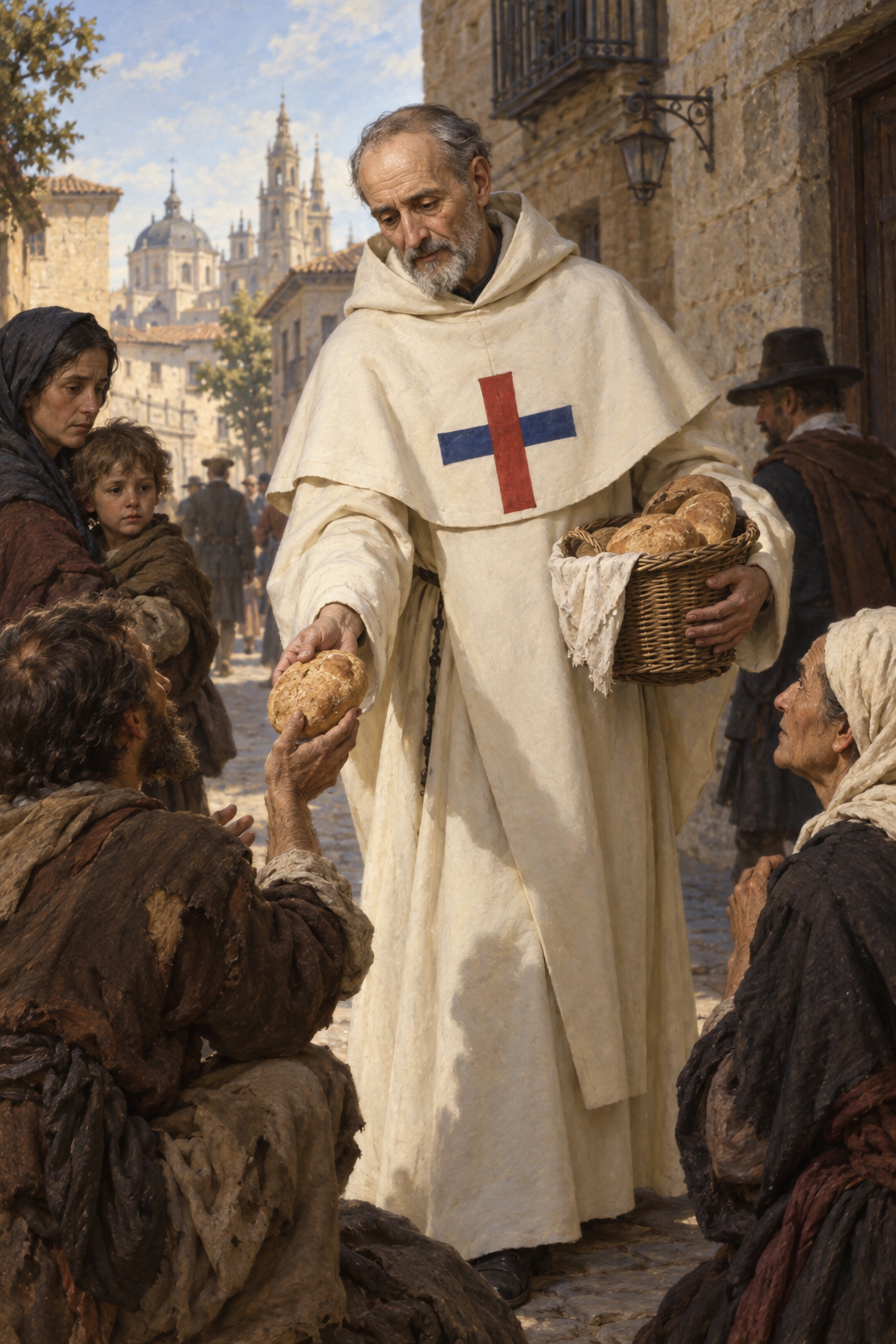
The association's work depended on many hands. A Spanish Trinitarian study cites the congregation's first agreement book for a meeting in December 1618, when Rojas urged members to direct money planned for festive lights toward feeding poor people. The account gives a specific example of how a devotional association could make a practical decision about its resources. It does not prove that Rojas alone fed everyone served by the group. The lay members contributed goods, administration and time. Remembering their role matters because the charitable institution endured beyond its founder, while the people who organized meals rarely appear by name in later devotional summaries.
Rojas also moved through the Spanish court. He was appointed to teach royal children in 1619, elected provincial of the Trinitarians in Castile in 1621 and selected as Queen Isabella of Bourbon's confessor in 1622. The Order's profile says he refused a royal carriage and did not turn these positions into a comfortable public style. Court proximity nevertheless brought influence, and it is more historically useful to ask how he used that access than to pretend he had none. Religious advisers could speak with rulers while poor people seeking help had much less direct access. Rojas's office connected the two worlds, even though the decisions of the crown were never his alone.
His Marian devotion became visible in the words “Ave Maria,” so closely associated with him that people called him Father Ave María. Spanish Trinitarians describe the greeting and the Marian lay association as mutually reinforcing practices. These belonged to Catholic Spain's public devotional life as well as to his own prayer. They gave the association a language its members could share while serving poor neighbors. Later accounts tell miraculous or intimate stories about him; such stories are better read as devotional memory unless their historical basis can be established. The verified outline is substantial without them: teaching, community leadership, court service and an organized response to poverty.
Rojas died in Madrid on 29 September 1624. The order and the lay congregation continued after him. Sources agree that Clement XIII beatified him in 1766, although official church pages differ over whether the day was in March or May. John Paul II canonized him on 3 July 1988. The Dicastery lists his liturgical memorial on 28 September, one day before the documented anniversary of his death. These later acts of recognition belong to different centuries and do not substitute for the history of the friars and lay people who sustained the work.
At the 1988 canonization, John Paul II connected Rojas's Trinitarian vocation with concern for poor and marginalized people. He said the lay congregation's members shared goods and helped people in need. The pope's words present a Catholic theological judgment about Rojas, while the underlying history is more concrete: a friar taught, governed communities, used royal access and organized others to serve neighbors. His significance lies in that combination of prayer, institutional leadership and practical care. The Ave María association also shows how a devotional movement in early modern Madrid could make room for lay people to act together, even amid a strongly ranked court society.
Wondering how to weigh the stories and sources? Learn how to read a saint biography.