Biography
Simon Thomas Gibbons
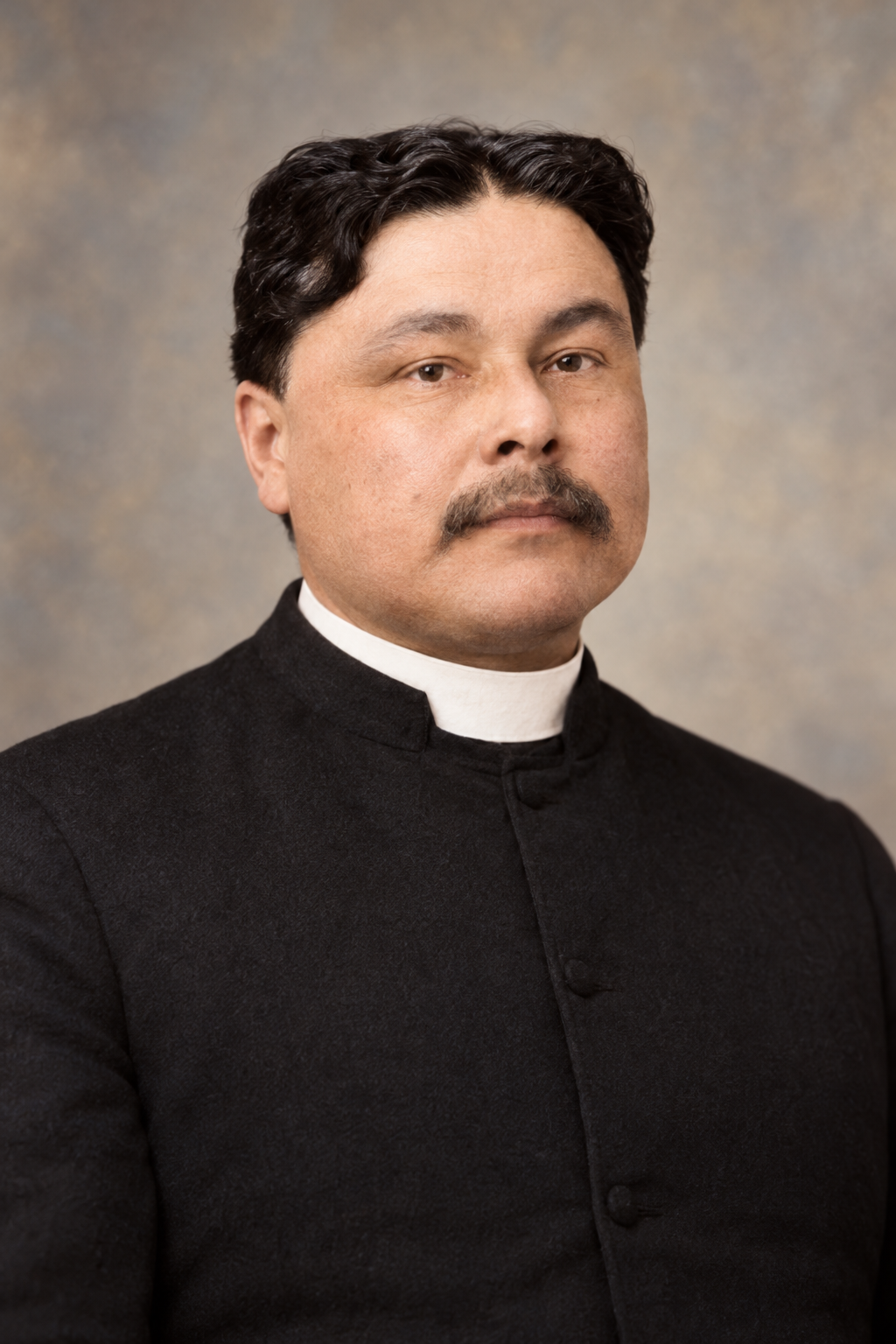
About Simon Thomas Gibbons
Simon Thomas Gibbons was an Anglican priest and church builder in eastern Canada. Probably born at Forteau in Labrador in 1851, he was the son of an Inuit mother and a fisherman named Thomas Gibbons. After his parents died, he entered the Church of England Widows and Orphans Asylum in St John’s.
The orphanage’s report for 1861, printed in a Newfoundland newspaper the following March, records Gibbons as still living there. It explains that he had already been placed under the Reverend George Poulett Harris for tuition. Harris waived his own fees and reported favourably on the boy’s progress. This is a small but concrete record of the education that became important to Gibbons’s later work. It is also an account written by the institution’s committee for its readers and supporters. Its praise should be understood in that setting, without assuming that it describes every part of his experience as a child.
The following annual report records another change. In December 1862, Mrs. Mountain took Simon from the asylum into her care. He continued, as before, attending the Church of England Academy, where Harris still taught him without charging his own fees. The report distinguishes this arrangement from those of children who had been apprenticed or placed with relatives. It does not describe a legal adoption. What it does establish is continuity in his schooling while his place of residence and daily care changed.
Before ordination, Gibbons had already served people facing bereavement. A published transcription of the Anglican burial register for the Tilt Cove mission names him as a lay reader in entries from 1872 to 1875. These include the burials of Thomas Watkins and Albert Heath in 1872 and Elisabeth Foster in 1875. The entries offer specific evidence of work that can otherwise disappear behind accounts of his later travels. Paul and Judy Gill, who transcribed the registers, warned that some pages had suffered fire damage and that handwriting was difficult to decipher. Their transcription is useful evidence, while the original entries still require checking.
Gibbons later moved to Clarenceville in Quebec and studied at King’s College in Windsor, Nova Scotia. Ordained deacon in 1877 and priest in 1878, he married Frances Eliza DuVernet in 1878.
His ministry took him to Victoria County in Cape Breton, then Lockeport and Parrsboro. Journeys to Britain raised money for churches. At Parrsboro, he also worked alongside the carpenters.
A personal encounter survives in Margaret Warner Morley’s travel book. She met Gibbons at Parrsboro while planning a journey through Cape Breton. He recommended the northern coast, mapped a route, and advised the travellers where and with whom to stay. Morley remembered both his humour and his sympathetic way of speaking about the people he had served. This practical help gives a more immediate view of him than the many dramatic stories later told about his journeys. Morley also recorded what people in Baddeck told her about his exhausting rounds. Those passages are valuable evidence of his local reputation, but they differ from the meeting she witnessed herself. Her admiration was strong, and her account includes racial generalizations that should not be repeated as neutral descriptions.
The churches provide another kind of evidence. St Peter’s and St John’s at Baddeck, built in 1883, is attributed to Gibbons in the Canadian Register of Historic Places. Its wooden construction, board-and-batten exterior, pointed windows, buttresses, and distinctive tower roof show how Gothic forms could be adapted to a modest building. The register connects its design with the ideals of the Ecclesiological Society, while treating Gibbons’s possible visit to Cambridge as uncertain. That distinction matters: a resemblance in architectural style does not establish every detail of the designer’s travels. The church remains a material record of the building work for which he raised support.
Architectural historian Peter Coffman placed Gibbons’s buildings within a wider change in Anglican church design. A report of his lecture, published by the Heritage Trust of Nova Scotia in 2009, describes the Cambridge Camden Society’s preference for visible structural divisions, open timber ceilings, deep chancels, and pointed windows. Coffman interpreted Gibbons’s towers at Baddeck and Jordan Falls as variations within this Gothic vocabulary, drawing comparisons with St Mary’s at Sompting in England. His discussion shows how a provincial wooden church could combine different architectural traditions. At Jordan Falls, he emphasized the translation of these forms into local shingle construction. This is a later architectural reading of the buildings, rather than Gibbons’s own surviving explanation of his designs.
Gibbons’s health declined, and he died at Parrsboro in December 1896.
His work has continued to interest people who care for Nova Scotia’s church buildings. In a 2026 interview, photographer Michael G. Winters described visiting churches associated with him at Baddeck and Jordan Falls, and admiring St Mark’s at Moose River. Winters also recalled the demolished church at Diligent River and visits to Gibbons’s grave in the cemetery at Parrsboro. His account describes a legacy that includes surviving buildings, lost places, and personal acts of remembrance. Gibbons is remembered through the communities he served and the buildings that preserve part of their religious history.
Wondering how to weigh the stories and sources? Learn how to read a saint biography.