Biography
Solanus Casey
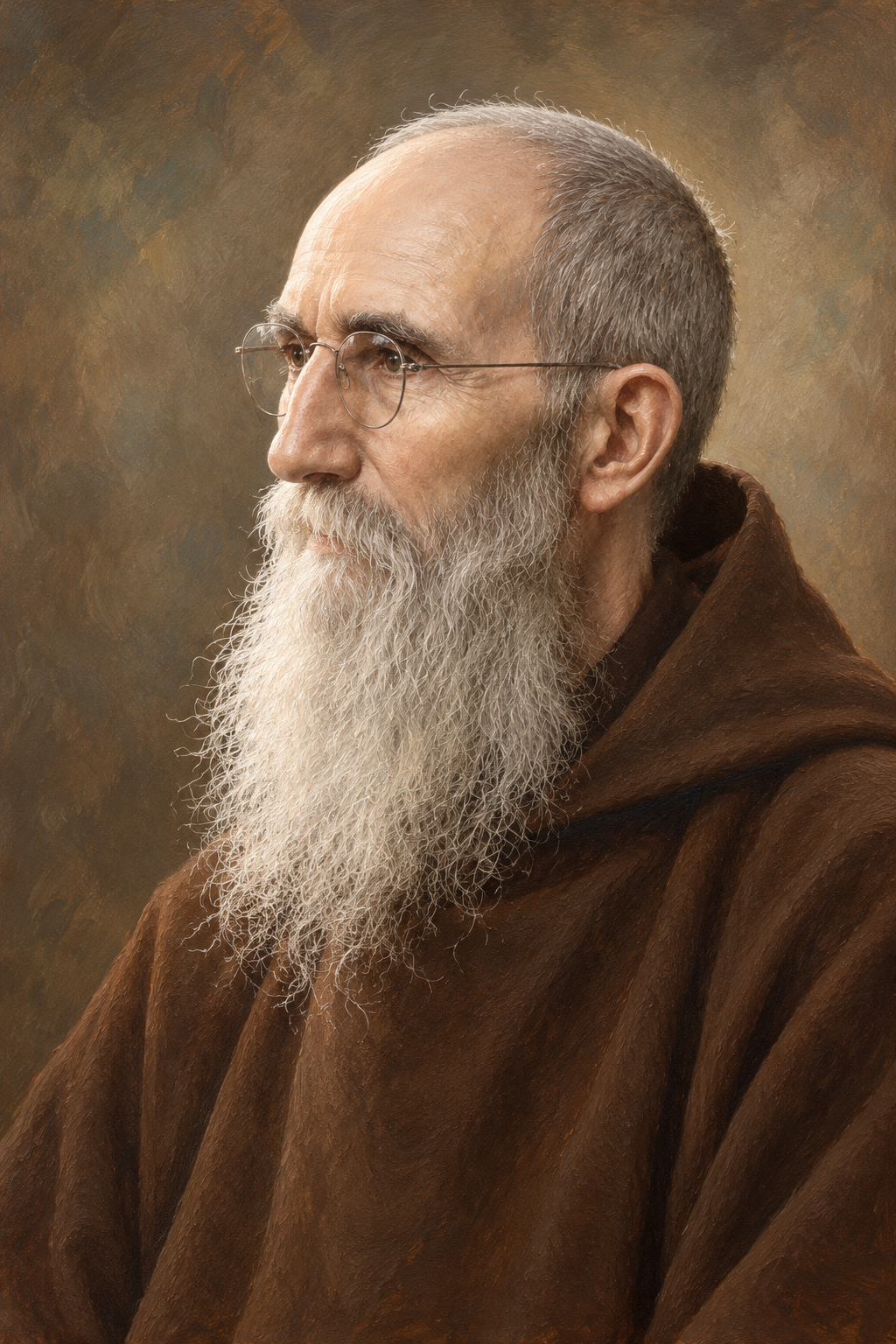
About Solanus Casey
Solanus Casey was born in 1870 into an Irish immigrant family at Oak Grove, Wisconsin.
Before entering religious life, he worked as a logger, hospital orderly, streetcar operator and prison guard. He studied for the diocesan priesthood at Milwaukee before joining the Capuchins in 1897. His religious name recalled Francis Solano, the earlier Franciscan missionary.
A surviving letter gives a practical glimpse of that transition. Writing to Bonaventure Frey in August 1896, Casey asked what books and clothes to bring, when studies began, and how to handle his unpaid seminary bill. The debt he named was $525, and he asked what to do if he could not pay it in cash. In February 1904 he wrote to his sister Ella, who was living far from a church. He recalled their parents’ earlier hardships, encouraged prayer at home, and suggested including neighbors even if they were not Catholic. He also asked to be remembered in prayer while awaiting the decision about his ordination.
His seminary studies proved difficult, partly because instruction was in German rather than his native English. As a simplex priest, he could celebrate Mass; his faculties excluded confession and doctrinal preaching. Those restrictions shaped his assignments, which often included welcoming visitors at the friary door. People increasingly sought him out for spiritual guidance.
Ordained in 1904, he served in New York before returning to Detroit in 1924. At Saint Bonaventure Monastery he became known for his work as porter.
His New York assignments brought him to Yonkers, Manhattan’s Lower East Side and Harlem. Alongside answering the door, he served as a sacristan and celebrated Mass. The encyclopedia contributor R. J. Armstrong describes a further responsibility that developed in Harlem: at his provincial minister’s direction, Casey began recording favors associated with enrollment in the Seraphic Mass Association. These were religious accounts of help received, rather than independent medical assessments. His advice linked requests for prayer with support for the missions and gratitude to God.
His correspondence also records the ordinary details of care. In an August 1927 letter to Mable Courtney at Grace Hospital, Casey explained that rain and a dental appointment had prevented a visit. Writing late that evening, he welcomed reports of her improvement and hoped she could return to work. He acknowledged that her knee might remain impaired, while expressing hope and trust in God. The letter closes with concern for her nurses and friends as well as Courtney herself.
That ministry brought him into daily contact with people who needed food as well as someone to listen. The Capuchin Soup Kitchen’s history describes Casey and Brother Francis Spruck distributing sandwiches at the monastery. As demand increased, they asked the guardian, Ulrich Danner, for help. Danner enlisted Herman Buss, who worked with lay Franciscans to organize a soup kitchen. Ray McDonough gathered donations and helped sustain its operations for many years. The institution began in 1929 and explicitly remembers its foundation as a shared undertaking.
Declining health eventually prompted another move. In 1945 he was sent to Saint Michael’s Friary in Brooklyn and later to the Capuchin novitiate at Huntington. He returned to Detroit in 1956, near the end of his life.
The center that bears his name remembers his willingness to listen to people from different religious backgrounds, including those without a church affiliation.
He died on July 31, 1957.
After his death, the effort to preserve his memory developed into a sustained investigation. The Father Solanus Guild’s institutional history records a report sent to Capuchin superiors in Rome in 1958 and the organization of the Guild in 1960. Paschal Siler subsequently gathered accounts from people who had known Casey, and Leo Wollenweber continued that work. A request for Casey’s writings led to their assembly in four typed volumes by 1980. The Guild dates the formal diocesan investigation to 1983 and says that priests, religious and laypeople gave sworn testimony. That testimony was submitted to Rome the following year. The process preserved both his own words and the recollections of others; the retrospective testimony should be distinguished from his contemporary letters.
In May 2017, Pope Francis authorized a decree recognizing a miracle attributed to his intercession. That decree concerned the cause leading toward beatification; it was not the beatification ceremony.
The beatification followed on November 18, 2017, at Ford Field in Detroit.
Edward Foley, a Capuchin involved in planning the ceremony, describes efforts to make it reflect Casey’s welcome to people at society’s margins. The participants included people served by the soup kitchen, and prayers were offered in several languages. The musical program emphasized participation: short refrains helped the congregation join in, and sign-language interpreters appeared on the stadium screens. The planners also chose a simple portrait without a halo, seeking to present Casey as a person whose holiness belonged within ordinary human life. This remembrance connected Casey’s quiet work at the monastery door with the community’s continuing commitment to hospitality.
Wondering how to weigh the stories and sources? Learn how to read a saint biography.