Biography
Sophrony of Essex
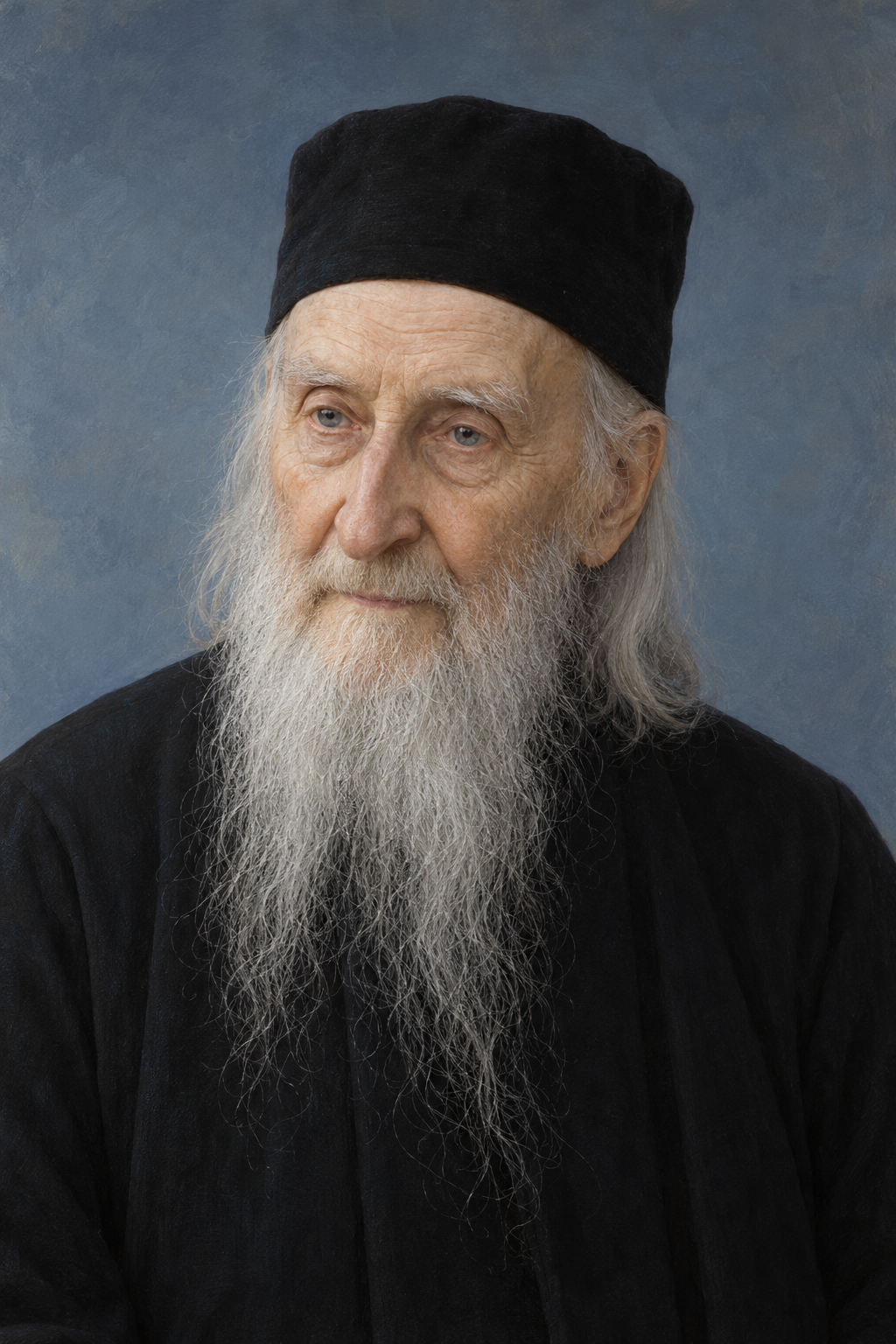
About Sophrony of Essex
Sophrony of Essex was born in Moscow in 1896. He became an Athonite monk, a priest, and a spiritual writer, preserving the writings of his teacher Silouan while developing a ministry of his own. His later recollections kept his family close. The foreword to his family letters describes the affection with which he remembered his father, mother, and nurse. His nurse took him to church as a child and helped form his early habits of prayer. Before he left Russia, his mother gave him a small cross; he kept it throughout his monastic life.
As a young man, he trained as an artist. His family encouraged that interest, and evening classes gave him a grounding in drawing and painting. He studied in Moscow with Konchalovsky and was also attracted to Kandinsky’s abstraction. After experimenting with abstract work, he concentrated on portraits. In the early 1920s he travelled through Italy and Berlin before settling in Paris, where his paintings entered major exhibitions. The catalogue of his work records appearances at the Salon d’Automne in 1923 and the Salon des Tuileries in 1924.
After a brief period of theological study in Paris, he entered Saint Panteleimon’s monastery on Mount Athos. There he became close to Silouan. Following Silouan’s death in 1938, he received permission to withdraw to the solitude of Karoulia. Priesthood did not end that solitary vocation, but brought responsibilities toward other monks. He served as a spiritual father at Saint Paul’s and other monasteries, as well as to hermits. Poor health and difficult living conditions complicated his effort to prepare Silouan’s manuscripts for publication.
Ordained a priest in 1941, he served as a spiritual father to monks and hermits. In 1947 he returned to France to prepare Silouan’s writings for publication. Disciples gathered around him and asked him to establish a monastery.
His letters show another side of that work. Writing to his sister Maria in 1958, he welcomed news from home and reassured her that her letters were a comfort. He described becoming an author as something unexpected, rather than a planned career. He had become so accustomed to his typewriter that it now helped his thoughts flow more easily than handwriting. In the same letter, he reflected on the privilege of having time for prayer while many people struggled to meet their material needs. His correspondence joined spiritual concerns to ordinary affection and conversation.
English friends helped find a property, and in March 1959 he arrived at Tolleshunt Knights in Essex with a small community.
The Essex foundation brought men and women into one monastic community. Its first six members included four men and two women, who settled in the old rectory because the property needed repairs. The community’s varied languages also shaped its worship. Alongside the Divine Liturgy, it gave a central place to the repeated Jesus Prayer. Giorda and Cozma’s study explains the practical importance of this arrangement: conducting every service in a single language would have excluded some members and visitors from full participation. The monastery therefore adapted an Athonite practice to a small community with several linguistic backgrounds.
At the monastery, he received people for confession and spiritual guidance. He also returned to painting, making icons and frescoes for its churches. The community remembers his attention to each visitor as a distinct person.
Painting remained part of his service. For the 1952 printed edition of Silouan’s writings, he designed decorative printing blocks. In France, he painted icons for a youth camp’s temporary chapel and for a priest who was returning to Russia. At Essex, his work became part of the monastery’s developing spaces of worship. One icon of the Mother of God existed before the chapel for which it was eventually used; the chapel’s icon screen was made to accommodate it.
Theologian Georges Mantzarides identifies the person as a central concern in Sophrony’s teaching. In this interpretation, a person becomes more fully themselves through love and relationship, rather than through isolation or opposition to others. Prayer for the whole world expresses that concern beyond the boundaries of an individual life. This is an account of Sophrony’s theology, not a claim that his religious experiences can be independently verified. His books helped carry such teaching beyond the monastery and the people who could visit him there.
He died on July 11, 1993. The Ecumenical Patriarchate recognized him as a saint in 2019. His monastery celebrates his feast on July 11.
A church bearing his name was consecrated at the monastery in June 2025. In his address, Patriarch Bartholomew recalled Sophrony’s plans for a larger church to accommodate the growing community and its visitors. Sophrony had imagined a circular building and prepared a paper model. The eventual dedication honored the monk who had conceived it. The patriarch connected the new church with the monastery’s continuing life of worship and hospitality.
Wondering how to weigh the stories and sources? Learn how to read a saint biography.