Biography
Stanisław Kazimierczyk
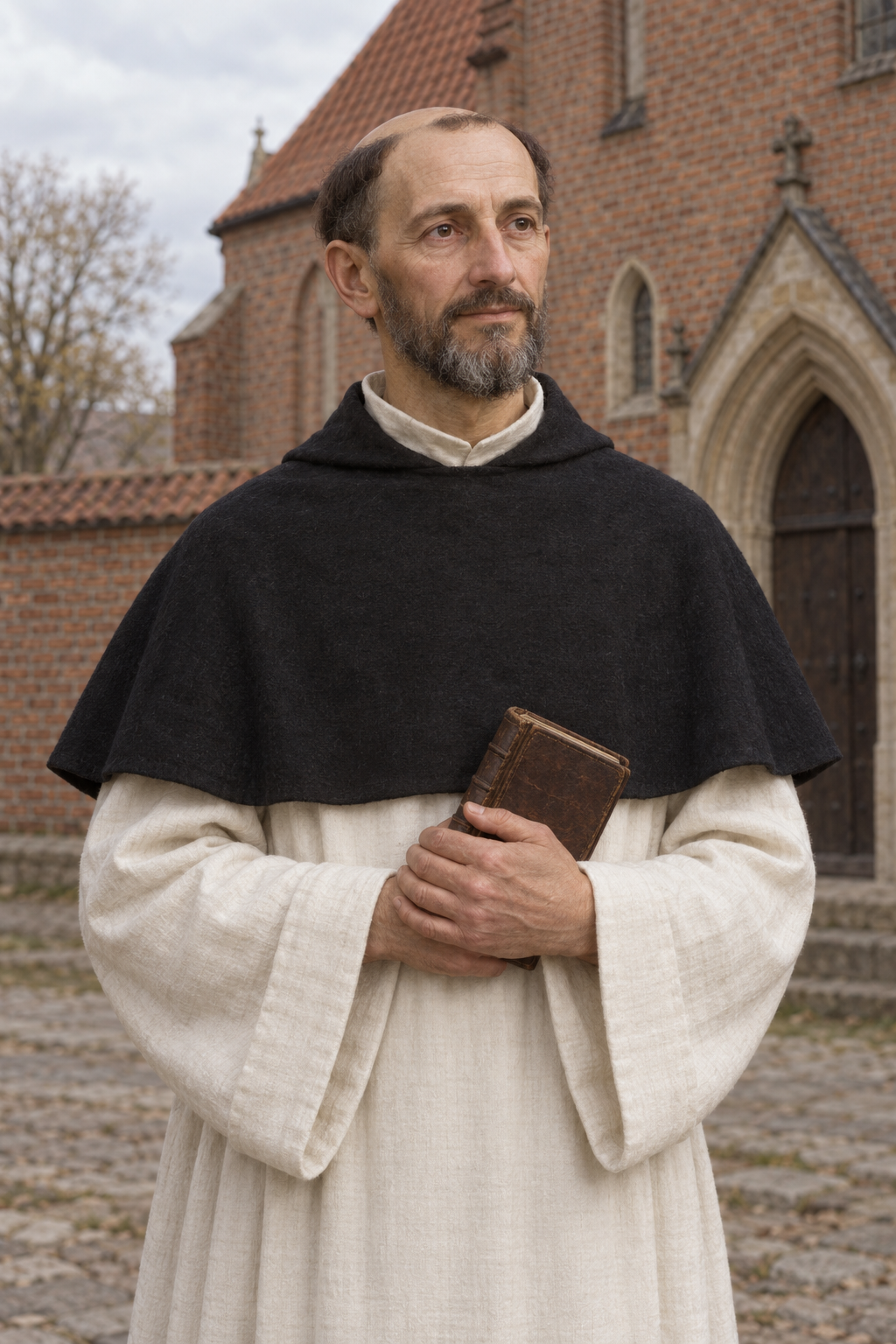
About Stanisław Kazimierczyk
Stanisław Kazimierczyk spent his life close to the church of Corpus Christi in Kazimierz, now part of Kraków. The birth date, September 27, 1433, comes from later biography rather than a contemporary record. Historian Stefan Ryłko considers the year probable but explains that the precise day may reflect the feast of Stanisław’s namesake. Claims that he earned advanced degrees in arts and theology are likewise unsubstantiated. A bachelor’s degree in arts is better supported. These distinctions leave a learned religious without giving him an academic career the evidence cannot establish.
A surviving municipal record gives a more direct glimpse of his responsibilities. On March 15, 1483, it identifies him as a confessor representing his religious superior in an inheritance matter. The entry places the devotional figure within the everyday legal business of his community.
He joined the Canons Regular associated with the church he had known since childhood. Their common life became the setting for his work as a priest, preacher and teacher of younger religious. The biography recalls that he began each day with Mass. The Vatican’s canonization biography emphasizes the care he gave to preparing sermons and hearing confessions. It also remembers the poor who came to the community’s gate. His service included both the people learning religious life within the house and those seeking help from outside it.
The same biography describes a reputation for holiness that continued after his death on May 3, 1489. Devotion gathered around his burial in Corpus Christi. In 1632 a special altar was built to hold his relics. The canons began formal efforts toward recognition in 1773, but Poland’s partitions, later wars and communist rule complicated their progress.
His memory also took shape through art. Janina Dzik’s study shows how seventeenth-century patrons developed images of his life and intercession. Marcin Kłoczyński, superior of the Corpus Christi community, commissioned works during a renewed effort to promote devotion. Paintings associated with Łukasz Porębski helped give visible form to that effort. Such pictures preserve the community’s later understanding of its holy predecessor. They are evidence of remembrance and religious aspiration, rather than portraits made from life or independent confirmation of every scene they depict.
Stanisław also appears among the holy figures associated with Kraków’s fifteenth-century religious flowering. Later tradition brought him together with John of Kęty, Simon of Lipnica and others in a remembered fellowship. Dzik traces changes in the grouping: an earlier manuscript named four figures, while later accounts added others. The familiar company therefore developed over time. Its devotional images express a shared ideal of holiness in the city. They do not establish that all the figures met regularly or formed a formally organized circle during their lives. Studying these changes helps distinguish the city’s later devotional identity from the relationships that can be established for a fifteenth-century priest.
At his beatification on April 18, 1993, John Paul II placed Stanisław within that flowering of religious life. He described a priest whose work embraced teaching, spiritual guidance and care for people in poverty. The pope also offered a personal recollection. During his years as archbishop of Kraków, he had repeatedly led prayers before Stanisław’s relics. This testimony connects the formal recognition with a devotion still practiced at Corpus Christi. The ceremony publicly confirmed a cult that local people had continued to express through prayer at the tomb. It joined an old community’s memory to a wider celebration of the Church. John Paul’s recollection shows that local prayer continued before the formal ceremony, rather than beginning with it.
Benedict XVI canonized him on October 17, 2010. His homily returned to the Eucharist as the center of Stanisław’s religious life. At Corpus Christi he had learned faith with his parents, made his religious profession and served as priest and educator. Benedict connected participation in the Mass with love of Christ and practical love of other people. In this reading of his life, Communion nourished care for neighbors rather than remaining an isolated act of devotion. The saint’s work among the needy belonged to the same commitment as his worship and teaching. The pope presented these connected responsibilities as an example for later Christians.
That connection remains visible in his local patronage. The extraordinary ministers of Holy Communion of the Archdiocese of Kraków have chosen him as their patron. At the May 5 celebration reported in 2021, they came to his tomb to pray for themselves, their families, their parish communities and the sick people to whom they bring Communion. Bishop Jan Zając recalled the beatification and canonization homilies, emphasizing attention to people who are ill. The celebration brought canons and lay ministers together around the same work of carrying faith into daily life. Stanisław’s memory continues in the church where he served, and in the ministry of people who take Communion beyond its doors to those unable to come themselves.
Wondering how to weigh the stories and sources? Learn how to read a saint biography.