Biography
Stanislaus Papczyński
About Stanislaus Papczyński
Stanislaus Papczynski was born Jan Papczynski on May 18, 1631, at Podegrodzie near Stary Sacz in Poland. The Holy See biography says he was baptized the same day.
He studied locally and then with Jesuits and Piarists. This educational path prepared him for preaching, teaching, and religious leadership. The page should not rush directly to the foundation before showing the disciplines that formed him.
His early studies also show why rhetoric and preaching became important later. The public page can mention learning and teaching without turning the biography into an academic profile. Formation served pastoral work.
At age twenty-three he entered the Piarists. He professed simple vows in 1656 and was ordained priest on March 12, 1661. In the Piarists he taught rhetoric and became known as preacher and confessor.
Those Piarist years deserve more than a passing reference. They gave him a real religious home before his later foundation. The final profile should not imply that founding the Marians erased or discredited the earlier vocation.
In 1670 Stanislaus left the Piarists with the necessary dispensations. The final page should state this carefully, avoiding hints of scandal not supported by the reviewed sources. It was a juridical and vocational transition.
This is also where source restraint matters. Unless final evidence supports more detail, the page should say he left with dispensations and then founded a new institute. It should not infer motives beyond the reviewed biographies.
He founded the Marians of the Immaculate Conception. The institute emphasized Marian devotion, prayer for the dead, and ministry to poor and marginalized people. This charism should be written precisely, not inflated into unsourced modern patronage claims.
Prayer for the dead is a distinctive element and should not be lost in generic Marian language. It connects the institute's devotion with mercy toward those who could no longer ask for help themselves.
The first Marian house received ecclesiastical approval on October 24, 1673. That date belongs in the biography because it shows the foundation taking visible ecclesial form, not remaining only a personal aspiration.
The page can also mention that the house approval gave the work stability. It does not need to claim institutional success in modern terms. The verified chronology is strong enough.
The second house at New Jerusalem, now Gora Kalwaria, became his residence. The existing catalog death place is detailed, and this deferred draft preserves it exactly in the importer test.
This place field is one of the richer in the current batch. The biography should help readers understand that New Jerusalem and Gora Kalwaria refer to the same later setting without changing the structured field before approval.
The public page may mention that later writers describe the Marians as an early or first Polish-founded order only if final sources support exact wording. This draft avoids that claim and relies on the safer foundation chronology.
Stanislaus died at the Cenacle of the Lord monastery in New Jerusalem on September 17, 1701. The Dicastery records his beatification in 2007 and canonization on June 5, 2016, with September 17 as his memorial.
His witness is best framed as priest, teacher, preacher, founder, and servant of Marian devotion joined to prayer for the dead and care for people in need. The final page should keep theology modest and exact.
The devotional application can be simple: remember the dead, serve the poor, and let Marian devotion lead to mercy rather than display. This keeps the page pastoral without making broad historical claims.
The final biography should also keep Stanislaus's priesthood visible. He was not only an institutional founder; he taught, preached, heard confessions, and guided people before and during the Marian foundation. Those ministries make the founder intelligible.
The title Stanislaus of Jesus and Mary can be used in prose to explain the religious name, but the public display name can remain the catalog's Stanislaus Papczynski. That keeps identity clear for search while still honoring the religious form of his life.
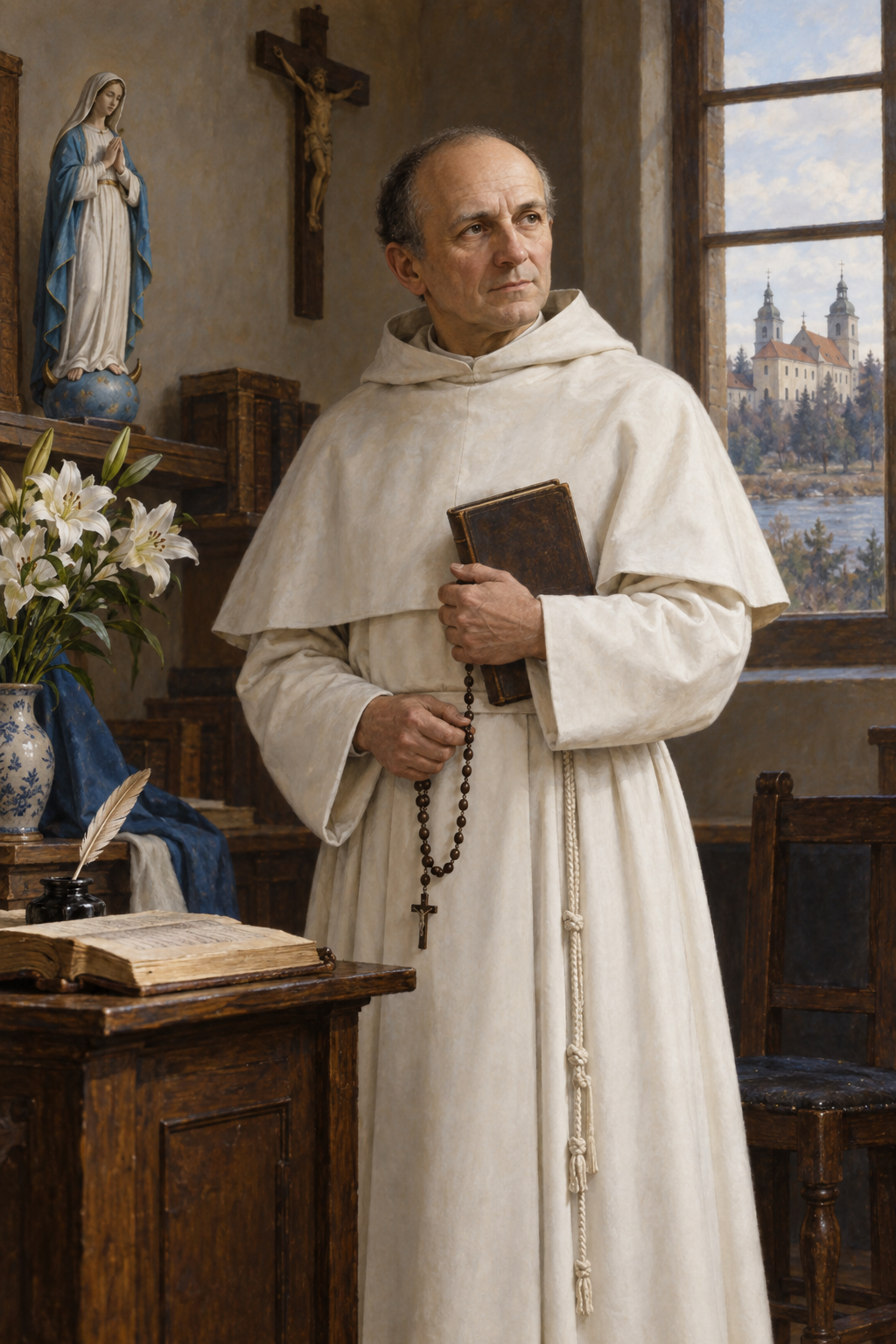
Because Marian imagery can easily become visually loud, the art should be restrained: white habit, rule book, rosary, lilies, and a modest image rather than spectacle. This visual restraint matches the prose's theological restraint.
His canonization in 2016 can close the historical arc, but the page should not let modern recognition overshadow the seventeenth-century life. The center is a priest-founder whose Marian devotion took shape in prayer for the dead and practical mercy.
For reviewers, the main unresolved question is not the basic biography but the temptation to add attractive claims. Leave "first Polish order" and broad patronage language out unless final sources support exact wording.
Artwork should show a Polish founder in a white Marian habit with rule book, rosary, lilies, and a restrained Marian image in a monastery study or chapel. Avoid exaggerated Marian spectacle, rendered text, logos, halos, modern props, and exact-likeness claims.
Wondering how to weigh the stories and sources? Learn how to read a saint biography.