Biography
Stephen I of Hungary
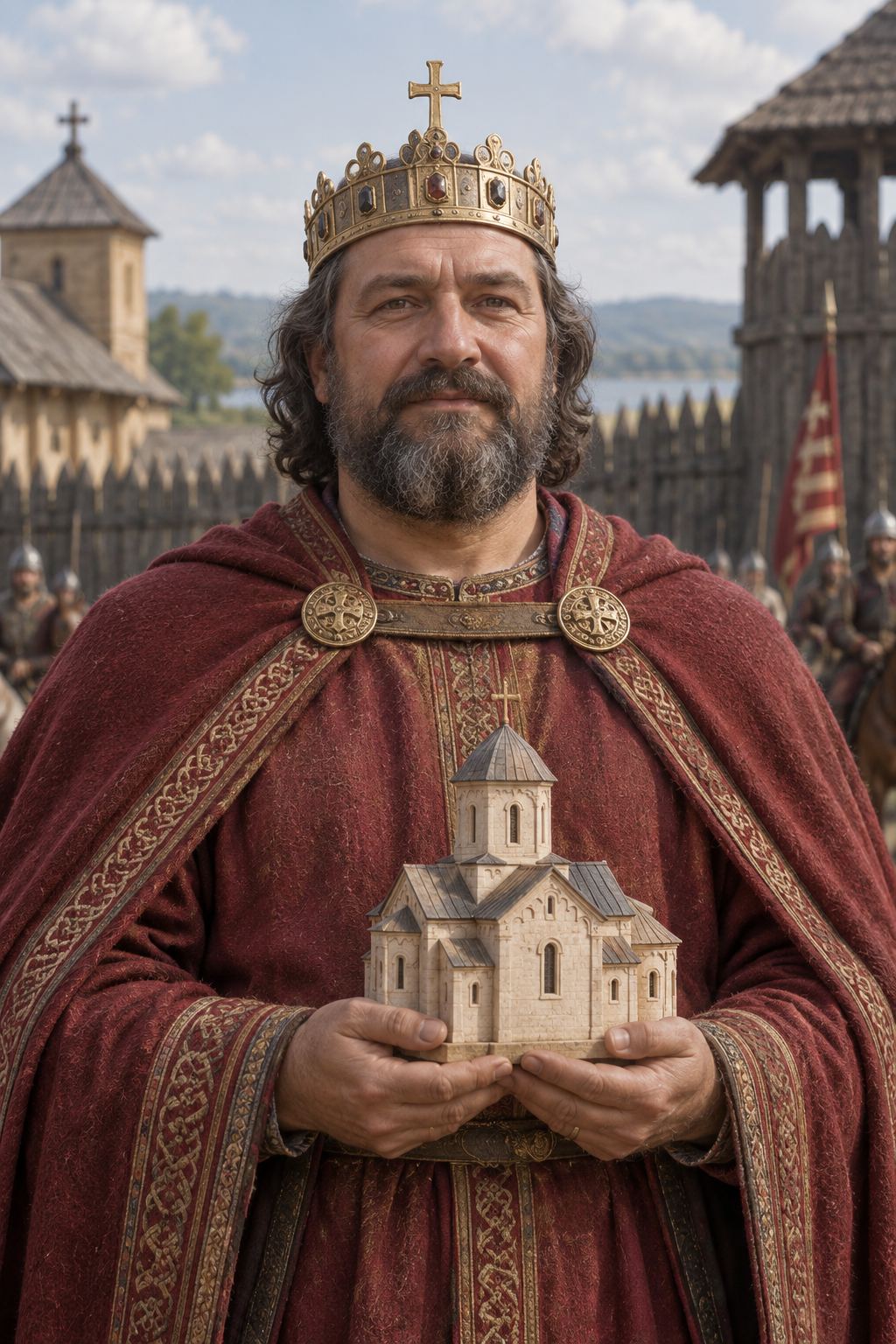
About Stephen I of Hungary
Stephen became Hungary's first king at the turn of the eleventh century, bringing the Árpád dynasty into the world of Christian monarchy. He had succeeded his father Géza as prince in 997, but succession was contested. Koppány challenged his rule, and Stephen defeated him in a violent struggle. The new kingdom was not created by a peaceful announcement or by baptism alone. It emerged through a struggle over who could command people and territory, with rival claims to authority within the ruling family.
His birth is commonly placed around 975, although the year is uncertain. In Hungarian he is known as István. The distinction between becoming prince and becoming king matters: his government began before the coronation that gave his rule its royal form.
Even the coronation's precise circumstances remain debated. The Hungarian Research Institute's account gives dates around the end of 1000 or beginning of 1001 and records uncertainty over whether the ceremony took place at Esztergom or Székesfehérvár. Stephen later fought to extend royal control over other regional powers. These conflicts cannot all be reduced to Christians fighting pagans: some of his opponents had Christian connections of their own.
The Church's expansion required buildings, clergy and material support. Stephen required groups of ten villages to provide a church and enforced the observance of Sunday. He endowed religious institutions and protected their property. Royal law thus helped make Christian worship a regular part of local life, but its requirements also carried penalties. The process involved compulsion as well as teaching and patronage. His support for Christianity should not be retold as though every subject freely welcomed every measure.
Pannonhalma illustrates how royal support worked. The monastery had been begun by Géza, and Stephen continued his father's undertaking. The abbey's historical account connects its resources with tribute from Somogy after Stephen's victory over Koppány. It also describes privileges protecting the community's independence and its choice of abbot. The surviving charter is not a simple untouched original: the archive explains that a later copyist expanded the text. Its evidence must therefore be read with attention to the monastery's later interests, even while it preserves the memory of Stephen's substantial support.
The monastery became a place of education as well as worship. Its history identifies Maurus, later bishop of Pécs, as a child educated within the community who subsequently became monk and abbot. Stephen appointed him to the bishopric in 1036. This is one concrete connection between the monastic communities supported by the crown and the personnel of the developing Church.
Stephen's family also belonged to this religious and political project. His wife was Gisela. Their son Emeric was prepared as heir, with Gerard, the future bishop of Csanád, involved in his education. An instructional work was commissioned for the young prince. John Paul II's account of the family emphasizes both the parents' responsibility and the practical formation of a future ruler. Emeric died before his father, so the intended succession did not take place.
The Admonitions associated with Stephen set out duties rather than merely celebrating royal power. The text urges the heir to protect the young Church and to show care beyond his own relatives and powerful supporters. Foreigners and people suffering violence are also placed within the ruler's responsibility. It calls for patience toward the weak, moderation in punishment and humility in prosperity. These are instructions for conduct, not proof that every act of Stephen's government met their standard. The work is transmitted in his name; the Catholic biographical account acknowledges that it may have been composed by someone close to him.
A surviving textile gives his patronage a more tangible form. In 1031 Stephen and Gisela donated a richly decorated chasuble to the Basilica of Our Lady at Székesfehérvár. The vestment later became part of Hungary's coronation regalia. The Hungarian National Museum describes it as a fragile object preserved with exceptional care. Its association with Stephen therefore begins with a gift for worship, before its later use in ceremonies of kingship.
Stephen died on 15 August 1038 and was buried at Székesfehérvár. His son had died in 1031, leaving no direct heir. The loss made the question of succession urgent rather than resolving it through the ideal father-and-son relationship described in the Admonitions.
Later images show Stephen offering the kingdom to Mary, a devotional scene that John Paul II invoked when encouraging Hungarians to renew that dedication.
His religious memory eventually extended beyond the Latin Church. Pannonhalma's archive records that Patriarch Bartholomew publicly recognized Stephen's veneration in the Eastern Church in 2000. During a later visit to the archive, the patriarch read the king's Latin monogram on the abbey's charter. The encounter brought together a surviving witness to royal patronage and a modern act of Christian remembrance. It belongs to the history of Stephen's reception, many centuries after his life.
Wondering how to weigh the stories and sources? Learn how to read a saint biography.
Explore similar vocations
Prayers for Stephen I of Hungary
Stephen of Hungary — Latin collect
Concede, quaesumus, Ecclesiae tuae, omnipotens Deus, ut beatum Stephanum, quem regnantem in terris propagatorem habuit, propugnatorem habere mereatur gloriosum in caelis.