Biography
Stephen of Jerusalem
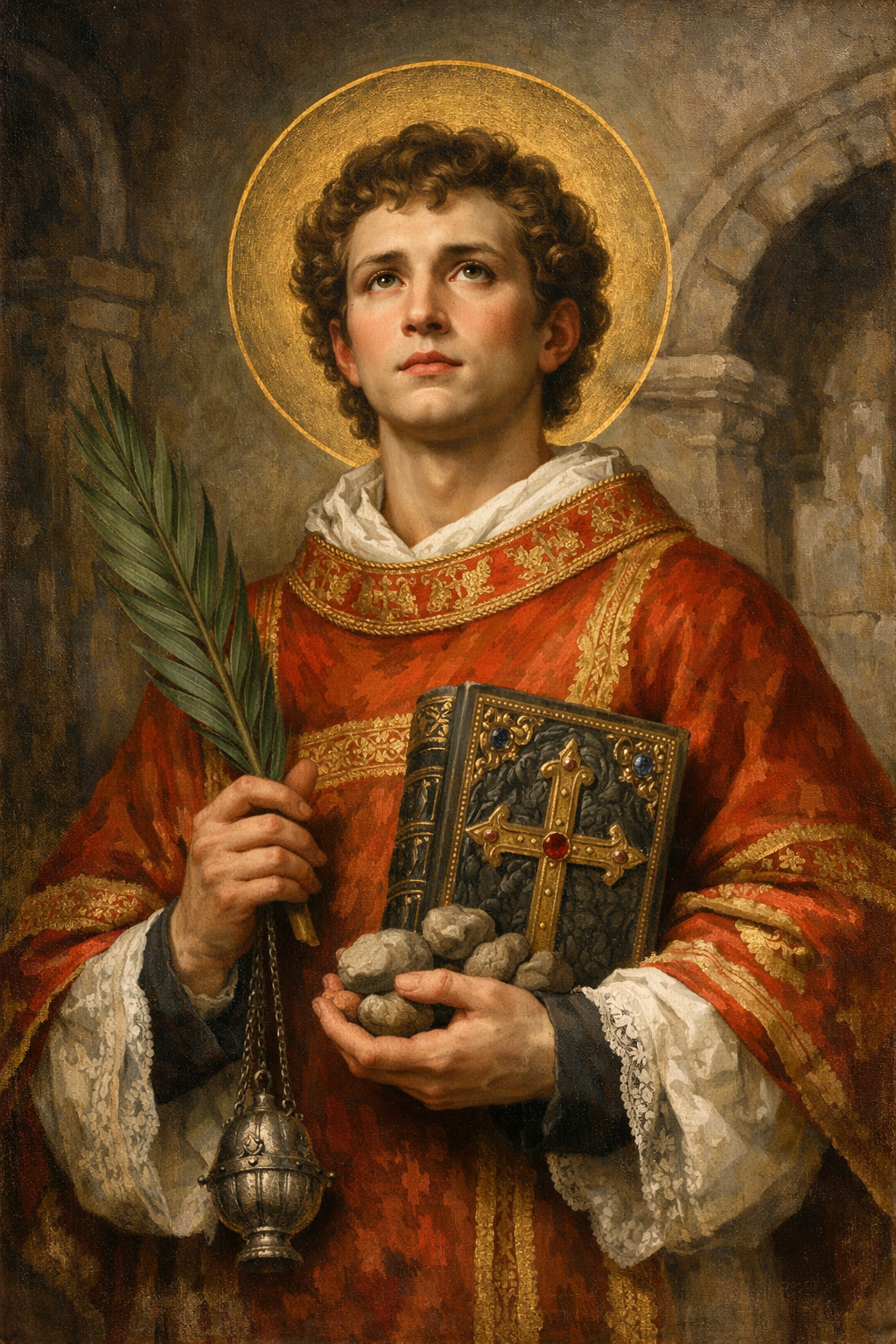
About Stephen of Jerusalem
Stephen is the prominent member of a group of seven introduced in Acts 6 within the first Christian community at Jerusalem. “Stephen of Jerusalem” distinguishes this catalog record from later saints of the same name; Acts itself calls him simply Stephen. The text gives no birthplace, parents, age, occupation, or birth year. His Greek name and his association with Greek-speaking believers have encouraged reasonable inferences about his background, but Acts does not state that he was born outside Judea. A careful life therefore begins with his public service and leaves his earlier years unknown.
Acts describes tension in the Jerusalem community when Greek-speaking believers complain that their widows are being neglected in the daily distribution. The Twelve ask the gathered disciples to choose seven reputable men filled with the Spirit and wisdom. Stephen, described as full of faith and the Holy Spirit, appears first in the list. The apostles pray and lay hands on the seven. Later Christian tradition sees this appointment as the seed of the diaconate and calls Stephen a deacon or archdeacon. Benedict XVI cautions that Acts does not itself use that office name here, so the title is received interpretation rather than the wording of the passage.
The appointment responds to an inequity affecting widows, but Stephen’s activity soon extends beyond food distribution. Acts says he acts with grace and power and that members of a synagogue dispute with him but cannot withstand the wisdom and Spirit with which he speaks. The narrative attributes wonders to him, claims that opponents prompt false testimony, and reports charges that he spoke against Moses, God, the holy place, and the law. Those accusations should be presented as accusations within Acts, not verified statements. Nor should a dispute among first-century Jews become a generalized indictment of Jewish people, among whom Stephen, the apostles, and Jesus also belonged.
Before the council, Stephen delivers the longest speech in Acts. He retells Israel’s story through Abraham, Joseph, Moses, the wilderness, the tent, David, Solomon, and the prophets. His argument emphasizes repeated resistance to God’s messengers and declares that the Most High does not live in houses made by human hands. Benedict XVI reads the speech as a Christ-centered interpretation of Scripture and as a challenge to treating the Jerusalem temple as God’s final dwelling. The speech is forceful religious polemic inside Luke’s narrative world. Its harsh conclusion must remain historically situated and must never be used to license contempt, collective blame, or violence against Jews.
Acts says the council members become enraged when Stephen accuses them of resisting the Holy Spirit and betraying and murdering the righteous one. Stephen looks upward and declares that he sees the heavens opened and the Son of Man standing at God’s right hand. The crowd cries out, rushes him outside the city, and stones him. This is a killing by a group, narrated without the procedural detail needed to reconstruct a formal Roman or Jewish trial. The violence should not be dramatized for entertainment. Stephen is remembered as a martyr because his public witness leads directly to his death, and as protomartyr because Christian tradition regards him as the first such witness after Jesus’s resurrection.
The witnesses place their cloaks at the feet of a young man named Saul. As stones strike him, Stephen calls upon Jesus to receive his spirit. He then kneels and asks that the sin not be held against those killing him. Acts says he dies after this prayer. Benedict XVI notes the deliberate resemblance to Jesus’s words at the cross: Stephen entrusts himself to Jesus and intercedes for his persecutors. Forgiveness here does not erase the wrong, excuse lethal violence, or remove accountability. It shows Stephen refusing to let his final words reproduce the hostility directed at him.
Acts 8 widens the lens. Saul approves the killing, and severe persecution begins against the Jerusalem church. Believers scatter through Judea and Samaria, while devout people bury Stephen and mourn him deeply. The apostles initially remain in Jerusalem. Those dispersed preach wherever they go, and Saul enters houses to drag away men and women for imprisonment. Stephen’s death therefore belongs to a chain of communal trauma and displacement, not an isolated heroic tableau. The later conversion of Saul into Paul gives the scene retrospective importance, but Acts does not say Stephen caused that conversion or that his death should be valued as a useful means to another person’s story.
The sources do not support the catalog’s former birth year 5 or a precise death year 34. Acts locates Stephen in the earliest Jerusalem community but provides no absolute date. His stoning occurs outside Jerusalem, yet the passage does not identify an excavated site; this packet records the city at settlement level and supplies no coordinates. December 26 in the Western Church and December 27 in the OCA are liturgical observances, not automatically the anniversary of his death. The OCA page documents the latter feast and the titles Protomartyr and Archdeacon while its hymn remains a liturgical text, not an automatically reusable prayer-table entry.
Stephen’s status also needs precision. Acts presents him as a disciple selected for an entrusted service, a public speaker, and a person killed for his testimony. “Deacon” is a sound traditional title when labeled as such; “layperson” is misleading if used to deny the office later Christianity sees emerging in the seven. “Martyr” and “Protomartyr” describe Christian reception grounded in the narrated death. His relationship with Paul is limited at this point to Saul’s presence and approval; claims that they were relatives or close acquaintances come from later tradition not established by Acts. His companions are the other six chosen members and the vulnerable community they were appointed to serve.
Stephen remains significant because service, interpretation, courage, and mercy meet in one short account. He accepts responsibility amid a complaint about neglected widows, speaks publicly when challenged, endures lethal hostility, and prays for those attacking him. His example does not ask readers to seek persecution or imitate inflammatory speech. It can instead support careful attention to inequity, courageous truth-telling, refusal of collective hatred, and forgiveness that names harm honestly. The record’s limits are equally instructive: no childhood can be reconstructed, no exact year or execution point should be invented, and later titles must remain visibly connected to the traditions that bestowed them.
Wondering how to weigh the stories and sources? Learn how to read a saint biography.