Biography
Szymon of Lipnica
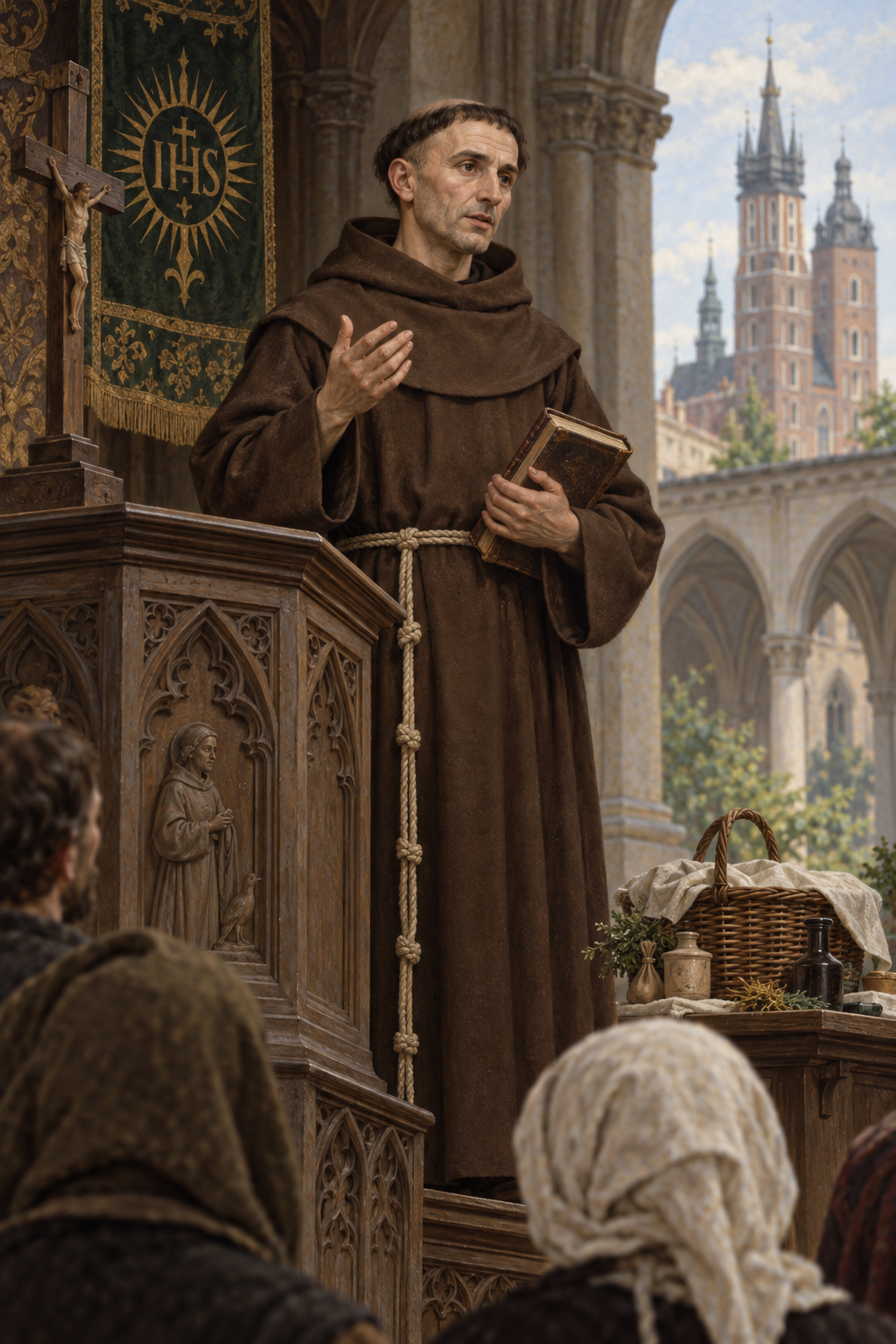
About Szymon of Lipnica
Szymon of Lipnica was born at Lipnica Murowana in southern Poland, probably between 1435 and 1440. The Holy See biography names his parents as Gregory and Anne.
The birth year should remain approximate. This deferred packet preserves the catalog's blank birth date because the sources give a range, and a signed partial date would overstate certainty.
That restraint is part of the slow-vetted method. A blank date is better than a confident-looking year when the sources offer only a range. The biography can still give the approximate range for readers.
In 1454 Szymon went to Krakow for studies at the Jagiellonian Academy. The page should connect his education with later preaching, not treat it as a decorative credential.
Krakow should be presented as both academic and ecclesial setting. His later ministry at Stradom and Wawel makes more sense when readers see that study, city, convent, and pulpit are connected.
The academy detail also protects the page from making holiness sound anti- intellectual. Szymon's learning served preaching, worship, and service. It was not detached from prayer or from the city where his later ministry unfolded.
In 1457 he entered the Observant Franciscan, or Bernardine, convent at Stradom. He was ordained priest around 1460. These approximate elements should be written with the same caution as the birth date.
The Bernardine identity should be explained simply as Observant Franciscan in the Polish context. That helps readers who know Franciscan habits but not local names for reform branches.
The Stradom setting should therefore be more than a place-name. It marks the religious community that shaped his public ministry. The catalog can say he entered the Bernardines without asking readers to sort out every Franciscan reform family.
Szymon's ministry included Tarnow, where he served as guardian, and later Stradom and Krakow. The final page should present him as a Franciscan preacher formed by community life, not as a solitary pulpit figure.
His service as guardian can be mentioned modestly. It shows that the sources remember him with responsibility inside the order, while the page should avoid turning administrative service into a separate story.
He became noted for preaching and was remembered as the first Friar Minor to preach at Wawel Cathedral in 1463. The page may include that sourced point, but it should avoid expanding it into broader claims about Polish preaching history.
This is another place for restraint. The sourced Wawel detail is strong enough; the page does not need to add rankings, influence claims, or rhetorical superlatives.
Devotion to the Name of Jesus was central to his ministry. The artwork can use a small IHS cue because it is directly tied to the source-supported devotional theme. Avoid rendered slogans beyond a simple symbol.
The IHS cue also keeps the visual focus on the subject of his preaching rather than on the preacher's personality. The public text should do the same.
That devotional emphasis belongs in the summary, biography, and artwork because both principal sources connect Szymon with preaching the holy Name. The text should keep the phrase reverent and clear rather than ornamental.
Szymon traveled to Aquila in 1472 for Saint Bernardine's translation, attended the 1478 General Chapter at Pavia, and visited Rome and the Holy Land. The page should keep these journeys concise and sourced.
These travels can show the wider Franciscan world around him. They should not be overread as proof of diplomatic rank or permanent office. The safer reading is that his life included study, community government, preaching, chapter life, and pilgrimage.
During plague in Krakow, Szymon cared for the sick. This ministry should be written with dignity and no graphic disease imagery. The page can say he served plague victims and died of plague on July 18, 1482.
The plague paragraph should name courage without spectacle. A covered basket of medicines or herbs can suggest care in art, while the prose avoids symptoms, panic, and anonymous suffering bodies.
The existing catalog records death at Krakow and memorial on July 18. This draft preserves those fields. Any final place hierarchy should be evidence-backed and tested, not added casually.
Szymon was canonized on June 3, 2007. His witness is best framed through Franciscan preaching, devotion to the Name of Jesus, learned formation, travel, and courageous service during plague.
The final paragraph should avoid treating canonization as the climax of the story in a bureaucratic sense. It can place the 2007 canonization after his death and memory, but the spiritual emphasis should remain on how his ministry held together learning, preaching, and mercy.
The final page should feel like a preacher's life rather than a plague story. His death matters, but it crowns a ministry of study, Franciscan discipline, public preaching, pilgrimage, and service.
Artwork should show a Polish Observant Franciscan or Bernardine in brown habit and cord, preaching in a Krakow church or cloister, with book, IHS cue, and a restrained medicine basket. Avoid graphic plague imagery, rendered text beyond the devotional symbol, logos, halos, modern props, and exact-likeness claims.
Wondering how to weigh the stories and sources? Learn how to read a saint biography.