Biography
Thomas Garnet
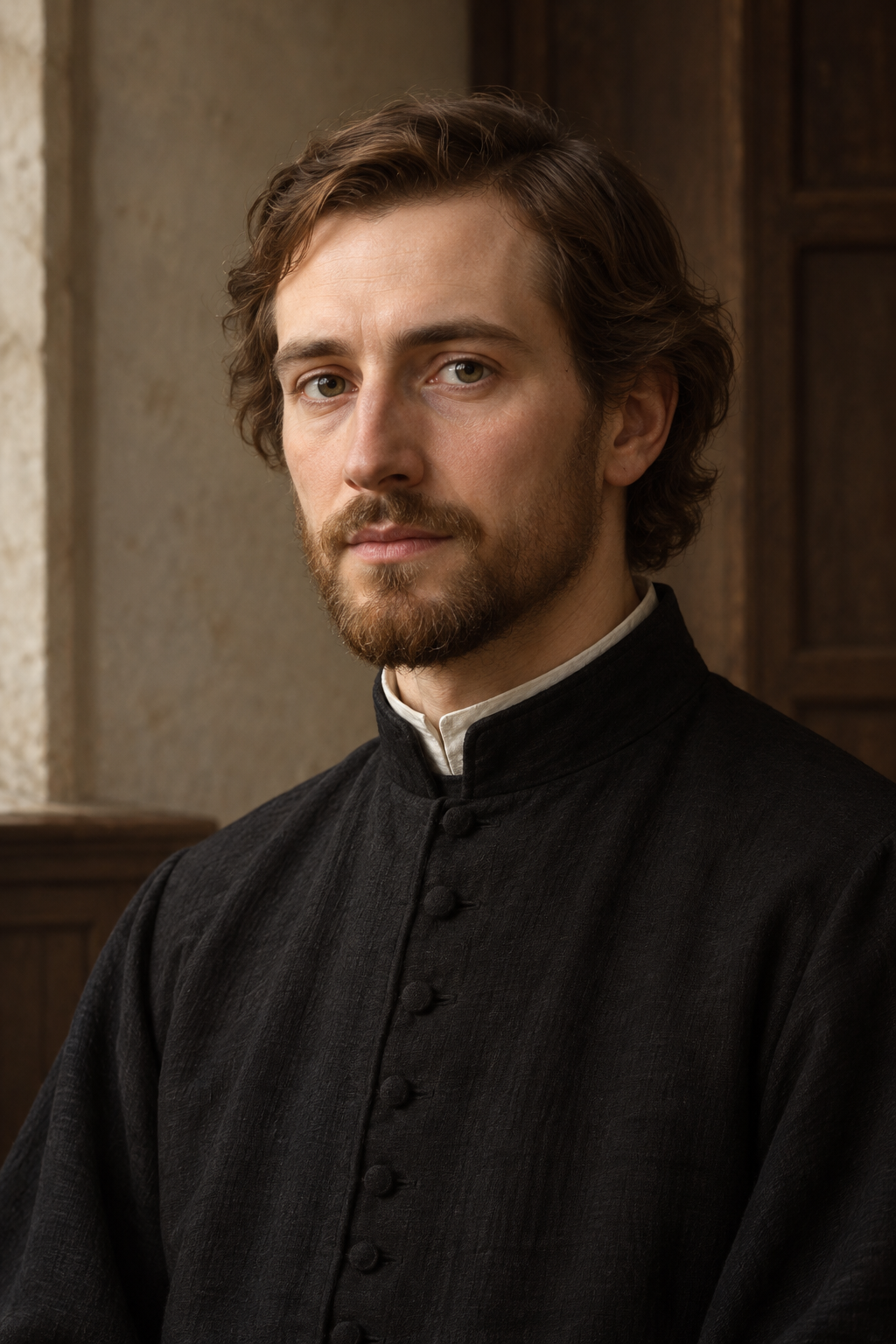
About Thomas Garnet
Thomas Garnet was an English priest whose education and ministry repeatedly took him across the Channel. He attended the grammar school at Horsham and later studied at the English college in Valladolid, where he was ordained in 1599. Returning to England meant serving Catholics in a setting where his priesthood could lead to imprisonment and death. His family was already closely connected with that religious community: his father Richard had been imprisoned for his Catholic faith, and his uncle Henry Garnet was a leading Jesuit in the English mission.
The Stonyhurst collection places Thomas among the first dozen boys who entered the new English Jesuit college at Saint-Omer in August 1593. The collection account says his parents sought a Catholic education and placed him as a page in the Arundel family’s household. His uncle told the family about the new school. In time, the small community of pupils grew to nearly fifty. Thomas went on to study theology in Spain, then returned as a missionary priest. One of his roles was as chaplain to his former schoolmate Ambrose Rookwood at Coldham in Suffolk.
His journey to Spain had not been straightforward. John Hungerford Pollen’s account describes Thomas leaving Calais with five other students in 1595. The Jesuit William Baldwin traveled with them under an assumed name. Bad weather forced the vessel to shelter off the English coast, where a search discovered the travelers and led to their arrest. The students were separated after the authorities found that they encouraged one another. Most eventually escaped. Pollen acknowledges uncertainty about some of Thomas’s individual experiences in custody, but records his eventual arrival at Valladolid in March 1596. The account preserves both the difficulty of reaching the seminary and the limits of what can be reconstructed about that journey.
In 1604, after several years of priestly work, Thomas entered the Society of Jesus. His later time at Louvain continued that Jesuit formation after the interruption caused by arrest and banishment.
After his return to England, Thomas was drawn into the investigation following the Gunpowder Plot of 1605. He had served Ambrose Rookwood, who was implicated in the conspiracy. Authorities imprisoned Thomas and pressed him for evidence against his uncle Henry. No connection between Thomas and the plot was proved. He was nevertheless kept in the Tower for seven months before being deported with forty-six other priests. The proclamation read to them threatened death if they returned to England.
Thomas continued his religious formation at the English Jesuit novitiate in Louvain. The Society of Jesus dates his vows there to July 2, 1607. That September he went back to England despite the warning attached to his banishment. Within six weeks he was arrested again after being betrayed by a former priest. During interrogation he refused to provide information. On June 19, 1608, he was tried at the Old Bailey on the charge of being a priest ordained under Roman authority. The Jesuit account describes the prosecution relying on a witness who claimed to have seen a letter bearing Thomas’s signature and an identification of himself as a priest.
He was condemned and executed at Tyburn on June 23, 1608. The Catholic Church in Norway identifies him as the first martyr associated with Saint-Omer’s college, whose later history continued at Stonyhurst. He was beatified in 1929 and canonized by Pope Paul VI among the Forty Martyrs of England and Wales in 1970.
At the execution, he acknowledged publicly that he was both a priest and a Jesuit. The Jesuit account remembers him expressing happiness at dying for Christ, rather than denying the vocation for which he had been condemned.
His memory also survives through the care taken by people who knew him. Luisa de Carvajal supported him in prison and sent a trusted servant to his execution to recover relics. Stonyhurst’s collection describes a surviving piece of linen associated with the shirt he wore. A letter from Luisa to a friend in Spain explains how she handled the shirt and cut strips from it. The surviving object and the letter bring the remembrance of Thomas into the experience of someone who regarded him as both a spiritual guide and a friend.
At the canonization on October 25, 1970, Paul VI singled out Thomas’s forgiveness. The pope recalled that he named and forgave those who had betrayed, arrested and condemned him, and prayed that they might share salvation with him. This is the church’s account of his final response to persecution. Paul VI set the martyrs’ faith within a wider appeal for reconciliation, welcoming Anglican guests and the official representative of the Archbishop of Canterbury. The ceremony honored their Catholic convictions while addressing Christians who inherited the divisions of the period in which they had died. Paul VI described religious conscience and civil loyalty as obligations that the martyrs had sought to hold together.
Wondering how to weigh the stories and sources? Learn how to read a saint biography.