Biography
Thomas Merton
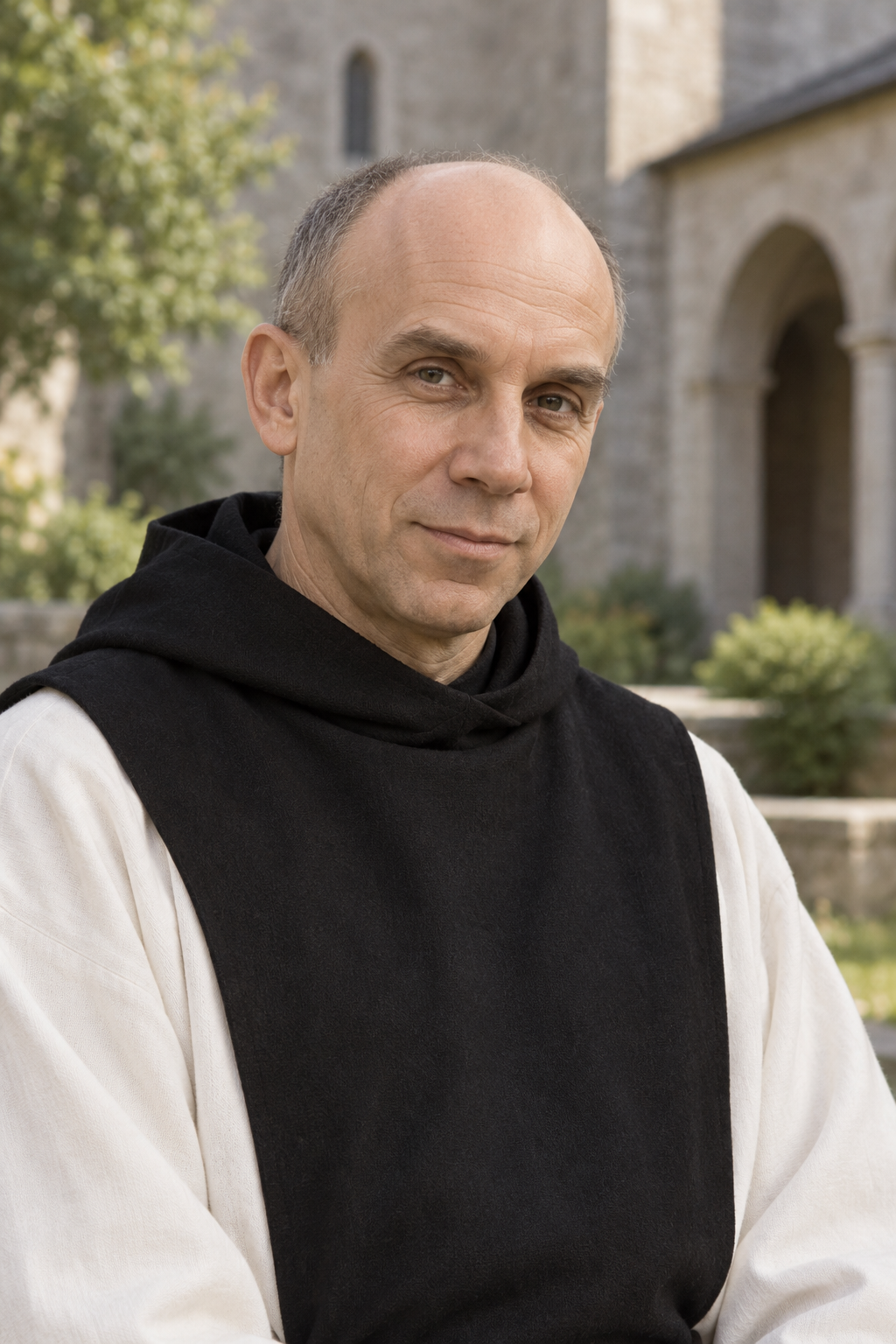
About Thomas Merton
Thomas Merton was a Catholic monk whose writing brought the concerns of a Kentucky monastery into conversation with a wider world. Born in Prades, France, in 1915, he was the son of two artists. He lived and studied in several countries before attending Columbia University in New York. In 1941 he entered the Abbey of Gethsemani. His autobiography, The Seven Storey Mountain, appeared in 1948, and he was ordained a Catholic priest the following year. He later trained younger monks and, from 1965, lived as a hermit on the abbey grounds.
His decision to become Catholic developed during his years at Columbia. The parish of Corpus Christi recalls that he began attending Mass there in August 1938, sought instruction the following month, and was baptized in November. In a later reflection, he associated the parish’s liturgy with joy and openness, qualities that helped him consider a religious vocation. His account presents worship as an experience that shaped a decision, rather than simply a ceremony marking the end of an intellectual search.
That connection with the parish continued. When he visited New York in 1964 to meet the Buddhist scholar Daisetz Suzuki, he celebrated a private Mass at Corpus Christi each morning. The parish’s account places his interest in dialogue alongside continuing Catholic worship. His engagement with another religious tradition did not require him to set aside the practices that structured his own life.
Merton’s correspondence connected his secluded life with people working amid public conflict. Scholar William D. Apel describes his friendship with Jim Forest, a peace activist involved with the Catholic Worker and Catholic Peace Fellowship. They first met in 1962, and letters sustained their relationship. Apel also records that Merton’s own religious superiors restricted his publication on war and peace. His encouragement of an activist therefore came from someone who had experienced institutional resistance to this work.
In February 1966, Merton answered a discouraged Forest with advice about the meaning of service. He urged him to attend to the worth of the work and the people it served, even when visible results were disappointing. He warned that slogans and causes could become substitutes for real relationships. He also questioned the desire to build a secure personal identity out of public achievement. In the surviving published excerpt, hope rests in God’s love rather than in the worker’s ability to measure success. This was counsel offered within a friendship, not a promise that political efforts would quickly prevail.
Apel describes another important friendship, with the writer and civil-rights advocate John Howard Griffin. After their meeting at Gethsemani in 1962, correspondence brought Merton news and insights from Griffin’s work. The exchange helps explain how a monk living apart from public campaigns could remain attentive to racial injustice. For Apel, these letters also reveal a pastoral vocation: Merton responded to the difficulties of particular friends, not only to large social questions. Apel interprets such exchanges through Merton’s understanding of mercy. In his reading, compassion included listening carefully to distress and offering encouragement, but also challenging a friend to reconsider the assumptions that made a difficult situation seem hopeless.
His life included serious conflicts with his commitments. In 1966, while recovering from surgery, he began a relationship with a young nurse known in his journals as M. Reporting a lecture by theologian Gregory Hillis, Fordham University describes the relationship and the strain it placed on his monastic vows. Hillis criticized Merton’s irresponsibility and his failure to reckon adequately with the imbalance between them. He also emphasized the limits of the surviving account: readers hear Merton’s reflections, while the nurse’s own perspective is absent. The journals reveal struggle and self-examination, but they do not make his account a complete history of the relationship. The Merton Center records that his journals were closed for twenty-five years after his death and then published in seven volumes during the 1990s. Their publication allowed readers to encounter his private uncertainties alongside the more composed voice of his published books.
Brother Paul Quenon, a fellow monk at Gethsemani, later recalled Merton’s influence on the community’s understanding of contemplative life. In a Vatican News interview, Quenon described a movement away from an overriding emphasis on penitential practices toward prayer as lived experience. He also remembered Merton’s love of Gregorian chant. At the fiftieth anniversary of his death, the community listened during its meal to a recording of him singing in his hermitage. That recollection locates the writer within the shared musical and prayerful life of the monastery, rather than treating him only as an isolated author.
Merton traveled to Asia in 1968 and met religious figures including the Dalai Lama. He died near Bangkok on December 10 of that year.
The Episcopal Diocese of Los Angeles lists him on December 10 in its 2025 calendar. This entry documents a local Anglican commemoration of a Catholic monk.
Wondering how to weigh the stories and sources? Learn how to read a saint biography.