Biography
Thomas of Tolentino
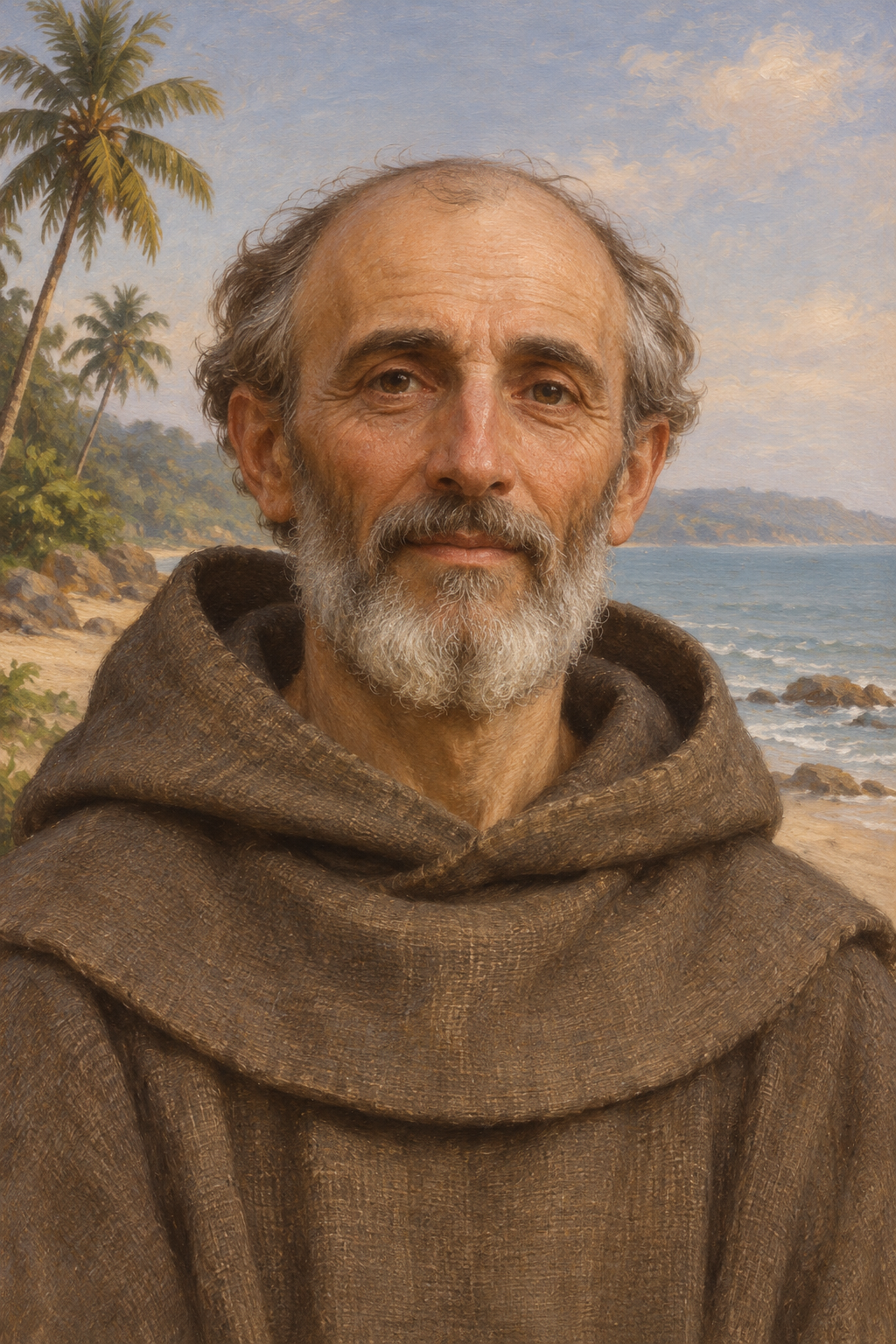
About Thomas of Tolentino
Thomas of Tolentino’s birth date is unknown; Francesco Carta places it probably around the middle of the 1240s. Reliable information about his early life is scarce. A later tradition places him in the Tolentino family and says he entered the Franciscan Order in 1263, but Carta stresses that the date is not established by contemporary evidence. The historical trail becomes clearer in the mid-1270s, when Thomas appears in disputes over Franciscan poverty.
Thomas joined friars who favored strict observance of Francis’s poverty after Pope Gregory X’s 1274 letter allowed the order to alienate or exchange property. Carta traces the factional conflicts through the testimony of Angelo Clareno, an interested witness. Thomas and other friars were investigated and confined in hermitages. A temporary compromise followed, but after 1279–80 Thomas was imprisoned with Peter of Macerata and Angelo Clareno.
Clareno’s testimony, on which Carta relies, says the minister general Raymond Gaufridi released Thomas in 1289 or 1290 after roughly ten years’ confinement. The episode unfolded within an institutional dispute over Franciscan poverty and authority, and Clareno wrote from the reform faction involved in that conflict.
After release, Thomas was sent with other friars to the Armenian kingdom of Cilicia at the request of King Hethum II. They were praised for their conduct, and at the end of 1291 Thomas returned west with companions to seek aid for Armenia, then threatened by the Mamluks. Pope Nicholas IV issued letters to rulers in France and England concerning aid. These diplomatic tasks show that Thomas’s mission included practical political advocacy as well as preaching.
Carta considers it possible that Thomas joined the Pauper Hermits founded by Celestine V in 1294 and later took part in efforts to reconcile Angelo Clareno’s faction. He is also reported in Greece, including Thebes and Negroponte, during an unsuccessful mediation. These episodes remain proposals rather than a continuous, securely documented itinerary.
In 1307 Thomas delivered two letters from the missionary John of Montecorvino to Pope Clement V in Gascony. Carta identifies these as the last surviving letters from Montecorvino and says their contents helped prompt the sending of seven bishops to the East. This episode connects Thomas with the developing Franciscan mission in Asia, even though the sources do not establish every stage of his own travels during the preceding years.
Thomas reappears in 1320 at Hormuz, having come from Tabriz with Franciscan and Dominican companions. The group intended to sail to Quilon in southern India but was taken to Thane on the western coast. Carta compares accounts by Jordan of Sévérac and Odoric of Pordenone, written close to the events, and notes that their descriptions differ. Modern scholarship also debates how many separate accounts Jordan composed.
At Thane, Thomas and his companions were brought before the local governor and qadi to explain their faith. Francesco Carta’s account, comparing the martyrdom relations, says Thomas spoke in the debate and answered a direct question about Muhammad in terms that the Muslim authorities treated as insulting. The story says the friars were exposed to the sun, questioned again, and that James was selected for burning; after a reported rescue and release by the governor, the qadi arranged another attack. Carta dates the killings of Thomas, James, and Demetrius to 9 April 1321, and Peter’s death to 11 April. The account identifies Demetrius as a companion from Tbilisi; later scholarship describes him as a lay brother, possibly Armenian or Georgian, rather than one of the ordained Franciscan friars.
The account of Thomas’s cult continued to develop well after the killings. Vurachi records that the Sacred Congregation of Rites authorized an Office and Mass for Thomas in the calendars of Goa and Daman in 1914. In 1961, a relic of his skull arrived at St John the Baptist Church in Thane, where an oratory and local commemoration followed. These events show how the memory of the four friars was attached to particular places and calendars, even as devotion varied over time.
The surviving accounts are close to the events but do not all tell the story in the same way. Carta identifies four reports written between 1321 and 1323, including two associated with the Dominican Jordan of Sévérac. Jordan had travelled with the group before separating from them in India; as Patrick Byrne observes, his early letter records that Jordan survived while Thomas and the others were killed, but does not provide Odoric’s elaborate scene-by-scene narrative. Odoric arrived at Thane later, heard the story there, and collected relics. His Relatio, dictated after his return to Europe, recounts a household dispute that brought the friars before the qadi, Thomas’s participation in the hearing, the debate over Christian belief, James’s ordeals, the governor’s attempted intervention, and the eventual executions. It is valuable evidence for early Franciscan memory, but its dramatic dialogue and miracles are a later report rather than Thomas’s own testimony.
Wondering how to weigh the stories and sources? Learn how to read a saint biography.