Biography
Turibius of Mogrovejo
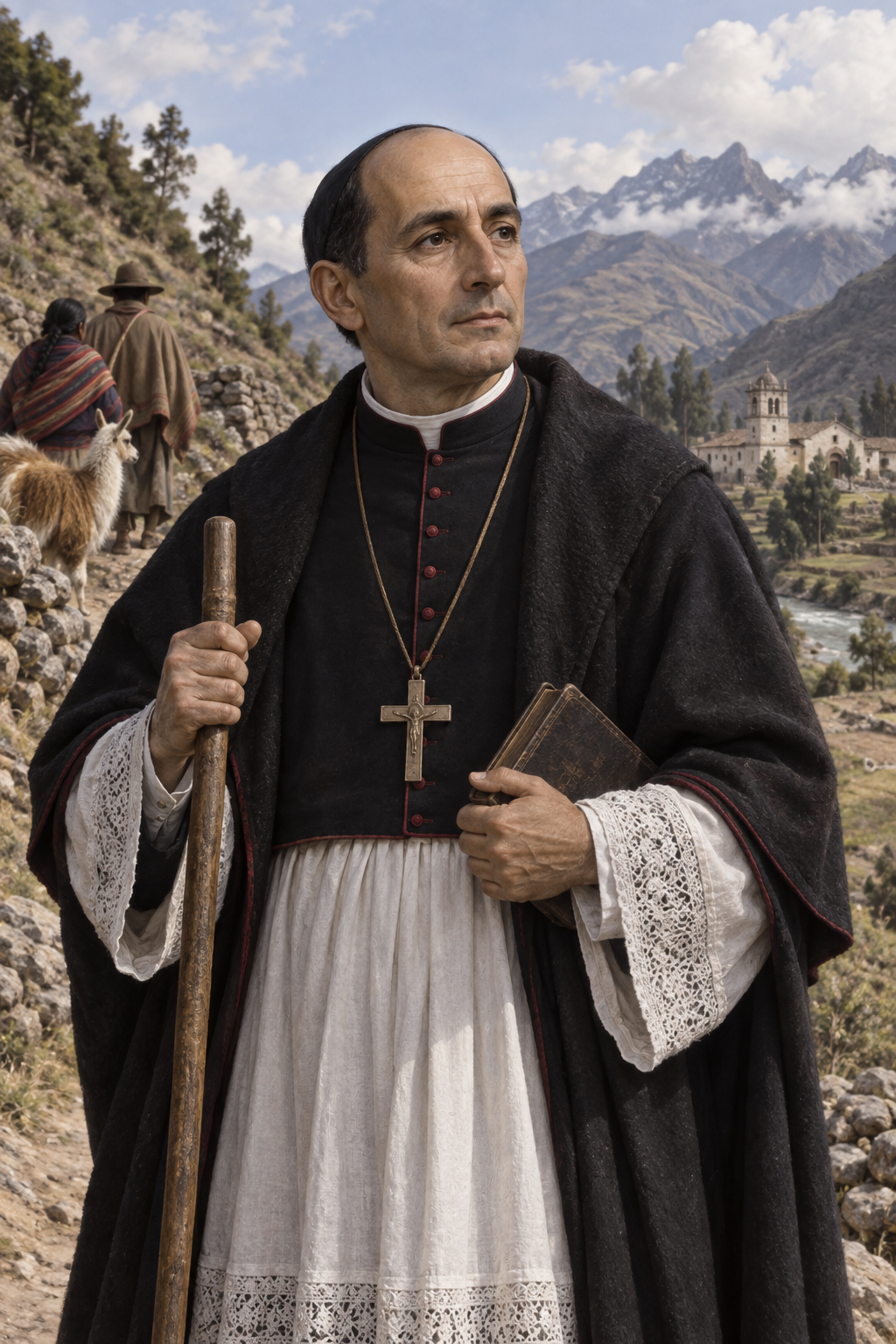
About Turibius of Mogrovejo
Turibius of Mogrovejo was born in Mayorga in 1538. He studied law and became a respected jurist before he held clerical office. His selection for the archbishopric of Lima was therefore an unusual change: he was still a layman when the appointment was made. After ordination and episcopal consecration, he traveled to Peru and took up the see in 1581. Church sources agree on the year of his birth but report different days in November, so this profile records only the year. His move from legal work in Spain to episcopal leadership in the Americas began a ministry far from the places where he had studied and worked.
Lima was the center of a large colonial church. The Dicastery's account describes indigenous communities facing exploitation by descendants of the conquerors, while some priests were too dependent on colonial privilege to challenge it. Turibius sought to restore clerical discipline and provide pastoral care to people whose needs powerful settlers could disregard. This setting matters to his story. His ministry took place within Spanish rule, and church sources especially remember his resistance to abuses within that system. He did not confine himself to ceremony in the capital or treat institutional order as an end in itself. The people reached by his work lived under circumstances very different from his own background in Spain.
Pastoral visitation was central to the way he governed. The territory attached to Lima stretched far beyond the city, and reaching dispersed communities meant travel across difficult climates and landscapes. Pope Leo XIV's letter recalls those journeys as a way to learn people's customs and needs rather than directing their lives from a desk. It also remembers his defense of indigenous people, correction of abuses, and closeness to the poor. The roads and social differences made such visits demanding; the important historical point is the sustained contact they created between the bishop and communities entrusted to him. Summaries give different totals for years spent traveling, so the biography does not depend on a disputed number.
Turibius also faced the problem of communicating Christian teaching across languages. The Third Provincial Council of Lima, convened in 1582–83, supported catechisms in languages used by local people, including Quechua and Aymara. He encouraged clergy to learn the languages of those they served so that preaching and sacraments could be understood. Benedict XVI identified the council's catechism as an enduring result of Turibius's pastoral organization. The effort made ordinary teaching depend on attention to listeners rather than on the convenience of the teacher. It should not imply that every indigenous community spoke one of those two languages, or that translation by itself removed the inequalities of colonial rule.
The same council addressed discipline and common pastoral standards across a large ecclesiastical province. Turibius founded a seminary in Lima and treated the formation of priests as part of the care owed to local communities. He visited clergy, expected responsible admission to orders, and called them to service. Pope Leo XIV connects such measures to the effect a priest's conduct had on the people. His work was not a single institution or decree: councils, local meetings, catechetical texts, and a seminary gave structure to a church spread across great distances. Their importance can be stated without assuming that every reform was immediately accepted or applied in the same way everywhere.
His defense of people exposed to colonial abuse sometimes brought direct conflict. Pope Francis cited a 1585 case in which Turibius excommunicated the corregidor of Cajatambo after seeing abuses against indigenous people. Francis also recalled his defense of ordaining qualified men of mixed ancestry when that was contested. These examples do not make Turibius independent of his era, but they show where his pastoral choices challenged interests within it. The same address presents charity and justice as connected parts of his ministry. Specific actions are more useful here than a claim that one bishop single-handedly changed every aspect of colonial life. His disputes are part of the documented account, alongside the institutions he built.
Turibius died on March 23, 1606, during a pastoral journey in Zaña, Peru. The setting connects the end of his life with the travels that had occupied much of his episcopate. The Catholic Church later beatified and canonized him; the Dicastery dates his canonization to December 10, 1726. His liturgical memorial falls on March 23, the day of his death. Sources consulted for this packet disagree on the beatification day, and accounts of his journeys give different counts. Neither disputed detail is needed for the well-supported outline of his life. The year-only birth date likewise reflects the evidence rather than a lack of research.
In 1983 John Paul II confirmed Turibius as patron of the bishops of Latin America. The designation is a later ecclesial reading of his ministry; it is not evidence that all communities experienced colonial evangelization in the same way. What remains distinctive in the record is the link between local travel, teaching in languages people understood, reform of clergy, and defense of those vulnerable to abuse. Turibius was a bishop whose responsibilities were institutional and personal at once. His story gives a concrete account of how a sixteenth-century church leader tried to govern a vast province through presence, education, and discipline, while leaving room for careful study of the colonial world in which he worked.
Wondering how to weigh the stories and sources? Learn how to read a saint biography.