Biography
Vincent de Paul
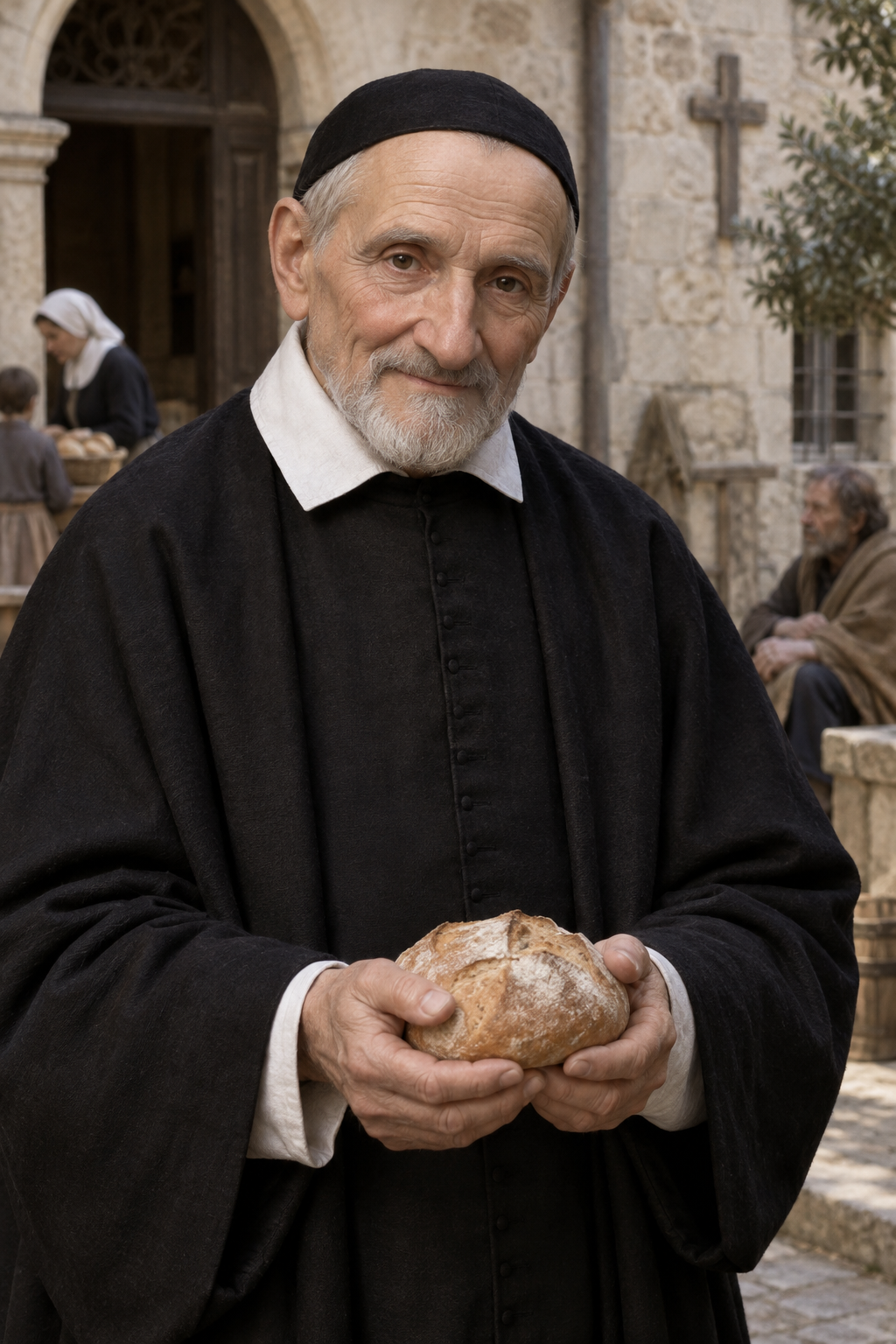
About Vincent de Paul
Vincent de Paul became a priest whose work joined preaching with the daily demands of feeding, nursing and organizing assistance for people in poverty. He came from a farming family in Gascony, in southwestern France. A benefactor helped him obtain an education; he was ordained in 1600 and completed a theology degree in 1604. His early ministry would eventually bring him into contact with both wealthy households and people whose need was far less visible to those households. The parish of Clichy, entrusted to him in 1612, was one setting for this pastoral work.
He was born at Pouy on April 24, 1581, the third child of Jean Depaul and Bertrande Demoras, according to John Paul II's centenary letter. As a young priest in Paris, Vincent sought a church income and obtained work distributing Queen Marguerite's alms. Pierre de Bérulle became his spiritual guide. Parish service and a position tutoring the Gondi children widened the range of people he encountered. Travel with the family brought him close to rural communities whose material hardship was accompanied by poor access to religious instruction. The needs of those communities challenged the limits of a ministry centered on the children of a prosperous household. Bérulle later directed him toward parish work at Châtillon.
At Châtillon in 1617, assistance became a shared undertaking with written arrangements. The foundation document assigned women successive days caring for sick neighbors, with substitutes when someone could not serve. The later rule required married and unmarried members to obtain a husband's or parent's permission. Women's work sustained the association, but its governance also retained the gender restrictions of its setting.
Vincent also gathered priests for rural missions. A contract dated April 17, 1625, established the initial undertaking; an association signed in September 1626 committed the group to community life and ministry among the rural poor. This became the Congregation of the Mission. Its work soon exposed another problem: a visiting mission could accomplish little lasting good without prepared local clergy. In 1628, at the bishop's request, Vincent and his companions began retreats for candidates for ordination at Beauvais. Training future pastors thus developed alongside preaching to villagers, rather than replacing it. Years of experience preceded the distribution of the community's Common Rules in May 1658. In 1655, papal approval confirmed simple vows of poverty, chastity, obedience and stability, committing members to lifelong service among the rural poor.
The expansion of assistance also depended on Louise de Marillac. At Vincent's request she visited the confraternities, bringing organizational ability to their work. The Daughters of Charity's history explains that social expectations limited the direct service some wealthy members could undertake. Marguerite Naseau, a peasant woman who had taught herself to read and then taught children, offered her help in Paris in 1630. Vincent entrusted her to Louise, and other women from poor rural backgrounds joined the work. These women were participants in developing the service, not simply recipients of charity. The Company of the Daughters of Charity dates its beginning to November 29, 1633. Its formation brought the collaboration of Vincent and Louise into an enduring community.
War made the need for assistance more urgent. Robert Maloney's study traces Vincent's relief campaigns in Lorraine from 1639 and his support for people displaced into Paris. Raising money was only part of the work: he required reports and receipts from those distributing it. Maloney reproduces a letter to François du Coudray insisting on accounts. The same study describes housing for abandoned children and a residence where artisans received tools for productive work. Material help and religious instruction remained closely connected in these projects.
His preaching was meant to be understandable. Pope Francis's account emphasizes Vincent's use of straightforward speech rather than elaborate rhetoric, and his care for the formation of priests. The manner of the preacher mattered alongside the subject of the sermon: humility, gentleness and simplicity belonged to the same vocation as active assistance. Francis also highlights Vincent's recognition of women's abilities, particularly Louise's insight and sensitivity. This reading of his legacy keeps personal contact with suffering people at the center of an expanding organization. The purpose of a community, a training program or a charitable association was service, not the public prominence of its founder.
Vincent died in Paris on September 27, 1660. The institutions associated with him continued beyond his lifetime. In 1885, Leo XIII named him patron of Catholic charitable associations. The Roman liturgy remembers him on September 27, linking his name with the work of priests, communities and laypeople caring for those in need.
Clement XII canonized him on June 16, 1737. A later marble statue by Pietro Bracci, installed in St Peter's Basilica in 1754, presents him holding a crucifix and directing attention toward his mission. Such commemorations gave public form to the memory of a life spent organizing Christian service.
Wondering how to weigh the stories and sources? Learn how to read a saint biography.
Explore similar vocations
Prayers for Vincent de Paul
Vincent de Paul: collect excerpt
give to all your people a heart of compassion