Biography
Vincenzo Grossi
About Vincenzo Grossi
Vincenzo Grossi was born at Pizzighettone, Cremona, on March 9, 1845. The existing catalog birth date and place are supported by the reviewed official source profile and are preserved in this deferred packet.
The page should present him as a diocesan priest. He should not be shown in bishop's vesture or described as a religious priest. The current catalog's blank second class is preserved.
That boundary matters because his holiness belongs to parish priesthood. The visual and prose should keep him in cassock, classroom, church, and oratory settings rather than borrowing symbols from other states of life.
Vincenzo's priesthood was expressed through parish ministry, catechesis, and formation. The page should make ordinary pastoral care visible without inflating it into dramatic episodes.
Ordinary pastoral care can still be concrete. A parish register, catechism, and small classroom help readers see the work of teaching, visiting, confessing, organizing, and encouraging people over time.
His service at Vicobellignano is central. The current catalog death place names Vicobellignano, and the biography can also present it as a setting of ministry and foundation.
The page should not turn Vicobellignano into a mere end point. It was a place where parish life, education, and the oratory mission could become one work of pastoral formation.
Vincenzo founded or inspired the Daughters of the Oratory for the Christian formation of young women. The congregational source helps describe that mission without depending only on a causes profile.
The page should describe young women's formation with dignity. It should not make the girls decorative figures around a priest; they were the people whose education and spiritual growth the work served.
The same rule guides the artwork. Young women can appear as students in an oratory-school setting, but Vincenzo's page should not reduce them to props or make their vulnerability sentimental.
Oratory language should be explained simply. Readers can understand it as a parish-linked environment for Christian instruction, prayer, community, and growth, rather than as a technical institutional term.
This explanation helps the Daughters of the Oratory make sense. Their name is not only organizational; it points to a pastoral method shaped by parish life, teaching, prayer, and community.
The biography should make that method visible. Vincenzo's holiness can be shown through repeated catechesis, attention to families, concern for girls' formation, and the practical organization needed to keep such work alive.
The existing catalog records death on November 7, 1917. The main source family supports that date, while an embedded source conflict has been noted in the reconnaissance. This draft preserves 1917 and flags the conflict for final review.
The conflict should be handled the same way as other disputed fields in this batch: preserve the current field during drafting, document the tension, and decide in the consolidated approval packet.
That conflict should be visible in the approval packet. It is better to state the preferred date and source tension than to pretend the evidence is perfectly flat.
The preferred date still aligns with the current feast day and catalog field. Nothing in this draft changes the runtime database or claims final resolution.
This also protects the test. The importer should prove that the existing date is preserved during preparation, while the source notes explain why the final review still needs to look at the conflict.
Vincenzo was canonized in 2015. The Holy See canonization booklet can support that recognition and the broader context of his public veneration.
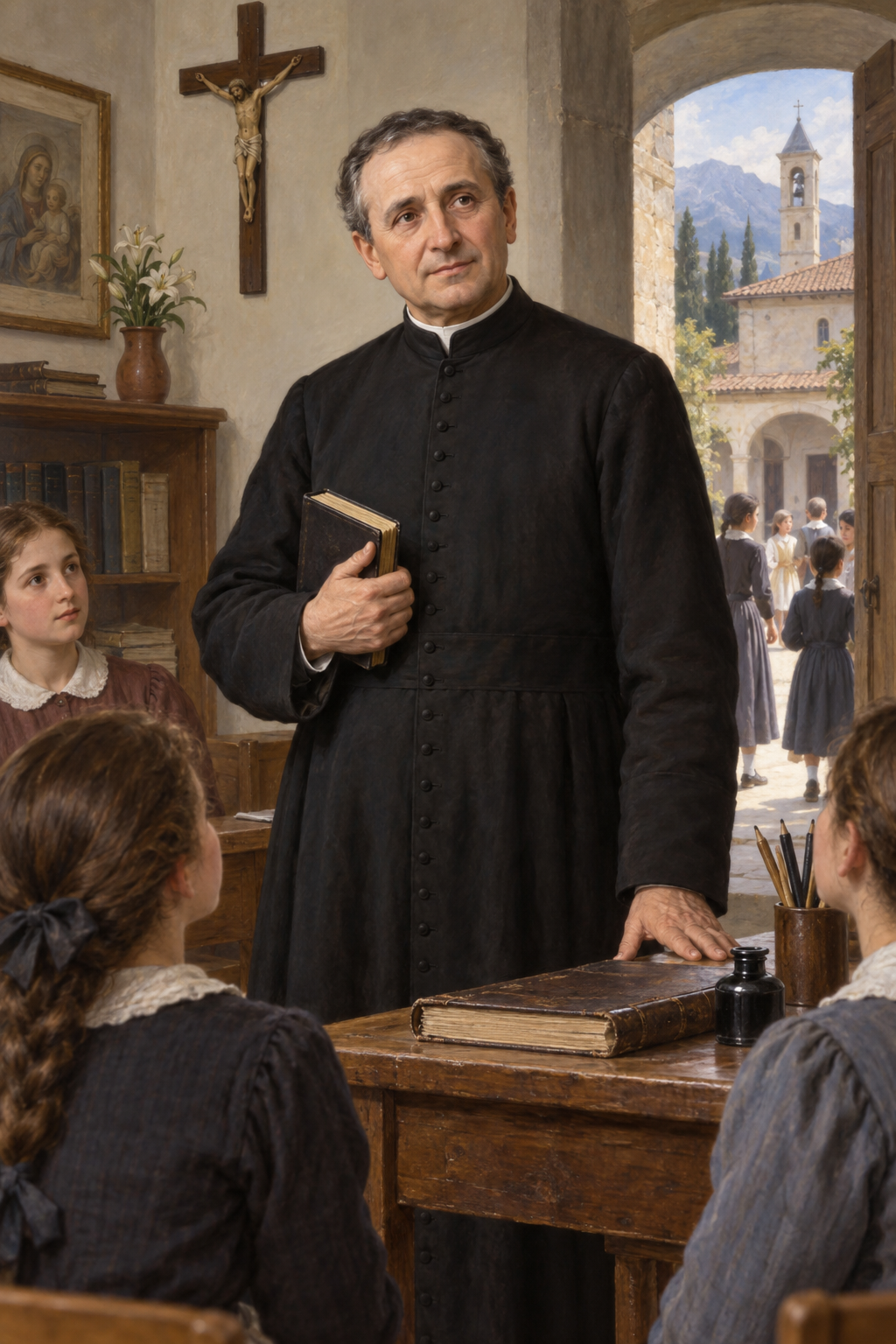
Artwork should show a simple black cassock, catechism or book, parish register, small crucifix, and an oratory-school setting. It should avoid bishop vestments, monastic habits, modern props, logos, and rendered text.
The final page should focus on durable pastoral formation. Vincenzo Grossi's holiness appears in the patient work of parish care and the educational mission that outlived him.
That focus keeps the page from becoming a founder resume. The center is a pastor whose attention to formation became a structure of service for others.
The Daughters of the Oratory should be presented as fruit of pastoral concern, not as a disconnected institution. The foundation belongs inside his parish life and care for Christian education.
His witness is useful wherever ordinary ministry feels small. The page can show that a priest's quiet catechesis and care can become a lasting school of faith for others.
The conclusion should encourage patient teaching. Vincenzo's work suggests that formation is built through repeated attention, not through one striking event.
That makes the reader action simple and faithful to the life: teach patiently, encourage steadily, and trust that ordinary formation can become enduring charity.
The page should leave readers with a priest at a desk, in a classroom, and at the parish door, doing the same faithful work over time.
Artwork should show a nineteenth- or early-twentieth-century Italian diocesan priest in black cassock in a parish/oratory school, with book, register, crucifix, and modest classroom doorway. Avoid bishop vestments, halos, exact-likeness claims, modern objects, logos, and readable text.
Wondering how to weigh the stories and sources? Learn how to read a saint biography.