Biography
Vincenzo Romano
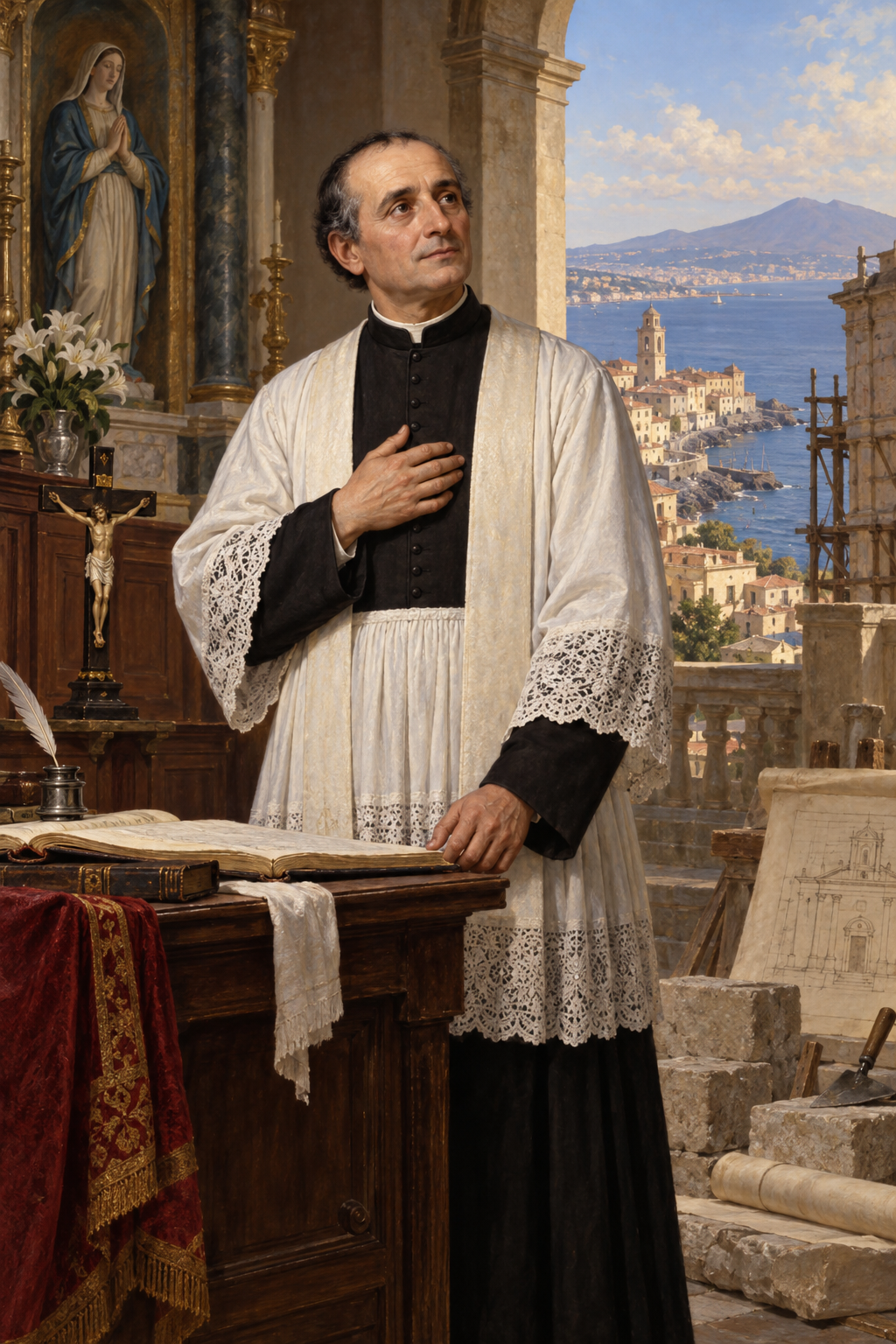
About Vincenzo Romano
Vincenzo Romano was born at Torre del Greco, Naples, on June 3, 1751. The existing catalog birth date and place are supported by the reviewed source profile and are preserved in this deferred packet.
His life is unusually local. Torre del Greco is not only a birth place and death place; it is the parish world where his priesthood unfolded among a particular people.
That local quality should be treated as strength, not limitation. Vincenzo's life shows how one place can become a field of sanctity when a priest remains faithful through changing needs.
Vincenzo became a diocesan priest. The current catalog's blank second class is preserved because the reviewed source shape is priestly and parish-centered, not monastic or episcopal.
This boundary also guides the art. A cassock and surplice are appropriate, but monastic habits, bishop vesture, or generalized saintly costume would blur the specific witness.
The public page should show ordinary parish ministry: preaching, sacraments, visiting, teaching, organizing, and rebuilding trust. It should not depend on one dramatic episode to make his holiness interesting.
Ordinary parish ministry should feel concrete. Registers, church repairs, visits, instruction, and sacramental care give readers a picture of work that is steady rather than spectacular.
Sources connect his memory with renewal and rebuilding at Torre del Greco. That context should be written carefully. The page can mention rebuilding church life without turning the image into a volcanic disaster scene.
That restraint matters because disaster can easily dominate the story. The spiritual point is not the destruction itself, but pastoral renewal and the patient rebuilding of a community's worship and trust.
The artwork can include coastal Torre del Greco, parish church, register, crucifix, and subtle masonry or plan cues. It should avoid eruption, panic, smoke, or sensational destruction.
The image can therefore hint at repairs through stonework or plans while keeping Vincenzo's priestly presence and parish care at the center.
The same restraint belongs in prose. The page can say that his ministry included renewal and rebuilding, but should not reconstruct events in detail unless the final packet adds a local source with exact support.
Paul VI's beatification address gives an official ecclesial witness to Vincenzo's pastoral charity. This draft uses it as recognition and interpretive support without long quotation.
The address should support the page, not overpower it. The biography remains the story of a local pastor whose care became visible over decades.
That long visibility is the point. Vincenzo did not need a wide geographic field to live a wide charity; he had a town, a parish, and people who needed steady priestly care.
Vincenzo died at Torre del Greco on December 20, 1831. The existing catalog death date, death place, and feast day align with the reviewed sources and are preserved in this draft.
The matching birth and death place should be presented as a sign of rootedness. The same town framed his origin, ministry, death, and public memory.
His canonization in 2018 can be cited through the Holy See Press Office notice. The final page should mention canonization, but keep its center on the long local ministry that made such recognition meaningful.
That relatively recent canonization should not lead to modern commentary or extra claims. The official notice is enough to support recognition while the life remains grounded in sourced pastoral work.
The biography should not overuse Neapolitan scenery. The coast and town help place him, but the spiritual emphasis is fidelity to one people over time.
This helps keep the page from becoming scenic travel prose. Torre del Greco is important because people lived, prayed, suffered, rebuilt, and received pastoral care there.
That human emphasis makes the coastal setting serve the biography. Sea, town, church, and masonry are context for a priestly life, not substitutes for the life itself.
Vincenzo's witness is useful wherever ministry feels repetitive. He shows that preaching, sacraments, repairs, visits, and patient pastoral organization can become a saint's path.
The reader reflection can draw from that repetition. Staying with a parish, family, or neighborhood need can be a concrete way to love.
The final page should feel like a parish priest's life: local, steady, sacramental, and practical. Its drama is not spectacle, but perseverance.
The conclusion should let that steadiness stand. Vincenzo Romano does not need dramatic eruption imagery; the long fidelity of priestly service carries the page.
This gives the final page a quiet shape: one priest, one town, one parish people, and years of work by which worship, trust, and care were renewed.
The reader should finish with the sense that local faithfulness can be holy even when it looks repetitive. Vincenzo Romano's life honors the grace of staying with people long enough to help rebuild what has been damaged.
Artwork should show a late-eighteenth or early-nineteenth-century Neapolitan parish priest in cassock and surplice, with register, crucifix, coastal Torre del Greco view, and subtle church-rebuilding cues. Avoid volcanic eruption, modern props, logos, halos, exact-likeness claims, and rendered text.
Wondering how to weigh the stories and sources? Learn how to read a saint biography.