Biography
Wandrille of Fontenelle
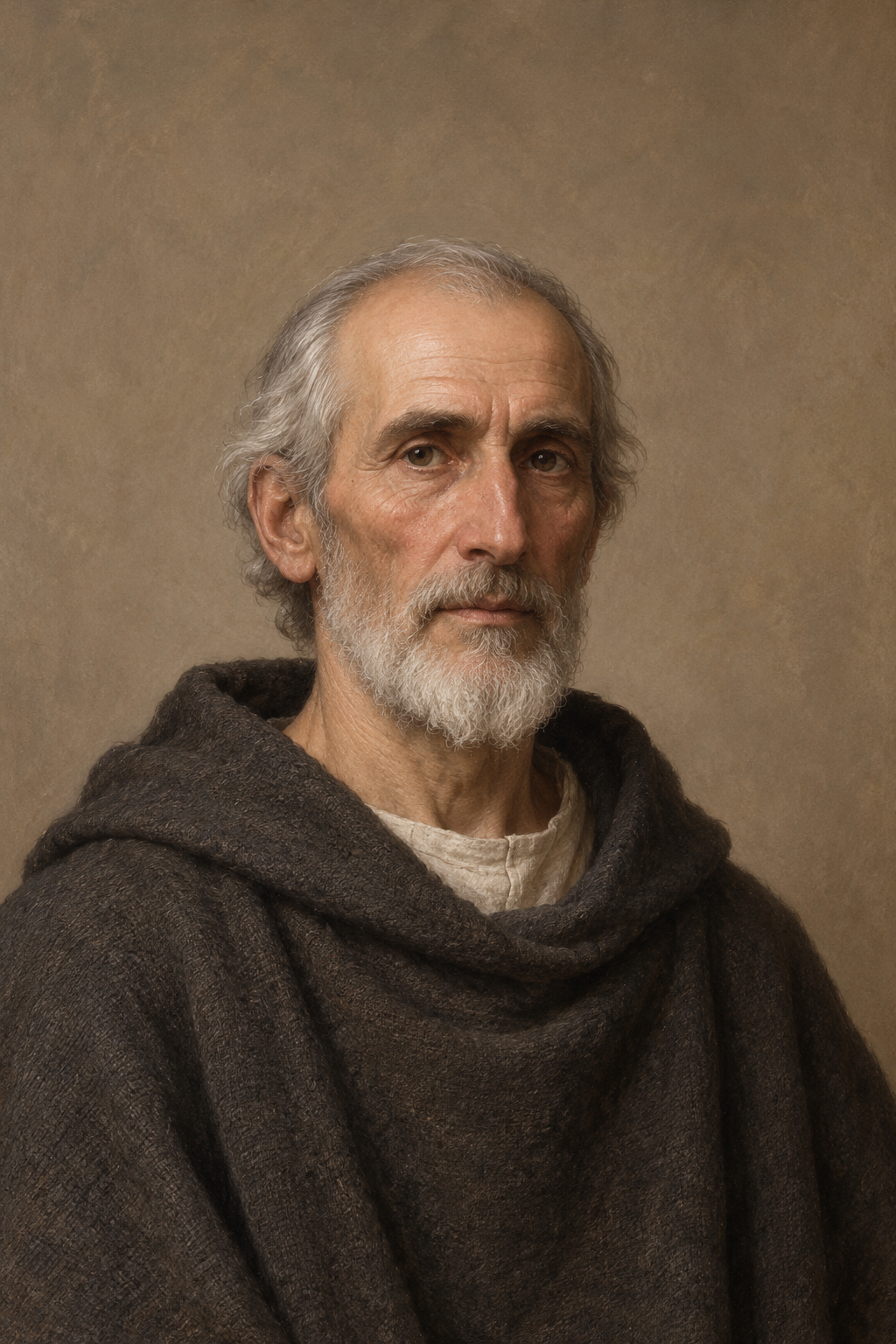
About Wandrille of Fontenelle
Wandrille founded the monastery of Fontenelle in Normandy, remembered by its community as a foundation of 649. Before settling there, he had left royal service and passed through several monastic communities. The abbey’s account places him at Bobbio in Italy and Romainmôtier in the Jura before his arrival near Rouen.
His earliest life describes a marriage undertaken at his parents’ request. It says that his wife agreed to enter religious life when he disclosed his intention. Summoned before King Dagobert for becoming a monk without permission, Wandrille is portrayed helping a poor man free a cart from mud while others mocked him.
The foundation belonged to a network of royal and episcopal relationships. Christian Cooijmans distinguishes the early Life’s account from the fuller ninth-century history, which names Erchinoald, mayor of the palace, and Wandrille’s nephew Godo as participants. He also qualifies the image of complete wilderness: the monastery lay near the Seine and the road between Rouen and Lillebonne. Its setting offered access to settlements and transport as well as opportunities for withdrawal.
The same account praises severe fasting and immersion in icy water as responses to temptation. These belong to its ascetic ideal, not a practice to imitate. At Fontenelle, it describes a practical adjustment: although he first sought to live by manual labor, the growing community led him to accept land for its support.
The author presents his teaching as a call to humility, mutual charity and perseverance. Its visions and miraculous episodes express the community’s religious understanding of him; they are not independently established events. The exact rule followed by the first community is uncertain. Pascal Pradié notes that its later history does not identify one at the foundation. He proposes a mixed observance drawing on Benedict and Columbanus, within a wider inheritance of earlier monastic teaching. Wandrille’s own movement between solitary and communal life helps explain that variety. It would be misleading to assume that the community began with every feature of later Benedictine uniformity already in place.
A journey to Rome belongs to a later layer of his biography. Sihong Lin notes that the earliest Life does not mention it, whereas the ninth-century account does. Later relic lists also connected Wandrille with Pope Martin I. Lin considers a visit and papal contact plausible in the setting of seventh-century travel and religious debate, but the evidence does not establish a precise itinerary or date. In particular, the suggestion that he travelled as an official representative of the Council of Chalon-sur-Saône goes beyond what the surviving material supports.
The later catalogues describe two ivory containers brought from Rome, one holding a relic attributed to Pope Leo the Great. These reports help explain the community’s Roman associations, but they are later testimony, not contemporary verification of the objects or their origins.
The earliest account has an unusually early material witness. Jamie Kreiner identifies a surviving booklet copied around 700, now Paris, Bibliothèque nationale de France, Latin 18315. Its value extends beyond the words alone. Decorated initials and divisions organize episodes, mark changes within scenes and separate items in sequences. Kreiner suggests that these visual choices could have guided reading and memory. The manuscript therefore preserves evidence of how Wandrille’s story was presented to an early audience, while leaving questions about particular readers unanswered.
Later writers made the founder a standard for assessing his successors. In Pradié’s reading of the Gesta, the ninth-century abbot Anségise appears as a restorer of the ideal established by Wandrille. Descriptions of clearing land also carry spiritual meanings: the transformation of the landscape evokes the cultivation of the soul. Wandrille’s knowledge and meditation on Scripture form part of this remembered model. Such passages offer evidence of the community’s values alongside their information about buildings, land and leadership.
His remains became part of the community’s experience of displacement. Cooijmans traces their removal with those of Ansbert during the ninth-century Viking threat and their later movement through several refuges. In 944, Count Arnulf of Flanders compelled their transfer to Saint Peter’s at Ghent, associating himself with the cult while preventing its return to Normandy. The history of the relics consequently involved political control as well as monastic devotion.
At Le Pecq, the parish explicitly honors Wandrille as its patron. The present church opened for worship in 1745. Its solemn dedication followed in 1995, when the parish also received a relic from the abbey. These ceremonies renewed a longstanding connection between the parish and Fontenelle.
The parish traces this relationship to a royal grant of Aupec to Fontenelle in 704. Its account connects the later priory and parish with that estate and with Wandrille’s patronage. The dedication ceremony of 1995 brought the bishop of Versailles and the abbot of Fontenelle together. It marked a renewed institutional link, rather than the beginning of devotion to a previously unknown patron.
Wondering how to weigh the stories and sources? Learn how to read a saint biography.