Biography
William Reed Huntington
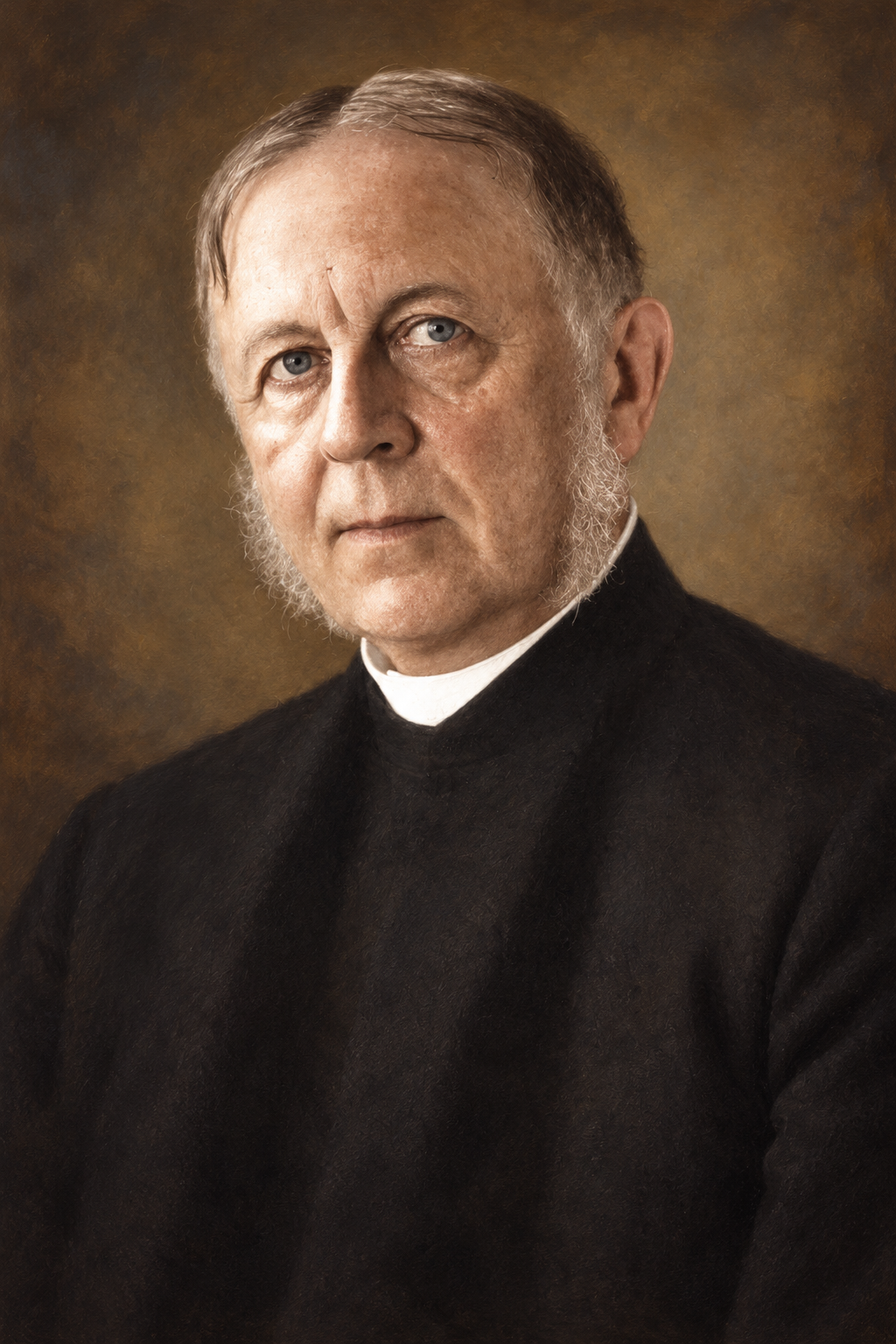
About William Reed Huntington
William Reed Huntington was an Episcopal priest whose work joined parish ministry with efforts to bring divided churches closer together. He also helped revise the Book of Common Prayer, becoming a leading figure behind the American edition of 1892. The Episcopal Church commemorates him on July 27.
Born in Lowell, Massachusetts, on September 20, 1838, Huntington graduated from Harvard in 1859. He studied theology with Frederic Dan Huntington and served briefly at Emmanuel Church in Boston. Ordained priest in 1862, he became rector of All Saints’ Church in Worcester that year and moved to Grace Church in New York in 1883. He remained its rector until his death in Nahant, Massachusetts, on July 26, 1909.
His sister Mary remembered a boy who delighted in reading and chemical experiments. Her memoir describes a family decision that made Harvard possible: their mother preferred it to Dartmouth, and their older brother Francis offered to pay the expenses. At college, William became close to the scientist Josiah Parsons Cooke, later his brother-in-law. Their friendship included Sunday evening discussions, prayers, and long walking journeys.
Mary also addressed accounts of his attendance at Harvard’s Unitarian chapel. She wrote that he sought the preaching of Frederic Dan Huntington without intending to abandon his own church. In her telling, science remained an attractive career, but Cooke encouraged the ministry. Their mother’s death strengthened William’s decision to pursue it. This affectionate family account presents vocation as a choice shaped by relationships, study, and loss.
At Worcester, his concern for unity found expression in The Church-Idea. William Wilkinson, recalling his ministry after his death, described the words about one flock and one shepherd inscribed above the church’s chancel. When fire destroyed the building, the arch and its inscription remained standing. Wilkinson remembered Huntington using that scene in a later church debate as an image of a unity that could outlast institutional failure.
Grace Church’s history associates him with the four-point proposal that became known as the Chicago-Lambeth Quadrilateral. It also describes an expanding parish ministry, with additional chapels and neighborhood classes. Music became another lasting part of that work. A boys’ choir and school began in 1894 under James Helfenstein, and a house for the choristers followed in 1902. These developments belonged to a parish supported by clergy, teachers, musicians, and benefactors as well as its rector.
Huntington himself resisted taking credit for everything Grace Church accomplished. Looking back in 1903, he acknowledged the institutions and policies inherited from Henry Codman Potter. He identified three newer features: wider access to the church, practical training for young deacons, and recognition of deaconesses as parish officers. His account placed the continuation of useful work alongside the introduction of new ministries.
The open-church arrangement did not abolish family-owned pews. Huntington asked their owners to permit free seating at services other than the principal Sunday and major holy-day morning and evening offices. Young deacons, meanwhile, worked under experienced clergy before taking independent assignments. Deaconesses joined the parish staff in 1892. Their training school used parish facilities and received parishioners’ support, but Huntington carefully distinguished its separate legal identity from that of Grace Church.
His approach to worship combined affection for inherited prayer with an insistence that services should meet changing needs. In an 1878 sermon, he argued that the prayer book preserved the voices of many generations. He opposed both careless innovation and a refusal to adapt. Revision, he maintained, should enrich worship without serving the victory of one church party over another.
He offered a practical example: city churches needed provision for an additional Sunday service, rather than an improvised arrangement that strangers could not follow. He also wanted more of the church’s devotional inheritance available for common use. Yet the same sermon associated English-speaking expansion with providential influence and described other peoples through a hierarchy of religion and culture. Those assumptions limit the breadth of its vision.
In A National Church, Huntington imagined Christian bodies moving toward visible unity through persuasion and accommodation. He connected this hope with American national life, treating denominational fragmentation as a public problem as well as an ecclesiastical one. He did not expect every congregation to worship identically: different services could share a building, and people attached to different forms of devotion would need to tolerate one another.
He recognized that sacramental belief and the continuity of ordained ministry remained substantial obstacles. His appeal therefore required concessions and mutual recognition, not simply enthusiasm for cooperation. At the same time, his proposed national unity was explicitly Christian. It should not be confused with a modern program for equal representation of all religions. His enduring concern was how Christians might preserve their convictions while learning to inhabit a common church. He urged Episcopalians to recognize baptized Christians beyond their own denomination and to contribute to a unity he believed already existed.
Wondering how to weigh the stories and sources? Learn how to read a saint biography.