Biography
Augustine Zhao Rong
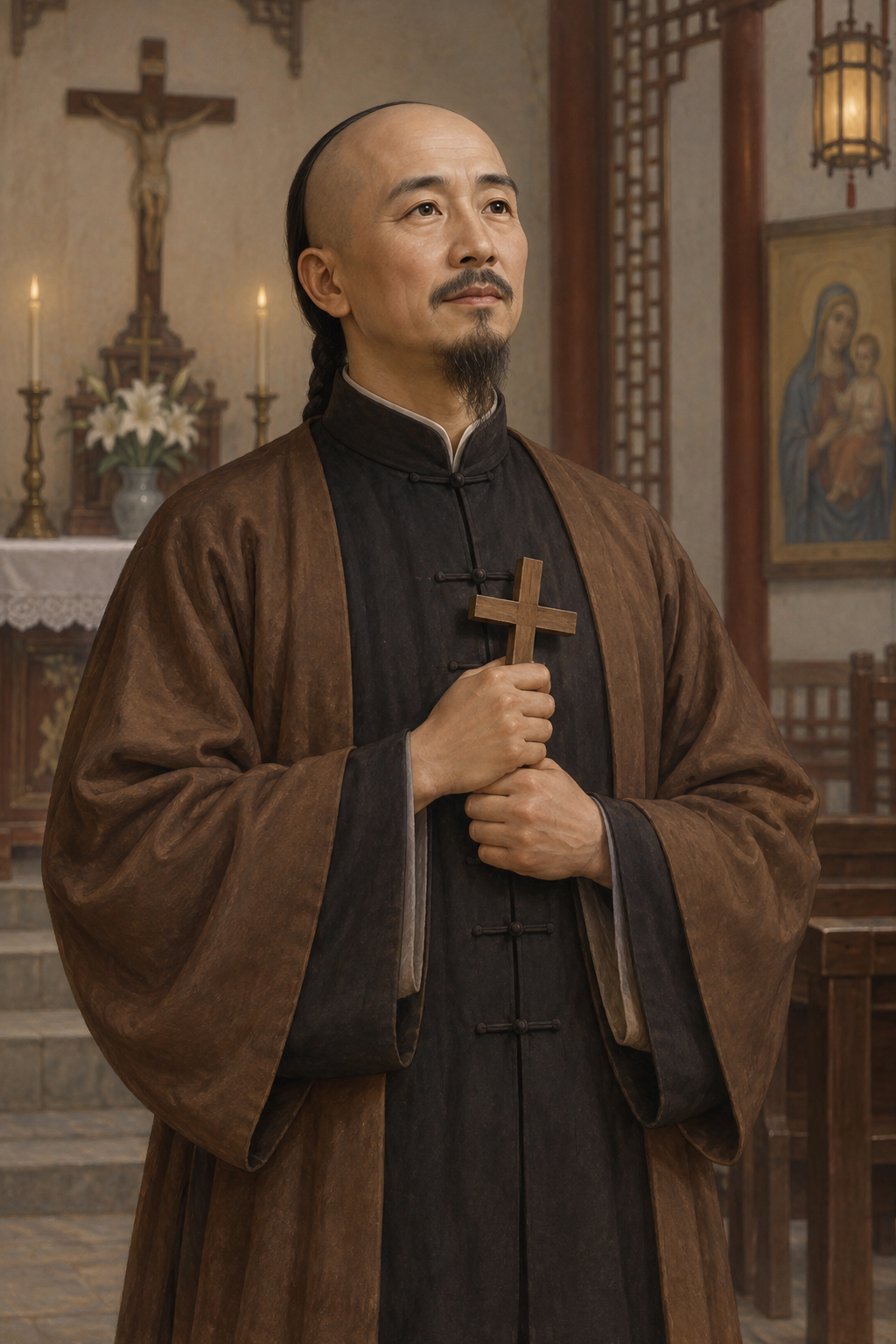
About Augustine Zhao Rong
The Christian communities of Sichuan and Guizhou grew in a period when imperial policy toward Christianity shifted between tolerance and persecution. Catholic missionaries worked across great distances, relying on local Christians to teach, host travelers, and maintain congregations when foreign clergy were detained or expelled. The Holy See’s account of the martyrs of China describes successive waves of persecution from the seventeenth through the nineteenth centuries and the growth of Chinese Christian communities alongside foreign missions. It presents Christianity as taking root among people who retained Chinese identity and culture. This background matters to Augustine Zhao Rong’s life: he entered the church as a local convert and later served as a Chinese diocesan priest in a mission often dependent on Chinese clergy.
Later church accounts place his birth in Guizhou in 1746. The Diocese of Augsburg says that he became a prison warden as a young man. Asia Harvest similarly describes him as a county-prison bailiff.
Zhao Rong’s work brought him into contact with Catholic prisoners during an anti-Christian campaign. The detailed chronology preserved by the Holy Spirit Study Centre’s Tripod study and by the Diocese of Augsburg centers on the French missionary Jean-Martin Moyë. Moyë was detained in the region, where Zhao Rong served as a guard. The prisoner continued teaching the faith, and Zhao Rong listened to him. After Moyë was released, Zhao Rong visited him to continue learning. He was baptized in 1776 and received the Christian name Augustine. Asia Harvest also reports his baptism in 1776 after he sought instruction from Moyë. His conversion thus preceded his priestly ministry by several years.
After baptism, Zhao Rong continued studying with Moyë and learned enough to assist the local church. The Diocese of Augsburg says Moyë taught him reading and Latin; the Tripod study describes the effort to prepare local candidates for priesthood as foreign missionaries faced restrictions. A local seminary gave Chinese candidates a path to pastoral leadership. Asia Harvest reports that Zhao Rong was sent to Sichuan during famine and plague in 1779 to assist Christians, and that he was ordained on 10 May 1781, aged thirty-five. The Archdiocese of Toronto’s account also places his training and ordination in 1781. The sources differ in some parts of their chronology, but these accounts agree that his baptism was followed by priestly preparation and ordination decades before his death.
As a priest, Zhao Rong served Chinese communities over a wide area. The Tripod study says that Bishop François Pottier sent him to work among the Lolo minority in Yunnan after observing his courage and ability. Asia Harvest describes him as leading outreach to minority communities in western Sichuan and traveling to encourage scattered Christians. The Archdiocese of Toronto likewise says that he preached in Yunnan and later visited believers across western Sichuan, explaining the faith and administering the sacraments. These reports portray a ministry dependent on travel and personal contact rather than a settled urban parish. They also show the growing role of Chinese clergy in a church where persecution could remove foreign missionaries and where local congregations needed priests who understood the region and its languages.
The political climate again became dangerous in the early nineteenth century. The Vatican’s collective history describes anti-Christian edicts under the Jiaqing emperor, including measures directed against Chinese students for the priesthood and clergy who preached Christianity. The Tripod study recounts a renewed persecution in 1815 and reports Zhao Rong’s arrest and mistreatment. The Diocese of Augsburg says that he had become associated with the apostolic vicar Gabriel-Taurin Dufresse and that Dufresse was captured during the persecution. Some later accounts connect Zhao Rong’s earlier conversion to Dufresse, but the earlier chronology linked to Moyë is independently detailed and places Zhao Rong’s conversion and baptism in the 1770s. The available evidence does not justify merging these accounts into a single, unambiguous conversion story.
Accounts agree that Zhao Rong was imprisoned, tortured, and died in 1815. They do not agree on the exact day: the Diocese of Augsburg gives 27 January, while Asia Harvest gives 18 December; the Vatican’s canonization biography records only the year. This profile therefore stores the year alone and does not turn a later feast into a historical death date. The Augsburg account places his death in Chengdu, while the other cited narratives are less precise about the location. His death followed a long period of priestly ministry, rather than the short sequence implied by the compressed wording of the Vatican’s 2000 collective biography.
Augustine Zhao Rong was canonized on 1 October 2000 with 119 other martyrs whose deaths span the years 1648 to 1930. John Paul II’s canonization homily names Augustine and the companions as witnesses from different periods of Chinese history and cautions against reducing their varied lives to one story. The July 9 memorial now recalls this broad group, and Vatican News presents Zhao Rong as a Chinese priest whose conversion and ordination helped mark the development of a local clergy. The collective title should not obscure the different identities of the people commemorated with him. Zhao Rong’s own record is concise but distinctive: a prison official became a baptized Christian, a priest, and a victim of renewed persecution.
Wondering how to weigh the stories and sources? Learn how to read a saint biography.