Biography
Bede the Venerable
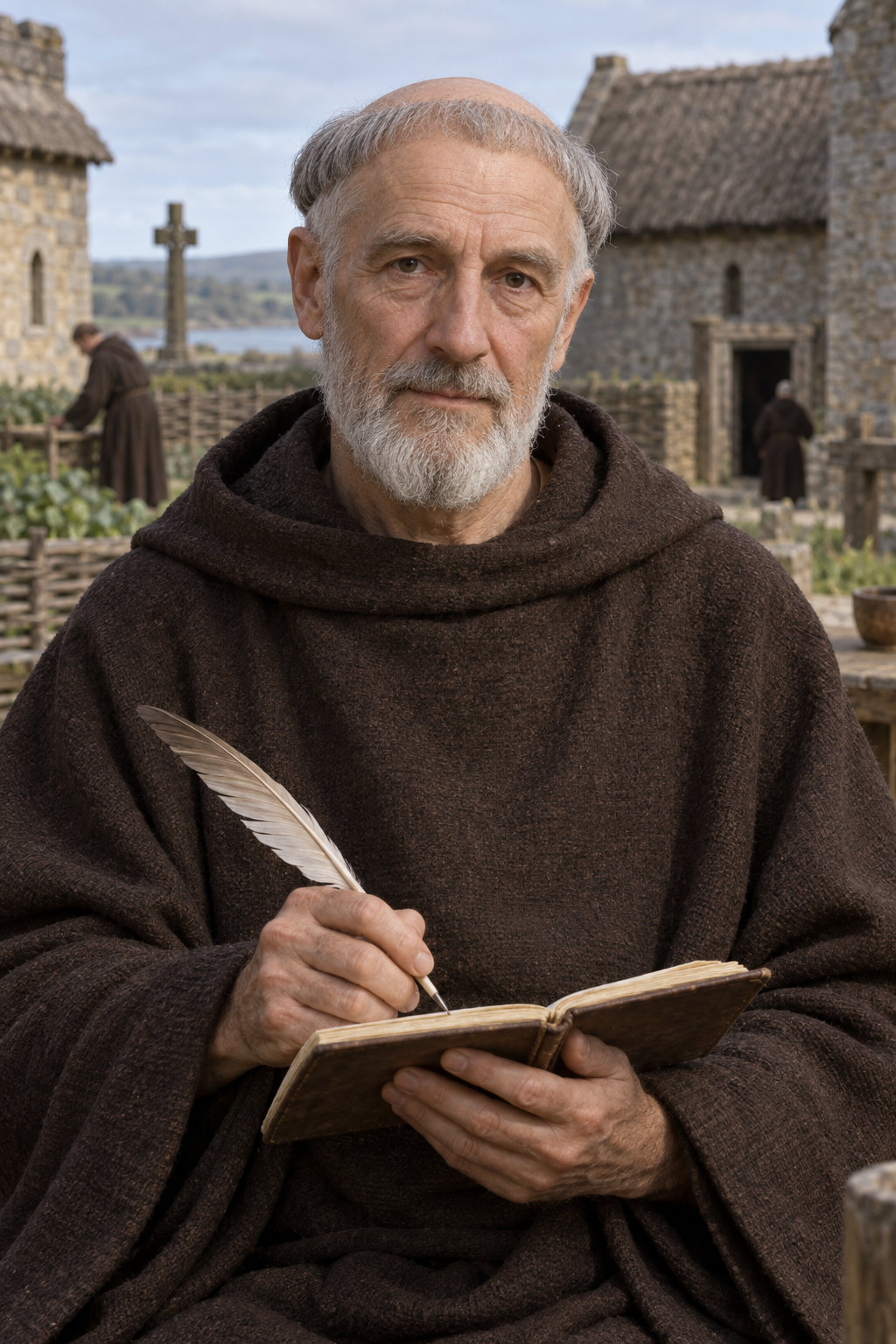
About Bede the Venerable
Bede the Venerable was born around 673 near Wearmouth in Northumbria. At seven he was entrusted to the monastery for education under Benedict Biscop, and later moved to Jarrow under Ceolfrith. The two communities shaped a life devoted largely to study, teaching and prayer. His subjects extended beyond church history to language, astronomy and mathematics. He died at Jarrow in 735. He rarely travelled beyond his monastery.
The resources behind his learning had been assembled through considerable travel by others. In his history of the abbots, Bede describes Benedict Biscop bringing books from journeys abroad and obtaining skilled builders and glassworkers for the monastery. A teacher of Roman church music also came to instruct the community. Near the end of Benedict's life, his concern for the library remained practical: its books were to stay together rather than be dispersed. Bede also records Ceolfrith enlarging the collection. His scholarly home was therefore connected to other places through people, manuscripts and acquired skills. When Bede wrote about these abbots, he preserved the labor that had made his own reading and teaching possible.
He described his own vocation briefly at the end of the Ecclesiastical History. Ordained deacon at nineteen and priest at thirty, he combined monastic observance with learning and instruction. The History itself drew on a network of correspondents. In its preface, Bede credits Albinus and Nothelm with material from Canterbury and with papal letters obtained in Rome. He distinguishes reports from other regions and acknowledges the possibility of errors in what had reached him. Addressing King Ceolwulf, he explains his purpose: accounts of good and bad conduct should help readers choose wisely.
That concern with testimony also appears in his prose Life of Cuthbert. Bede says that he submitted a draft to Herefrith and others who had known the bishop, and corrected it in response to their comments. The community at Lindisfarne then heard the work read and considered it suitable for copying. He records that further stories were offered at that stage, but that he declined to keep enlarging a text he regarded as complete. This account shows a writer negotiating both evidence and the expectations of the people who had commissioned his work. He asked them in return to remember him in prayer, during his lifetime and after his death, and explained that he had already written a shorter verse life of their saint.
Bede's scholarship was rooted in his reading of Scripture. In a modern audience devoted to him, Benedict XVI describes his interpretation as centered on Christ and on the relationship between the Old and New Testaments. Images of the temple and tabernacle became ways of thinking about the Church and Christian life. His homilies brought this learning into worship, explaining how the mysteries being celebrated concerned the lives of believers. The same account emphasizes his attention to parents and other lay people, rather than only to the education of monks. His works circulated beyond Northumbria; Boniface requested copies for use in his mission. Learning that began in a monastery could therefore reach other churches through the slow work of copying and exchange.
A surviving letter to Ecgbert gives the pastoral writer a sharper voice. Illness prevented a visit, so Bede sent advice in writing. He urged the bishop to appoint enough priests and teachers to reach villages throughout an extensive diocese. Teaching should not assume that everyone knew Latin: he says he had himself supplied English versions of the Creed and the Lord's Prayer to priests who needed them. He also condemned the collection of episcopal payments from remote communities left without instruction or confirmation. His criticism concerned an unequal exchange, in which church authorities received material support while failing to provide the care entrusted to them. He wanted the bishop's conduct and teaching to agree.
His pupil Cuthbert's letter describes a final illness marked by breathlessness, continuing lessons and dictation. Bede was working on an English rendering of part of John's Gospel and on selections from Isidore. Cuthbert remembers the urgency with which he asked a pupil to keep writing, as well as the small possessions he distributed among the monastery's priests. It recalls an Ascension antiphon that moved him to tears and ends with him facing the place where he prayed, supported by a pupil. This is the recollection of an affectionate disciple, whose particular memories preserve a teacher still concerned for those around him.
The survival of his books gives material evidence of their later use. The British Library catalogs a ninth-century French copy of The Reckoning of Time that had reached England by the early eleventh century. Readers there added Latin and Old English glosses, and a lunar table acquired musical notation. The manuscript is now part of Cotton Vespasian B VI. These additions record readers working with Bede's text long after his death, adapting a book about the reckoning of time within their own learned practice.
Wondering how to weigh the stories and sources? Learn how to read a saint biography.
Explore similar vocations
Prayers for Bede the Venerable
Bede the Venerable: sourced prayer excerpt
do not forsake us orphans