Biography
Gregory the Great
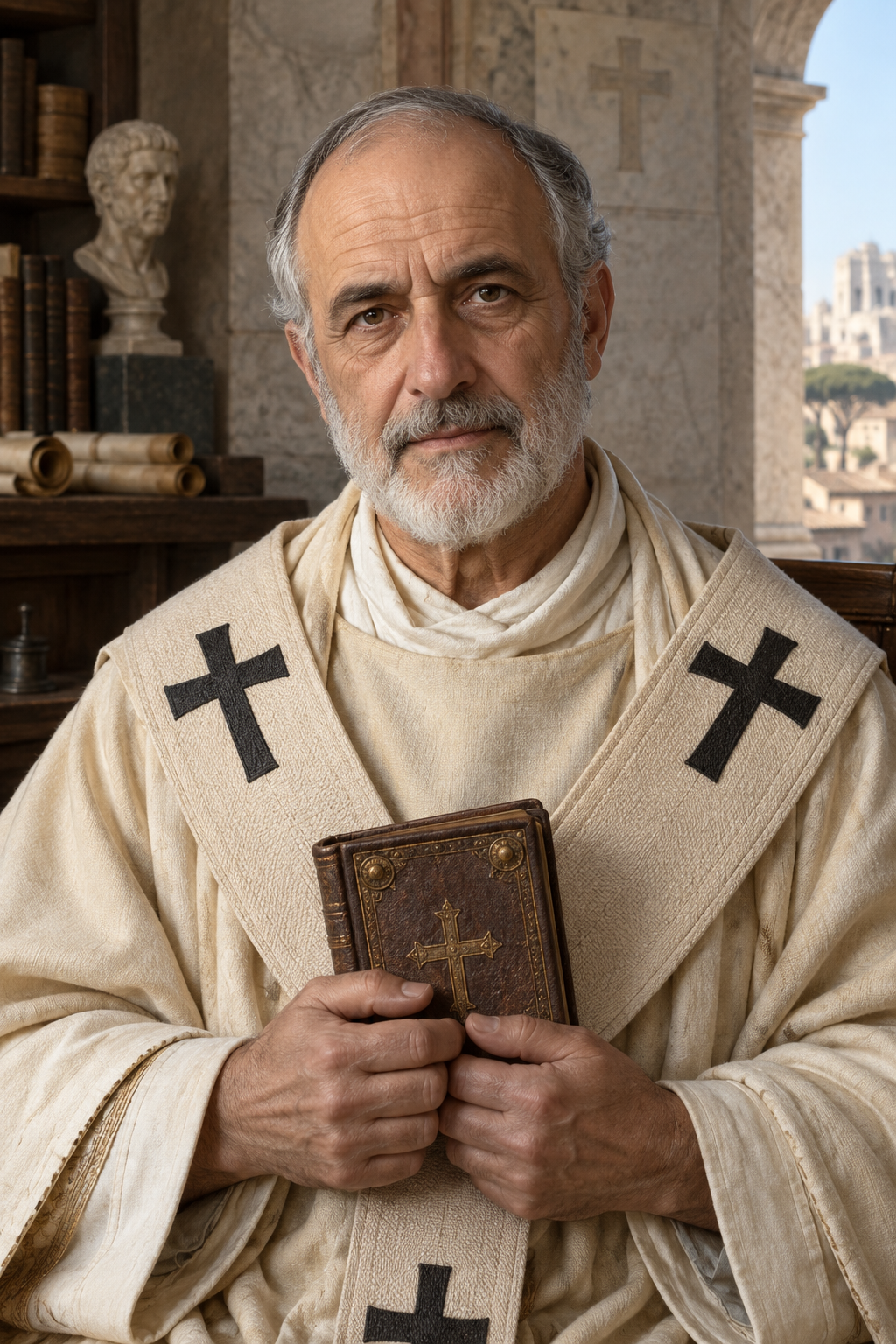
About Gregory the Great
Gregory the Great became bishop of Rome after serving the city in civil office and seeking a quieter life as a monk. Born around 540 into a wealthy Roman family, he became prefect before turning his family home on the Caelian Hill into the monastery of Saint Andrew. Pope Pelagius II later sent him as a representative to Constantinople, where he sought imperial help against the Lombards. After returning to Rome, Gregory assisted the pope. Flooding, hunger, and plague afflicted the city, and Pelagius died in 590. Gregory succeeded him amid these emergencies, carrying responsibility for people whose needs included food and protection as well as worship.
Gregory also worked toward peace with the Lombards. Negotiations with King Agilulf brought a truce, followed by a more durable settlement in 603. His correspondence with Queen Theodolinda accompanied that effort, connecting diplomatic work with religious discussion and gifts for the royal family.
That responsibility reached into the accounts of the Church's estates. Writing to Peter, his agent in Sicily, Gregory ordered dishonest weights destroyed and unjust grain charges corrected. He wanted tenants to receive written protections so that the abuses would not return after his death. He also directed that church funds be advanced to people forced to borrow before they could sell their produce, with repayment spread over time. The letter treats restitution as a duty: church income must not depend on keeping money wrongly taken from others.
He also had to decide how a mission should approach unfamiliar communities. In his letter to Mellitus, Gregory advised keeping sound temple buildings while removing the idols and converting the places to Christian worship. He proposed changing sacrificial gatherings into Christian celebrations. The approach sought gradual change through places and customs people already knew, rather than requiring every outward habit to disappear at once.
The mission belonged to a more complicated religious landscape than a story of one pope converting an entire island would suggest. Britain already had Christian communities from the Roman period, while the Anglo-Saxon kingdoms had different rulers and religious histories. Gregory's missionaries worked in Kent, where royal support mattered, but this was only part of the later spread of Christianity. Irish missionaries and other communities also contributed. The transition extended over generations, and older practices did not vanish immediately when rulers accepted baptism. Gregory's initiative was therefore an important beginning for a particular mission, not the beginning of all Christianity in Britain.
His Pastoral Rule applies a similar attention to differences between people to the work of teaching. A preacher should not give precisely the same counsel to hearers facing opposite temptations. Gregory distinguishes those who possess wealth but will not share it from those who give generously while continuing to take what belongs to others. The first group must learn that hoarding necessities harms their neighbors; the second must stop treating gifts as an excuse for injustice. He also warns teachers who understand Scripture but speak proudly to examine their own conduct. The book makes leadership demanding in a particular way: correcting someone else never removes the teacher's obligation to accept correction personally.
Gregory's biblical teaching took several forms. His reflections on Job attend to the narrative, its spiritual meaning, and the conduct of the reader. His Gospel homilies were delivered in the churches where Rome's people gathered for worship, rather than reserved for a scholarly circle. Benedict XVI dates the first of that series to Advent 590 at Saint Peter's and its last to 593 at Saint Lawrence's. Scriptural interpretation and public preaching thus belonged to the same episcopal ministry. Gregory wanted reading to lead into the life of the hearer, joining reflection on the text to choices about how to live.
He also taught through stories. Book Two of the Dialogues is devoted to Benedict, with questions from Peter giving the narrative the shape of a conversation. In its account of Benedict's last meeting with his sister Scholastica, she asks him to remain through the night for further conversation. He refuses, she prays, and a storm prevents his departure. Gregory presents the outcome as a lesson about love, not merely an unusual change in the weather. This is a miracle narrative within an edifying work; its role in Gregory's teaching can be described without presenting the storm's supernatural cause as independently established history.
His final years were marked by recurrent illness, including gout, while the demands of office continued. He died on 12 March 604. The name Gregorian later became inseparable from the history of church music, but that association should not be mistaken for proof that he personally composed the surviving chant repertoire. The extent of his liturgical reforms and his connection to later books bearing his name have long been debated. His place in Christian history rests more securely on the surviving writings and the work of government they record than on assigning every later Gregorian practice directly to him.
Wondering how to weigh the stories and sources? Learn how to read a saint biography.
Explore similar vocations
Prayers for Gregory the Great
Gregory: closing troparion petition
Entreat Him that He may save our souls.