Biography
Bernard of Clairvaux
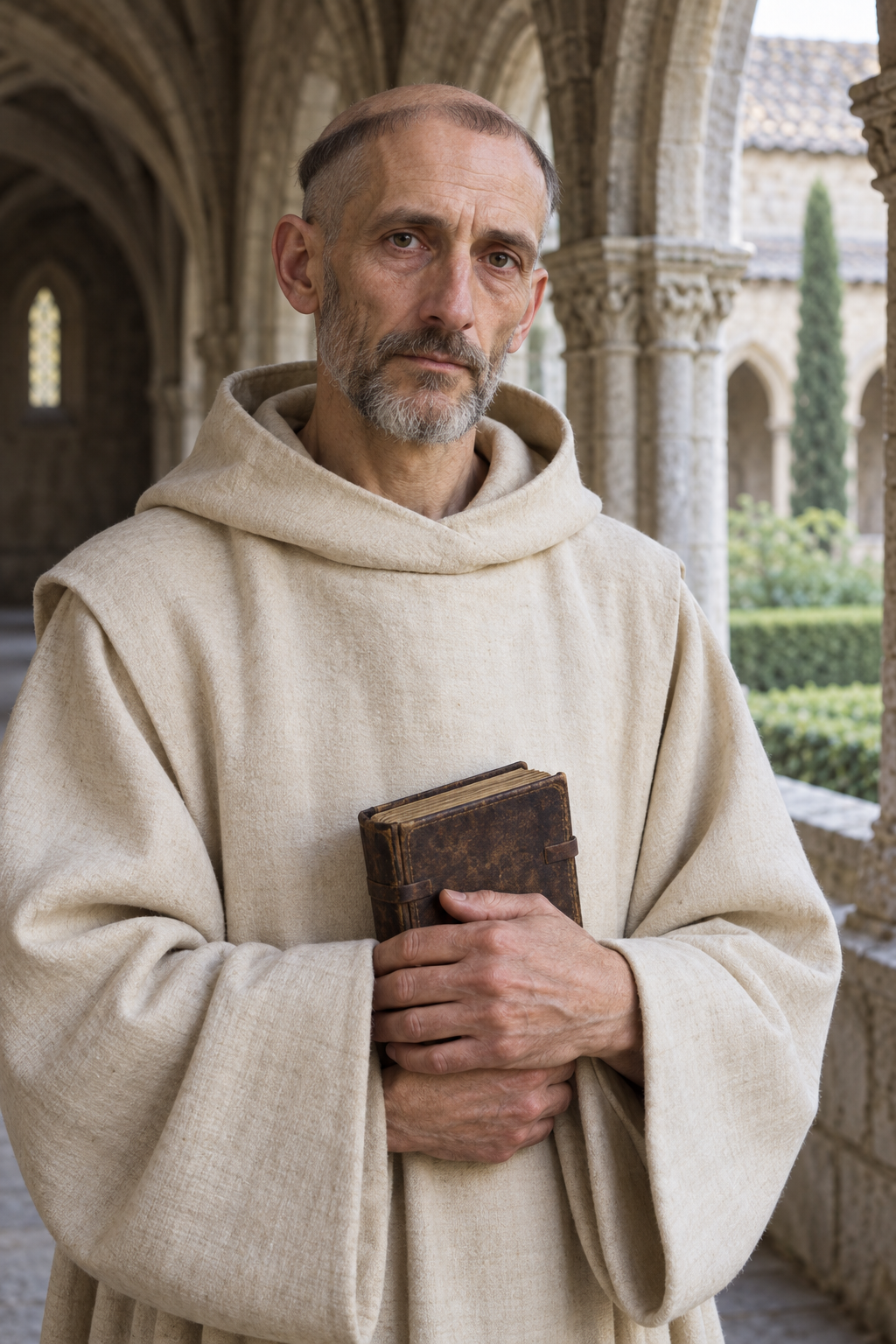
About Bernard of Clairvaux
Bernard of Clairvaux was a monk whose responsibilities repeatedly drew him beyond the monastery. He wrote about prayer and the love of God while also advising church leaders and intervening in public disputes. Born in 1090 at Fontaines in France, he studied at the school attached to Saint-Vorles in Châtillon-sur-Seine. Benedict XVI's account emphasizes that the details of his childhood are limited.
He entered Cîteaux, a monastery founded before his arrival to pursue a demanding form of communal religious life. The Cistercians' official history dates his entry to 1112 and records the arrival of relatives with him. Their program sought simplicity and poverty through a close observance of Benedict's Rule. Bernard therefore joined an existing reform; he did not originate the community at Cîteaux. In 1115 he was sent to establish Clairvaux, which became the monastery associated with his name and the center of his own work as an abbot.
The new community faced difficult material conditions. The Vatican City biography describes limited resources and a severe way of life in its early years. It also records Bernard's chronic stomach difficulties and William of Champeaux's effort to provide him with gentler living arrangements. His campaign for austerity extended to monastic decoration: in his Apology to William of Saint-Thierry, he criticized practices that he considered a distraction from prayer.
Bernard's spiritual writing asks what moves a person to love. In On Loving God, he begins with God's prior generosity rather than with an achievement by the believer. He describes a movement from concern for oneself, through reliance on God's help, toward loving God for God's own sake. The argument also makes room for the neighbor: a person cannot claim unlimited comforts while refusing to share with someone who has the same human needs. His account of religious growth thus connects the direction of desire with the use of ordinary goods.
He also explored love through the biblical Song of Songs. Passages preserved in Pius XII's Doctor Mellifluus portray the relationship between the soul and God through the language of marriage. The emphasis is on a union of wills and love rather than a physical relationship. In the same collection of excerpts, Bernard distinguishes seeking knowledge for reputation or profit from learning that helps oneself and others grow. His concern is the purpose of study, not a blanket rejection of understanding or careful thought.
His correspondence shows how an abbot's influence could serve an individual petition. In Letter 511 he asks the Queen of the Franks to restore favor and property to Wicardus, who had complained of dispossession and exile. Bernard presents the man's intention to enter religious life as a reason to help him. The letter also commends the abbot carrying the request. Its surviving words establish the appeal, not the justice of every allegation or the outcome. The modern edition identifies the queen as Eleanor of Aquitaine and dates the letter between 1144 and 1147.
Other interventions had far wider and more troubling consequences. In letters promoting the Second Crusade in 1146, Bernard urged Christians to take up arms and connected participation with spiritual reward. In his letter to England, he also forbade attacks on Jews. His reasoning nevertheless treated Jewish communities as witnesses within a Christian account of history and looked toward their conversion. Protection from killing did not mean acceptance of religious equality. In a letter to Archbishop Henry of Mainz, Bernard condemned a monk's incitement to murder alongside his unauthorized preaching.
The crusade failed to achieve its intended success. Pius XII's later account acknowledges that failure while defending Bernard from blame. That defense belongs to the papal author's assessment; Bernard's own appeals remain evidence of his active promotion of the expedition.
Bernard also disputed Peter Abelard's approach to theology and corresponded with Peter the Venerable of Cluny. When his former pupil became Pope Eugene III, he addressed the responsibilities of papal office in On Consideration. His relationship to the pope thus combined respect for an office with the continuing responsibilities of a spiritual adviser.
His admiration for religious discipline could also embrace organized warfare. In Praise of the New Knighthood supported the Templars, a military religious community. Vatican News includes that work alongside his teaching on Jesus and Mary. Holding these different writings together matters: an account confined to his language of love would leave out a substantial part of the religious world he supported. His contemplative teaching and his endorsement of armed service belong to the same author's legacy, even when their relationship is difficult for later readers.
Bernard died on 20 August 1153. Alexander III canonized him in 1174, and Pius VIII declared him a Doctor of the Church in 1830.
His lasting importance can be approached through the surviving works themselves: an account of love, appeals made for other people, and interventions that tied spiritual conviction to public power.
Wondering how to weigh the stories and sources? Learn how to read a saint biography.
Explore similar vocations
Prayers for Bernard of Clairvaux
Prayer in tribulation — Bernard, quoted by Pius XII
It is good for me, O Lord, to embrace Thee all the more in tribulation