Biography
Charles de Foucauld
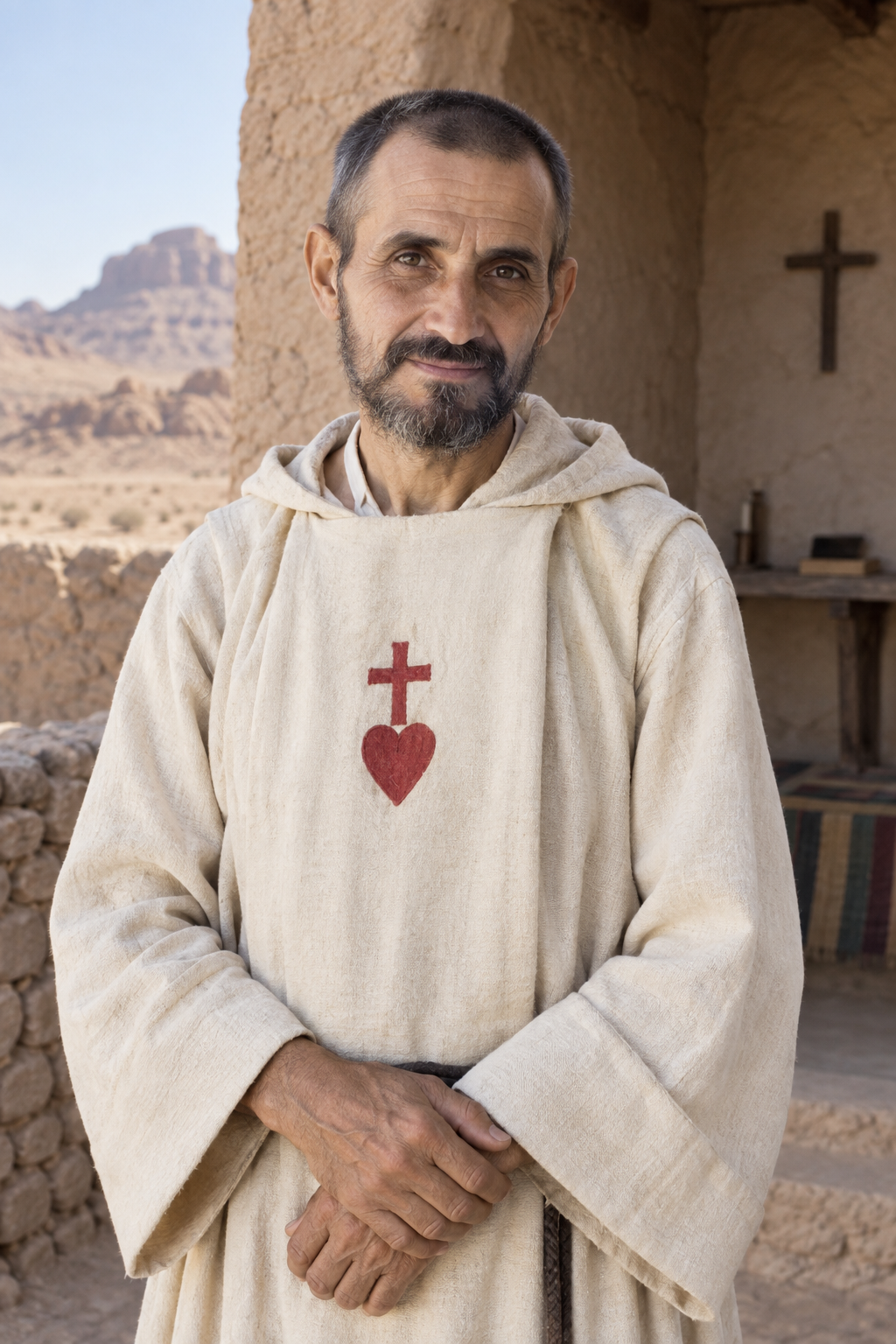
About Charles de Foucauld
Charles de Foucauld spent much of his adult life looking for a way to follow Jesus in the ordinary work and obscurity of Nazareth. Born in Strasbourg on September 15, 1858, he lost his parents as a child and grew up with his sister Marie in their grandfather's care. He followed a military career but lost his Christian faith during adolescence. His exploration of Morocco in 1883–1884 brought him into contact with Muslims whose practice of faith unsettled his unbelief. With his family's welcome and Huvelin's guidance, he returned to Catholic practice in October 1886.
His published account of Morocco begins by thanking the people who made the journey possible. Mac Carthy's advice had helped prepare the expedition. He named French and Moroccan helpers together, including Christians and Muslims, refusing to separate his gratitude along those lines. Among them were Hadj Bou Rhim and Bel Qasem el Hamouzi, whom he credited with protecting his life at the risk of their own. Charles remembered Bou Rhim as a particularly dependable friend during the months they travelled together. He wrote that his host had guessed he was a Christian before Charles acknowledged it himself. The admission strengthened their friendship rather than ending it. These memories give his exploration a human setting: the journey depended on local knowledge, courage, hospitality, and the trust that developed between particular people.
He entered the Trappists in 1890, living in France and Syria. Seeking greater poverty, he later left with permission and served the Poor Clares at Nazareth from 1897 to 1900.
Priesthood became the next step in that search. On June 9, 1901, Bishop Joseph Bonnet ordained him in the seminary chapel at Viviers, following preparation at Notre-Dame-des-Neiges. Charles understood his priestly work through the Eucharist: contemplation and service were to belong together, rather than compete for his attention. He would spend long periods in adoration during his years in Béni-Abbès and Tamanrasset. The same commitment led him to learn the Tuareg language, translate the Gospels, and compile linguistic tools for those who would come after him.
At Béni-Abbès, where he arrived in 1901, his carefully ordered hermitage became a place of constant welcome. People came seeking help, and he wanted them to regard his house as a fraternity. He objected to slavery in the region and called for protest against government injustice.
He settled at Tamanrasset in 1905, among Tuareg neighbours whose language demanded years of sustained attention. His linguistic work grew from an initial practical lexicon into a much larger dictionary, using poetry and prose collected locally. The material was not confined to religion: poems celebrated love, warfare, animals, and the landscape. The linguist Adolphe de Calassanti-Motylinski helped him develop a more systematic method. Charles sometimes regretted that these studies left too little time for the manual labour he associated with Nazareth. Yet he continued the demanding task, preparing resources that would outlast his own residence in the Sahara.
His friendships developed within an unequal colonial order. He entered Tuareg territory with French military expeditions in 1904 and 1905, an association that could make a priest difficult to distinguish from an occupying army. Historian Dominique Casajus shows that personal affection did not mean agreement with French rule or Christian belief. Letters sent to Charles by Tuareg correspondents carried requests for remedies, news of family life, and affectionate greetings. They reveal relationships with people pursuing their own concerns, not simply an audience waiting for conversion. The friendship of the leader Moussa ag Amastan likewise did not make him a Christian disciple.
Charles's own correspondence preserves the limits of his outlook. In a letter dated June 4, 1908, he proposed education and what he called civilization as preparation for converting Algeria's Muslims. The language placed European Christian society above the people he hoped to serve. His wish to act generously coexisted with assumptions that denied equal value to their religious life. Elsewhere he described the daily work of correcting his faults and beginning again, disappointed by how little he believed he had accomplished. His spiritual writing records both determined faith and this persistent dissatisfaction with himself.
The prayer now called the Prayer of Abandon grew from a meditation he wrote in 1896 on Jesus's final prayer. Its familiar wording is a later adaptation, not a text he left in exactly that form. It expresses readiness to entrust oneself to God, and became a common prayer among communities inspired by him.
Charles was killed at Tamanrasset on December 1, 1916. The Catholic Church beatified him in 2005 and canonized him on May 15, 2022.
After the canonization, Pope Francis remembered Charles's hospitality and the influence his spirituality had exerted on his own theological formation. He singled out Father Paoli and the books of Voillaume as ways he encountered Charles's spirituality during his own years of theological study.
Wondering how to weigh the stories and sources? Learn how to read a saint biography.
Explore similar vocations
Prayers for Charles de Foucauld
Charles de Foucauld: sourced prayer excerpt
do with me what you will.