Biography
Cirilo Bertrán
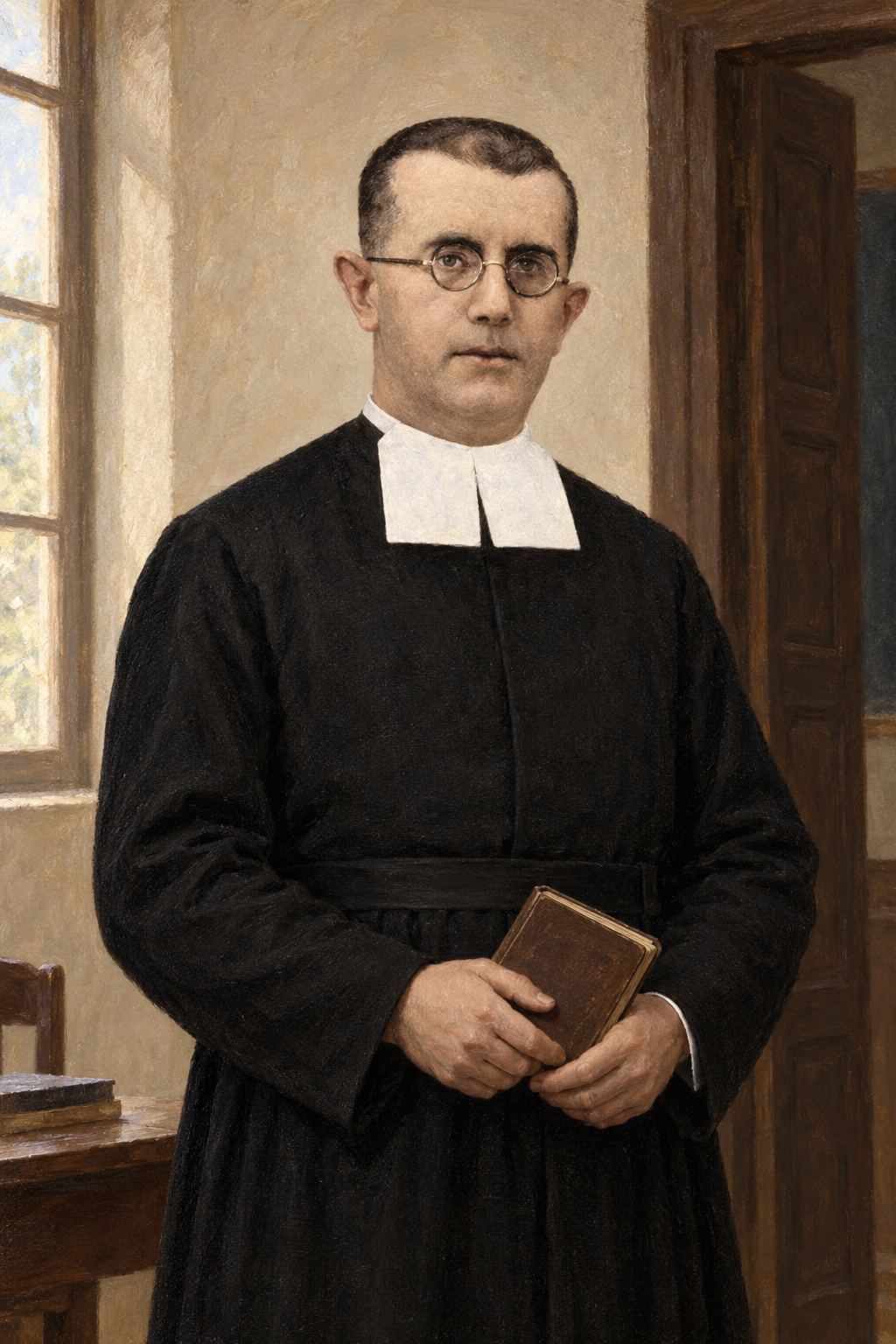
About Cirilo Bertrán
Cirilo Bertrán was a Spanish teaching brother whose life was spent in classrooms and the leadership of school communities. Born José Sanz Tejedor at Lerma on 20 March 1888, he came from a working family and joined the Brothers of the Christian Schools at Bujedo. He later directed their community at Turón, where he and seven brothers died with a Passionist priest on 9 October 1934.
His teaching career began well before his final assignment. The Lasallian account places him at Deusto in 1909, followed by work at the Sacred Heart institution in Madrid and schools at Puente de Vallecas and Santa Susana. Other appointments took him to Villagarcía and Sanlúcar de Barrameda. He made his perpetual vows in 1916. The succession of places reflects a life available for the institute’s educational work, rather than a career confined to one familiar town.
He also served as a director at Isla and Riotuerto and then at the San José school associated with Santander’s Catholic Circle. The same account describes his manner as calm and thoughtful. When he moved to Turón, those qualities helped a community living with growing tension. He completed only one full school year there, but brought years of teaching and leadership experience to the task.
A history preserved by the former pupils of La Salle in Santander offers a closer view of his leadership there between 1925 and 1930. It reproduces the recollection of an unnamed brother who had lived with him, originally collected for a memorial notice. That colleague remembered three especially happy years of religious life. Although the community was poor, Cirilo found ways to meet its needs and encouraged the brothers to remain united. The testimony is a personal remembrance, not an independent account of everything that happened in the school. Its value lies in the particular qualities a companion chose to recall: practical care and attention to community life. The same local history remembers his simplicity and his approachable manner with pupils and their families. These recollections place his educational work within everyday relationships, extending beyond the duties of a school director to the people who shared his house and entrusted children to his care.
Turón stood in an Asturian mining district, and the brothers’ school served miners’ sons. The New Catholic Encyclopedia places their deaths within the political unrest and anticlerical conflict of the Spanish Republic. Restrictions on religious education had directly affected the work of teaching congregations. The uprising of October 1934 preceded the outbreak of the Civil War in 1936. Keeping those events distinct matters: Cirilo’s death belonged to an earlier episode of violence, even though the Church later remembered the victims alongside other twentieth-century Spanish martyrs.
Cirilo arrived as director in 1933. During the summer of 1934 he attended a month-long retreat at Valladolid. The canonization biography remembers his prudence and serenity as a support to the other brothers.
On 5 October armed men arrested the eight brothers and Father Inocencio de la Inmaculada, who had come to provide sacramental ministry. They were confined in the Casa del Pueblo. The revolutionary committee ordered their deaths, and they were taken to the cemetery and shot in the early hours of 9 October. The Vatican account remembers them preparing through prayer, confession and forgiveness.
Their deaths did not erase the distinction between their vocations. The eight Lasallians were brothers, while Inocencio was the priest who served the school community. In his canonization homily, John Paul II presented the teachers as witnesses to faith through their educational service. He emphasized their fraternity and perseverance in prayer, and explained that they were educators rather than participants in a human war. His interpretation directs remembrance toward their religious commitment and care for young people.
The cause also included another Lasallian, Jaime Hilario, who died separately at Tarragona in 1937. He was not one of the nine killed at Turón. John Paul II explicitly distinguished him in the same homily. That distinction prevents a shared canonization from becoming a misleading account of a single arrest or execution. The Church’s collective remembrance joins different lives without making their final circumstances identical.
The diocesan investigation of the Turón martyrs’ cause began in the 1940s. They were beatified in 1990 and canonized in 1999. The New Catholic Encyclopedia traces those stages and the recognition of their martyrdom, showing that public veneration followed a later process of testimony and judgment.
At Turón, remembrance remains connected with a living parish. In November 2024 the Archdiocese of Oviedo reported celebrations for the twenty-fifth anniversary of the canonization. The parish priest described a space dedicated to the martyrs in San Martín’s church, with a painting by local artist Juan Luis Varela and a reliquary. He also described a small chapel dedicated to them in the parish rooms. These places keep the memory close to the community in which the brothers taught.
Wondering how to weigh the stories and sources? Learn how to read a saint biography.