Saint profile
Cunibert of Cologne
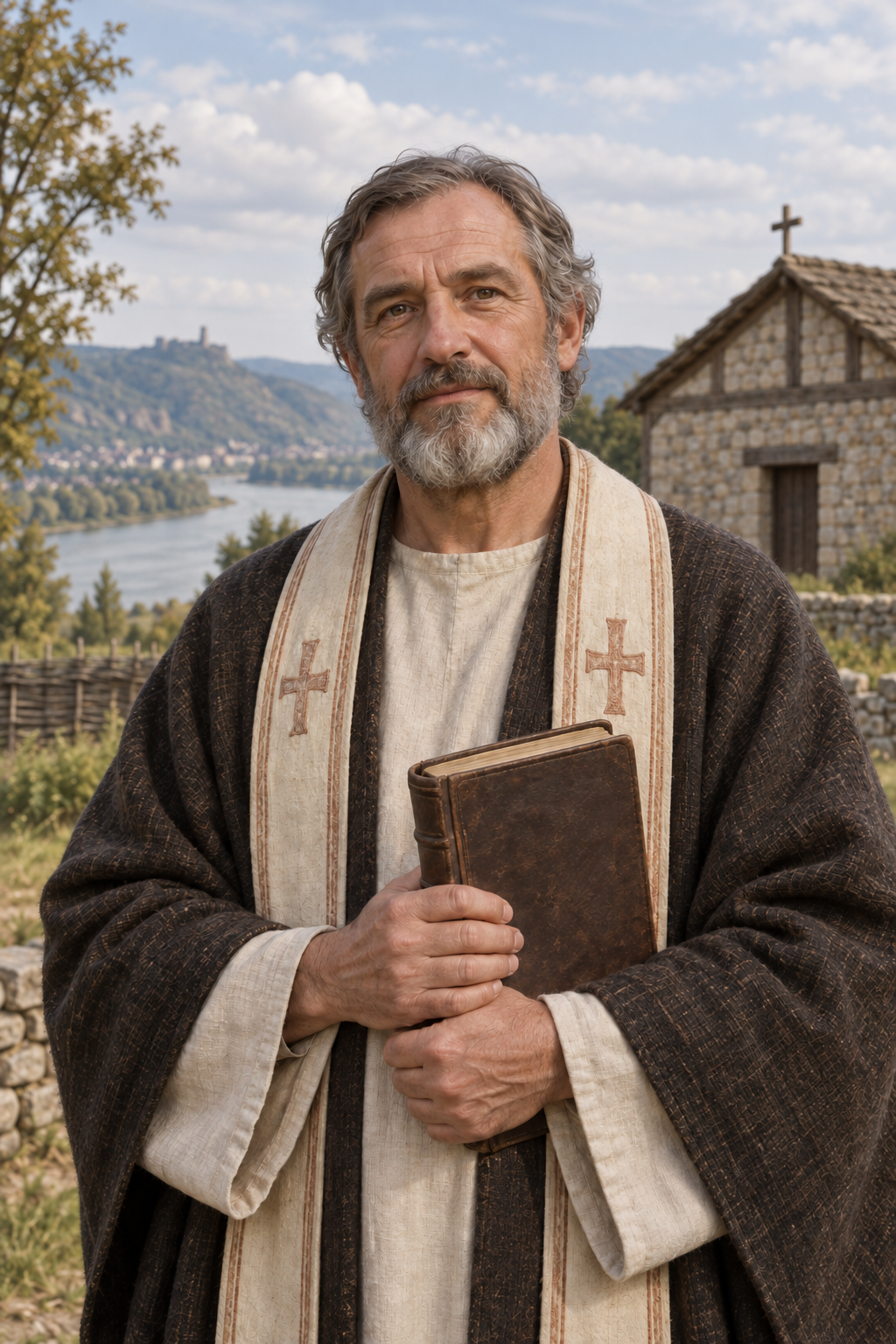
About Cunibert of Cologne
Cunibert belongs to the first generation of Cologne bishops for whom more than a name survives. Even so, the evidence is uneven. The seventh-century Chronicle of Fredegar records his political activity, while conciliar material establishes his episcopal office. His saint's Life was composed centuries later. Heribert Müller therefore warns that the dossier also contains forged charters and tendentious narrative. A responsible account begins with those limits rather than treating every source as contemporary.Müller's later biographical study reaches the same caution by comparing genres. A council subscription records office; a chronicle selects political action; a saint's Life shapes an exemplary career; and a grave inscription celebrates memory. None answers every biographical question. Cunibert can therefore be placed securely in institutions and public events while his upbringing, personal spirituality, and ordinary episcopal work remain largely inaccessible.His birth is usually placed around 590. A Moselle or Trier-Metz aristocratic background is probable, but the proposed birthplace at Remich and other local claims are not secure. The later Life describes education at a royal court and an ecclesiastical path through Trier. Those details may preserve a plausible social setting, yet the regional political history cautions that they also resemble a conventional ninth-century account of a successful Frankish bishop.Cologne then stood near the edge of the Frankish political heartland. The regional study argues that Cunibert's influence arose from his own court relationships more than from an already dominant Cologne see. His career thus reveals a moment when Austrasia's importance allowed a Cologne bishop to operate close to royal power. Later bishops again become little more than names in lists, which makes broad institutional continuity unsafe to infer.Cunibert became bishop of Cologne by the 620s. Calculations from a later consecration tradition have produced 617 or 623, but the secure point is his appearance at the Council of Clichy in 626/627. The council addressed church property, episcopal authority, clerical discipline, asylum, violence, and the protection of religious women and widows. Cunibert's subscription places him within the working episcopate of the Frankish kingdoms without proving that he personally authored every canon.Fredegar presents Cunibert as a valued adviser to Dagobert I. This role joined church office with government in Austrasia, the eastern Frankish kingdom. Dagobert established his young son Sigebert there, and the chronicle names Cunibert with the duke Adalgisel in the arrangements for the child's rule. The report is close in time and gives the clearest picture of Cunibert's public importance, although Fredegar's political aims mean that praise and motive cannot simply be accepted at face value.After Dagobert died in 638 or 639, Cunibert went to Compiègne in connection with the division of the royal treasury and Sigebert's share. Following Pippin the Elder's death, he supported Grimoald's succession as mayor of the palace. The Neue Deutsche Biographie also notes that Cunibert disappears from prominent political action after about 640 and is last encountered in a royal charter of 651. This quieter record should not be filled with invented pastoral journeys.The regional biography associates Cunibert with western initiatives, episcopal consecrations, and monastic foundations, but often uses cautious language. A role in revising the Lex Ribuaria has likewise been proposed rather than proved. These possibilities fit a bishop integrated into royal government, yet they are not suitable as featured events without closer examination of each charter and its authenticity. The safer conclusion is that Cunibert helped connect Cologne's church with Austrasian court society.Claims for extensive missionary work in Frisia, Saxony, Westphalia, and Gaul rest heavily on a grave inscription of uncertain date and later tradition. NDB finds little firm support for many associated churches and foundations. A royal grant connecting Cologne with a church at Utrecht before 634 may be credible, but it does not by itself document Cunibert personally preaching across all those regions. “Missionary” may remain a received title; the expansive itinerary should not be narrated as established history.Cologne tradition says Cunibert built or enlarged a church dedicated to Clement on the Rhine and was buried there. The site later became the collegiate church of Saint Kunibert. This burial association is plausible, while architectural details remain later testimony. The story that a dove revealed Ursula's grave to him belongs to legend. It should not be used as evidence that he discovered a historical burial or as a substitute for an event from his documented public life.Cunibert probably died around 663, but the exact year is uncertain. His cult is securely visible by the early ninth century and remained especially rooted in Cologne and Trier. The present Archdiocese of Cologne celebrates him on November 12 as a bishop. That observance supports the feast field, while it does not turn the traditional day into a documented death date. His enduring historical importance lies in the unusual glimpse the surviving sources give of a Cologne bishop acting within Merovingian government.