Biography
Daniel and Companions
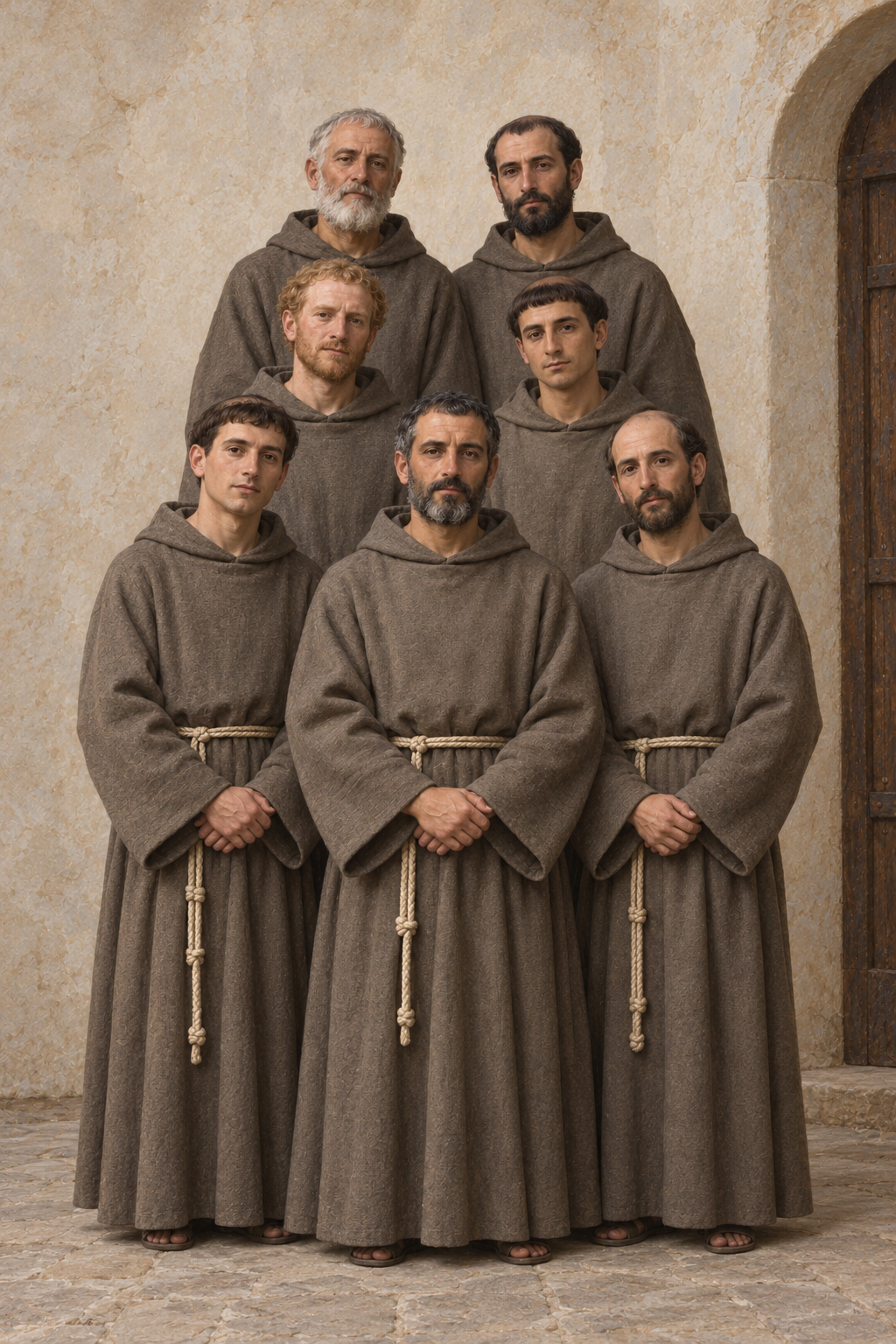
About Daniel and Companions
Daniel and his companions are honoured as seven Franciscan martyrs of Ceuta. The traditional group comprises Daniel, Samuel, Angelo, Donulo, Leo, Nicholas and Hugolinus. Their cult is well established, but the historical events behind their shared story remain disputed.
The Passion preserved in the Chronicle of the Twenty-Four Generals places their deaths in 1227. It describes a journey from Italy through Tarragona to Ceuta, where the friars first preached to Christian merchants from Mediterranean ports. They then entered the city without the required permission to proclaim Christianity publicly. Arrest and imprisonment followed.
The same narrative presents their preparation through confession, Communion, prayer and washing one another’s feet. It includes a letter attributed to Daniel from prison, explaining their mission through biblical passages about preaching and suffering. These details show how the account portrays the friars’ religious commitment; they do not independently establish the authenticity of the letter or its reported setting.
The story also includes confrontational denunciations of Islam, rather than describing only quiet worship or care for an existing congregation. In Ambrogio Maria Piazzoni’s account, Daniel insults Muhammad during an interrogation and refuses demands to retract and convert. The friars are then condemned and killed. A responsible account should preserve this difficult part of the tradition without repeating its hostile language as a judgment on Muslims.
Piazzoni, writing in 1986, accepted the prison letter and the central martyrdom narrative while distinguishing them from much later material about Daniel’s earlier life. He regarded the surname Fasanella as late and insecure. Other details, including a meeting with Francis of Assisi and particular foundations in Calabria, depend on a much later and uncertain source.
More recent scholarship challenges the story more fundamentally. Christopher MacEvitt notes that the earlier writer Elemosina assigned the names Leo, Ugo and Dompnus to the Moroccan martyrs of 1220. Later texts made these names part of a separate group supposedly killed at Ceuta in 1227. Following Isabelle Heullant-Donat’s argument, he treats this as evidence that the Ceuta group may have been created to reconcile conflicting traditions. The account therefore cannot safely be presented as an undisputed eyewitness report.
Daniele Solvi’s discussion of Franciscan martyr literature likewise treats the Ceuta martyrs as historically uncertain. He places the expansion of such narratives within the fourteenth-century order’s debates about poverty, obedience and collective identity. These stories told later Franciscans something about who they hoped to be, as well as preserving or reshaping memories of the past.
The history of their veneration is clearer. Leo X authorized their cult for the Franciscans in January 1516, with an October 13 observance. Their continuing place in Franciscan devotion should be distinguished from certainty about each event narrated in their Passion. The church’s remembrance and the scholarly debate can both be stated without concealing either.
Wondering how to weigh the stories and sources? Learn how to read a saint biography.