Biography
Daniel the Hesychast
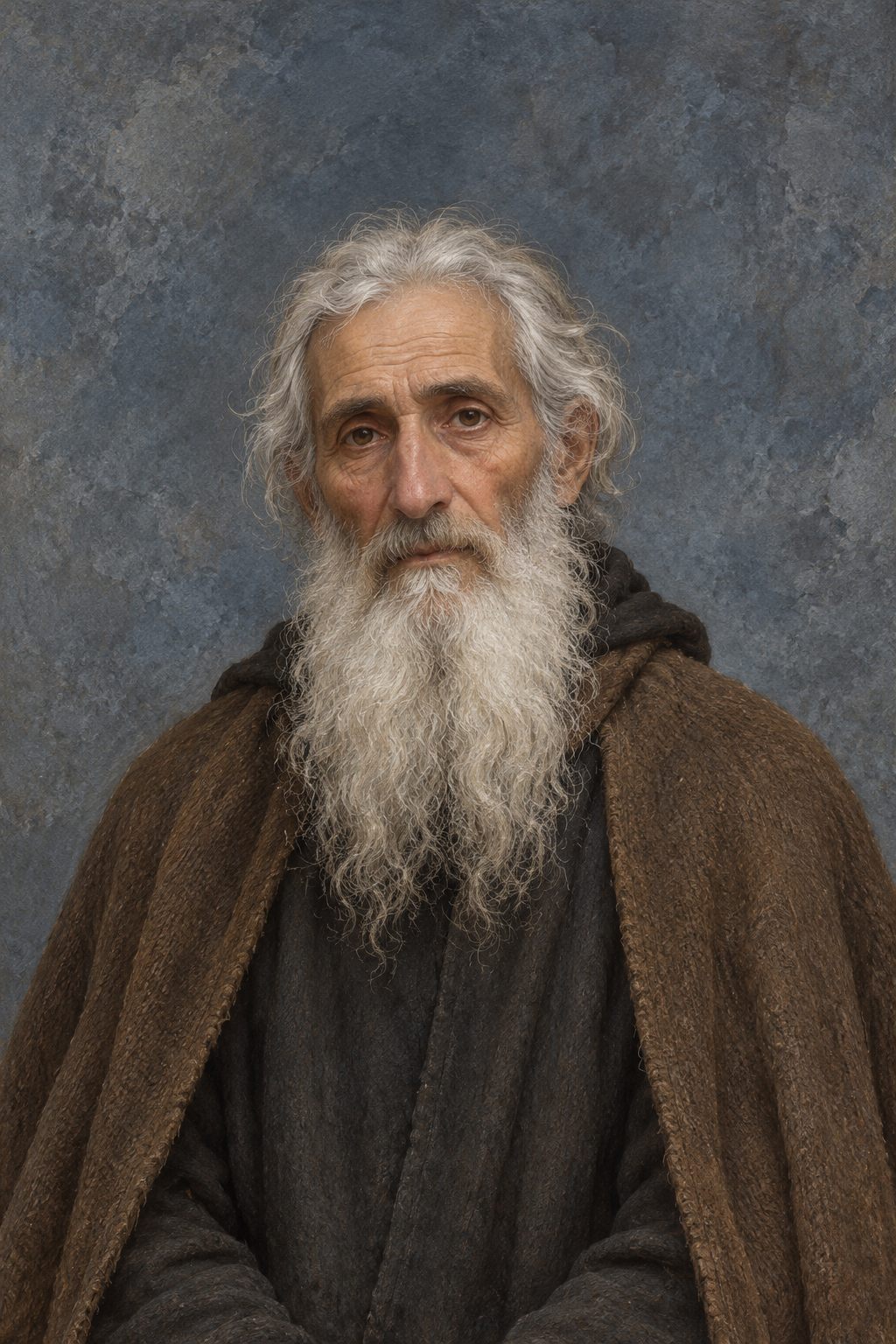
About Daniel the Hesychast
Daniel the Hesychast was a Moldavian monk remembered for solitary prayer and for giving spiritual counsel. His traditional Life places his birth early in the fifteenth century and gives his baptismal name as Dumitru. It describes his entering a monastery near Rădăuți, taking the name David, and eventually receiving priestly ordination. Daniel was the name associated with his later, stricter monastic profession. The account follows him through several communities before his withdrawal to a solitary cell. These details belong to the received monastic biography; they do not supply a securely documented birthday.
The same Life describes him making baskets, supporting himself by his work, and combining long periods of prayer with attention to people who sought him out. Its picture of solitude is therefore not one of complete indifference to other people. Visitors came for counsel, while the monk repeatedly sought a quieter place to live.
The rock-cut chapel near Putna is closely associated with his memory, but its history calls for care. Archaeologist Paraschiva-Victoria Batariuc discusses a proposed dating in the thirteenth or fourteenth century, earlier than Daniel’s traditional lifetime. That proposal does not erase the site’s later association with him. It does mean that a familiar account of Daniel personally carving the entire chapel should not be presented as an established archaeological finding. The surviving place and the stories told about it offer different kinds of evidence, and their histories need not begin at the same moment.
The best-known story about Daniel concerns Stephen the Great after his defeat at Războieni. In Ion Neculce’s collection, Stephen comes to the hermit for advice, but must first wait until Daniel has finished praying. After hearing his confession, Daniel urges him to continue resisting the Ottoman army and to build a church dedicated to Saint George after victory. The story ends with Stephen’s recovery and the foundation at Voroneț. Neculce introduces his collection as stories handed down orally, leaving readers free to believe them or not. This is a later tradition about spiritual counsel and political courage, not a surviving transcript of a meeting between the two men.
Daniel’s final years are associated with Voroneț, where church tradition remembers him as abbot. Archbishop Calinic’s account emphasizes that the year of his death is unknown. The grave inscription identifies the monk by both names, David and Daniel, but gives no death date. For that reason, the often-repeated year 1496 cannot carry the weight of a dated contemporary inscription. The uncertainty concerns the chronology of his life; it does not mean that his remembrance began only in modern times.
Records preserved in the Romanian Academy Library show a much older history of veneration. Oana-Mădălina Popescu identifies a 1551 act referring to Daniel as a holy abbot, as well as his painted image at Voroneț from 1547. Later princely documents associate the monastery with both Saint George and Daniel. A grant of 1699 exempts monastery servants from specified taxes, and subsequent rulers renew privileges. Several eighteenth-century documents refer to Daniel’s relics. These administrative records were not written as biographies, but they show how firmly his memory belonged to the monastery’s institutional life. Popescu distinguishes documents naming him as a patron from those specifically mentioning his relics.
Putna preserves another material witness: a reliquary whose inscription records that Ghedeon, abbot of Voroneț, paid for its silver covering in December 1749. The monastery reports holding a portion of Daniel’s relics in that reliquary. Its account also reproduces the grave inscription connecting the names David and Daniel. Such objects help trace the transmission of his veneration even where a detailed personal chronology cannot be recovered.
The Romanian Orthodox Church formally proclaimed his sainthood in 1992. This recognition followed centuries of local devotion, rather than introducing a previously unknown figure. His annual commemoration falls on December 18. Daniel’s patronage now extends to a particular chapel in Bucharest. In December 2025, the Romanian Patriarchate’s news agency reported that the lower chapel of the National Cathedral was placed under the protection of Daniel the Hesychast and John Jacob of Neamț, the New Chozebite. The dedication belongs to that chapel, rather than making Daniel the patron of the whole cathedral. Together with the older records from Voroneț, it shows two specific settings in which communities have entrusted their worship to his intercession.
Wondering how to weigh the stories and sources? Learn how to read a saint biography.