Biography
Daniele Comboni
About Daniele Comboni
Daniele Comboni was born at Limone sul Garda on March 15, 1831. The catalog stores Limone sul Garda, Brescia, Italy, as his birthplace, and this draft keeps that field unchanged.
His life developed between northern Italy and Central Africa. The page should not make that geography decorative. It shaped his vocation, his hardships, and the missionary plan for which he is remembered.
Comboni became a priest and turned toward missionary service. The Vatican biography presents him as a man whose vocation was inseparable from the peoples of Central Africa and from the formation of a local Church.
That point matters for modern readers. The language of nineteenth-century mission can sound paternalistic, and the article should avoid colonial triumphal imagery while still reporting what the sources say.
Comboni is associated with a plan often summarized as the regeneration of Africa. The biography should paraphrase this responsibly as a program of evangelization, formation, education, and local participation.
It should not imply that Europe alone possessed agency. A careful article can state that Comboni wanted Africa to be evangelized with Africans as real participants, while recognizing the period's missionary vocabulary.
His plan required institutions, collaborators, and perseverance. He founded or inspired missionary communities that carried forward work among African peoples, including men and women committed to formation and evangelization.
The Comboni Missionaries source is useful for founder memory, but the public page should not import modern statistics or promotional language. It should stay with Daniele's life and the enduring outline of his mission.
Comboni's work involved travel, illness, death among collaborators, financial strain, and repeated attempts to sustain mission in very difficult conditions. The article can name hardship without romanticizing suffering.
He became vicar apostolic and bishop for Central Africa. The catalog classifies him as `Bishop` and `Missionary`, and this draft preserves both fields.
The bishop identity should be visible in the portrait and prose, but not as a display of rank. His episcopal service belonged to mission responsibility and pastoral care.
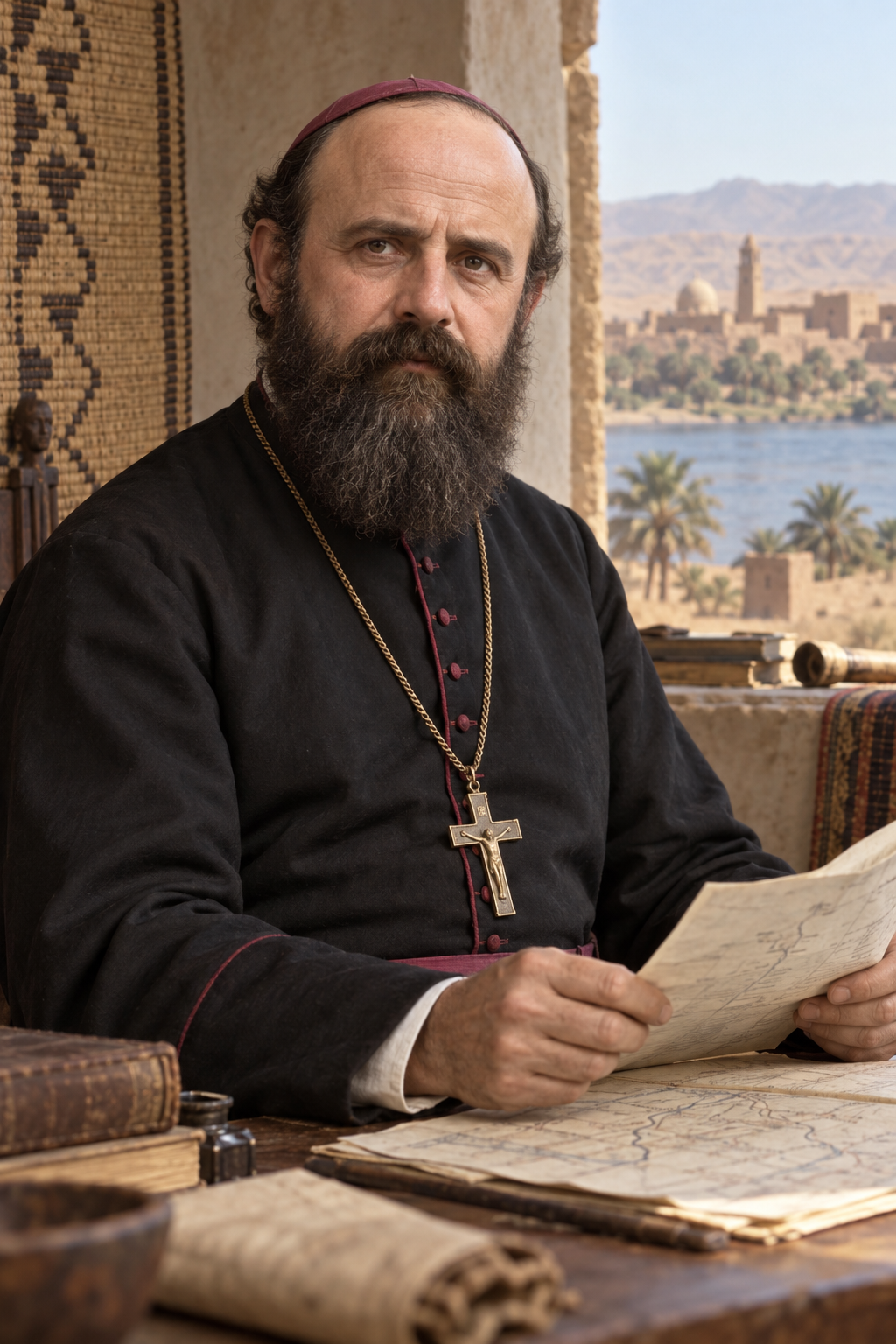
The generated artwork follows that line: black missionary episcopal dress, a pectoral cross, maps or papers, warm light, and Nile/Sudan context, without crowds, conquest symbols, or exoticized figures.
Comboni's death came at Khartoum on October 10, 1881. The catalog stores that death date and place, and the Vatican and Dicastery sources support the broad life facts.
The biography should treat Khartoum as a real place, not a scenic backdrop. It was the setting of his final labor and death, and it anchors his story in the African mission he had served for years.
After his death, the communities connected with his vision continued to carry his name and charism. That continuity belongs in the conclusion, but it should not crowd out the historical person.
Comboni was beatified in 1996 and canonized by Pope John Paul II in 2003. Those recognitions confirm public Catholic memory, but the heart of the page is his missionary service.
The final article should be careful with words such as civilization and regeneration. Where a source uses period language, the page can explain the pastoral aim without adopting every nineteenth-century assumption.
It should also avoid making the story only European. The most accurate witness to Comboni's memory includes his desire that African people and communities have active responsibility in evangelization and formation.
That desire did not remove all the limits of his age, but it is central to why he is remembered. He wanted mission to become rooted, educated, and locally sustained.
The page can therefore present Daniele Comboni as a missionary bishop who built structures for a future he would not fully see. His holiness is not a single journey or ceremony, but persevering fidelity to a demanding vocation.
His enduring significance lies in that combination: prayer, plan, formation, institution-building, and costly pastoral presence in Central Africa.
The final profile should also leave room for failure, frustration, and incompleteness. Comboni died before seeing the stable future for which he had labored. That unfinished quality makes the narrative more honest: the sanctity remembered by the Church was not success measured by quick results, but faithfulness to a mission that required other people to continue the work.
For that reason, the article should avoid language that makes Africa a problem to be solved by one European missionary. The supported account is better and more careful: Comboni wanted evangelization, education, and formation to become rooted among African peoples themselves, and he spent his strength building structures for that hope.
Artwork should show a nineteenth-century Italian missionary bishop with a simple pectoral cross, papers or mission plan, and modest Sudan/Khartoum context. Avoid colonial triumph, crowds posed as background, flags, weapons, readable text, halo, modern objects, and exact-likeness claims.
The badge crop should keep his face, cross, black episcopal dress, papers, and mission setting readable. It should read as missionary bishop before it reads as a generic explorer portrait.
Wondering how to weigh the stories and sources? Learn how to read a saint biography.