Biography
Alexander Hotovitzky
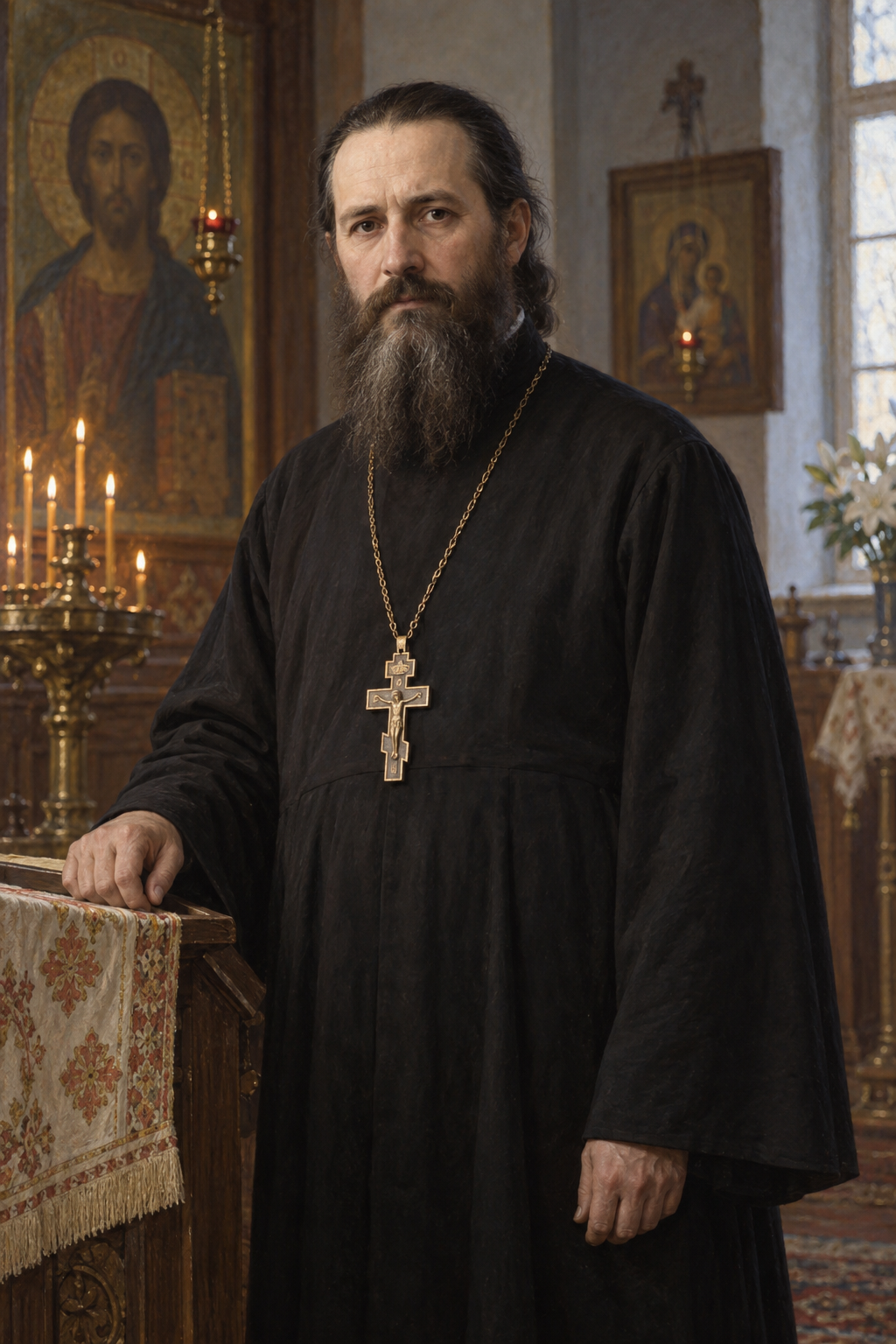
About Alexander Hotovitzky
Alexander Hotovitzky was born on 11 February 1872 in Kremenetz, Volhynia, then within the Russian Empire. The OCA profile presents him as an Orthodox priest whose life crossed national and ecclesial boundaries through missionary work. His early formation and ordination should be linked to separate source claims in the importer rather than inferred from the profile heading. [O1]
Hotovitzky served Orthodox people in North America, where clergy often had to minister across language, immigration, and jurisdictional boundaries. His work belongs in the catalog as missionary ministry, not merely as institutional office. The exact parishes, dates, and publications require fuller source review before they become featured events. [O1]
He later returned to Russia. The OCA identifies Moscow as his death place and 19 August 1937 as his death date, and classifies him as priest/deacon, missionary, and martyr. Those fields should be represented as Orthodox source claims, not translated into a generic cross-tradition taxonomy. [O1]
Hotovitzky's significance is the continuity of pastoral and missionary service through changing political conditions. The profile supports a concise account of his identity, priesthood, missionary work, death, and Orthodox martyr veneration; unsupported anecdotes, quotations, and exact imprisonment details should remain empty. [O1]
The pastoral setting is essential to understanding Hotovitzky's work. A priest serving immigrant and Orthodox communities had to preserve worship, teaching, and community memory while congregations adapted to a new country. The official profile supports describing that service in broad terms, but it does not provide a complete register of every parishioner or journey. [A1]
His witness should be described without importing later political categories into the earlier record. The profile records pressures affecting his ministry, but a careful biography distinguishes documented ecclesial service from later interpretation and leaves private relationships, quotations, and numerical claims empty. [A1]
The account of his final period is treated with the same restraint. Where the source gives an event, the biography records it; where it gives no exact date or conversation, the text does not manufacture one. Hotovitzky's significance is presented as faithful pastoral service under pressure, anchored to the official OCA profile and its stated facts. [A1]
Hotovitzky's ministry required more than ceremonial leadership. The official account places him among communities that needed preaching, sacramental care, instruction, and continuity while adapting to unfamiliar social conditions. Those responsibilities explain why the profile treats pastoral service as a series of connected duties rather than a single title. [A1]
The immigrant setting shaped the meaning of community memory. Worship and parish life gave people a way to retain inherited practice while forming new local institutions. It is supported to say that his ministry served people for whom ecclesial life and social belonging were closely connected. [A1]
The pressures described in the official account should be reported without turning the biography into a political tract. A careful record states what happened, identifies the source's certainty, and avoids assigning private motives that are not documented. [A1]
Hotovitzky's witness is therefore presented through durable service: he taught, ministered, accompanied communities, and remained associated with Orthodox faithfulness under pressure. The profile records supported identity, pastoral work, and death, with deliberate omissions where the source does not support more. [A1]
The North American period should not be flattened into a generic missionary story. Hotovitzky worked among people whose religious life carried memories of home, and pastoral service involved both worship and the patient formation of community. The OCA profile supports this setting, while the exact size and frequency of every congregation remain unreported. [A1]
His return to Russia did not erase the earlier missionary work. It placed that work within a life that crossed more than one political and cultural setting. The accepted biography keeps the sequence visible without claiming that every later decision can be explained from the short profile. Where the source is silent about motives, the importer leaves motives out. [A1]
The martyr classification is also kept in its proper layer. It is an Orthodox recognition of the witness preserved by the Church, not a license to invent a scene of death or to transfer terminology from another tradition. The record uses the OCA's own identity and classification, preserving the source's ecclesial vocabulary. [A1]
Readers should therefore find a life organized around priesthood, mission, community, return, and recognized witness. They should not find fabricated letters, unsupported prison details, or exact institutional totals. Those omissions protect the distinction between a well-supported catalog entry and a larger devotional literature that needs its own sources. [A1]
This conservative presentation also leaves room for later archival work without hardening conjecture into catalog fact. [A1]
That distinction keeps the record open to better evidence while protecting the current catalog from conjecture. [A1]
This preserves a useful record without pretending that the short profile is a complete archive. [A1]
The source-boundary itself is part of the record. [A1]
Wondering how to weigh the stories and sources? Learn how to read a saint biography.