Biography
Evloghia of Samurcășești
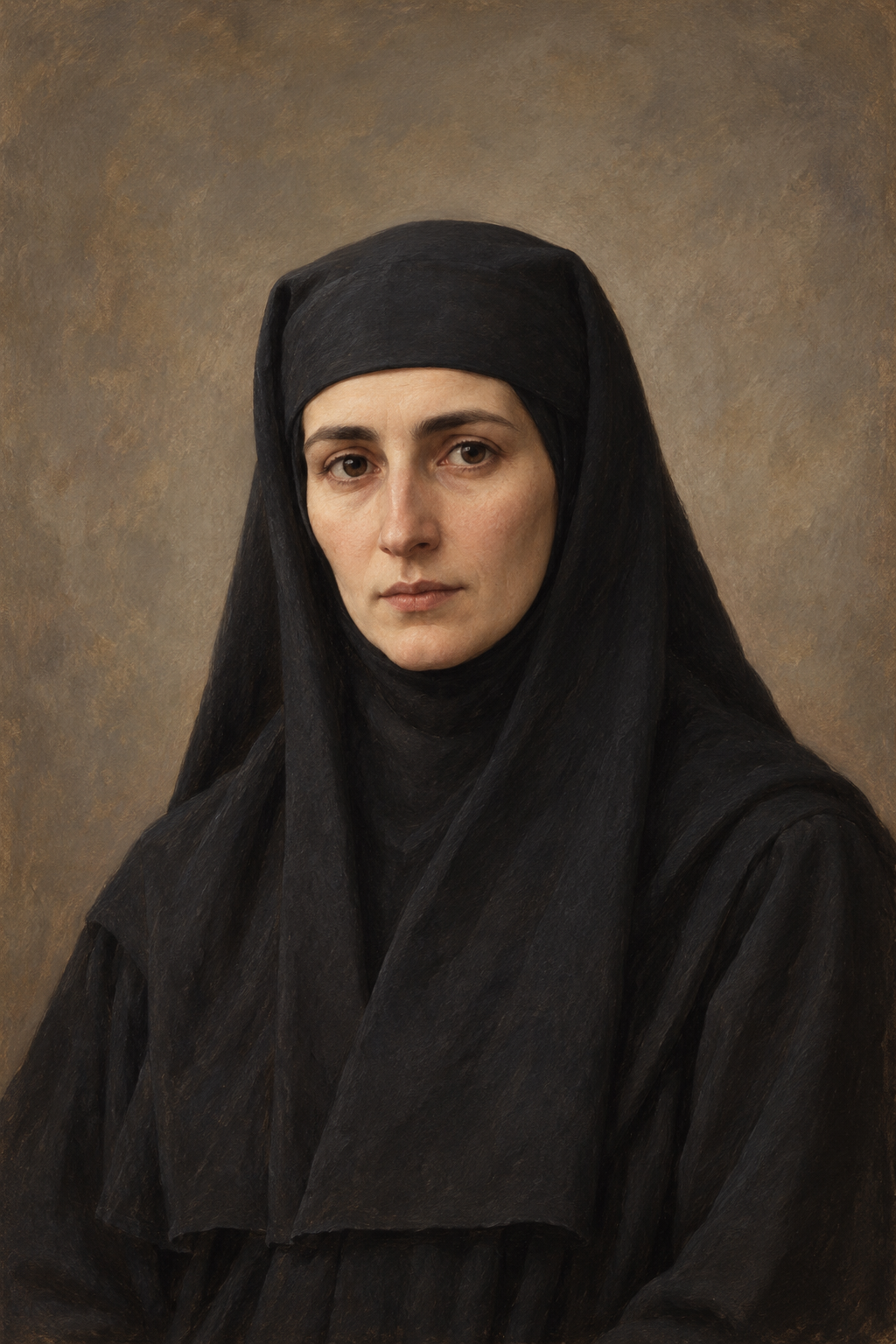
About Evloghia of Samurcășești
Evloghia of Samurcășești was born Ecaterina on November 24, 1908, in Nimfeo, in northern Greece. The Romanian Orthodox Church’s account describes a childhood marked by her mother’s death and abuse from her stepmother. After a fall caused a spinal injury, she was sent to relatives in Bucharest. The account presents her later recovery as miraculous and connects it with a vision of Mary and Catherine.
Her public work left traces beyond later devotional memories. Daniel Rolea’s study reproduces notices from Cuvânt Bun naming Ecaterina among its distributors in 1929. During the 1930s she carried religious books and icons through villages, taught children church songs, and helped organize branches of the Patriarch Miron missionary association. The notices also describe arrests and hostility from local police before the communist period.
A report from Turtucaia described a mixed reception: some listeners mocked her, while others subscribed to the journal she carried. In 1932 its editors thanked her for support they considered essential to keeping the publication alive.
Her mission included practical assistance. Patriarch Daniel’s account recalls collections for a charitable dining room, help for poor students and families, and a meal offered to fifty people in 1934. After the 1940 earthquake damaged Samurcășești’s church and cells, she collected donations in the villages to help restore them. Her work also supported an Athonite church at Kapsala.
Nicodim’s testimony describes a network of support that reached students as well as village households. He counted himself among the young people she helped obtain scholarships and accommodation while studying. His account connects her with teachers, clergy, and families able to provide assistance. She encouraged young people to study and involved them in charitable work. These recollections come from a beneficiary who later became her biographer, and his gratitude is evident throughout the account.
He also remembered her playing with children and following the needs of sick people closely. Her public speech could be forceful, yet he described a gentler manner in family settings. When someone had missed a meal at a charitable kitchen, she would return to cooking rather than leave the person hungry. He presents these everyday acts alongside the more dramatic stories of her life. At the monastery, she also made arrangements for her own burial in advance, including setting aside wood needed for preparing the funeral food.
Patriarch Miron recognized her charitable service with an honorary diploma in 1935. Later church remembrance also emphasizes that she sought guidance for herself. The Athonite monk Ghedeon urged her to examine her own conscience while trying to correct others. Her work was undertaken with clerical blessing and cooperation, not as an attempt to replace parish life. She helped children prepare religious celebrations and explained Scripture in language accessible to her village audiences.
Working with parish priests, Ecaterina urged couples living together to marry in church. A contemporary account reproduced by Rolea reports more than forty such weddings in villages where she worked, with priests providing their services without charge. She received the monastic name Evloghia at Samurcășești on November 21, 1942. Her missionary journeys continued after her profession.
Bishop Timotei’s account describes her helping patients reach hospitals in Bucharest and approaching people with influence on their behalf. Family connections and relationships formed through her mission could thus serve practical needs. He also identifies two disciples, Evloghia and Filofteia, who preserved her memory within the monastery. Their recollections helped carry that memory beyond the generation that had known her directly.
The canonization decree recounts that communist attackers beat her at Ulmeni in December 1949 while she was distributing religious materials. She was taken to Bucharest’s Brâncovenesc Hospital and later returned to Samurcășești, where she received Communion and died on December 19. The church honors her as a martyr.
Nicodim Bujor, who knew her personally, preserved memories of her work and death. Her disciples also maintained her memory at the monastery. Writing after the 2026 exhumation, Bishop Timotei Prahoveanul reported that her remains had already been exhumed in 1956 and reburied in a smaller coffin. This earlier ceremony emerged as part of the recent investigation.
Timotei places this remembrance within the longer archival work of Abbess Lucia Bostan, who had researched the monastery’s past over several decades. He describes a tradition maintained discreetly before 1989 and then passed to later generations of nuns. The recovery of information about the earlier exhumation shows that even a remembered life can retain gaps in its written record.
Her canonization was approved in 2025, and the local proclamation took place at Samurcășești on October 4, 2026, with the presentation of her icon and relics. At the ceremony, the synodal decision was read publicly, and the community heard the hymn composed in her honor. Pilgrims joined local representatives in the liturgy, giving public expression to a remembrance long maintained at the monastery.
Her feast is December 19.
Wondering how to weigh the stories and sources? Learn how to read a saint biography.